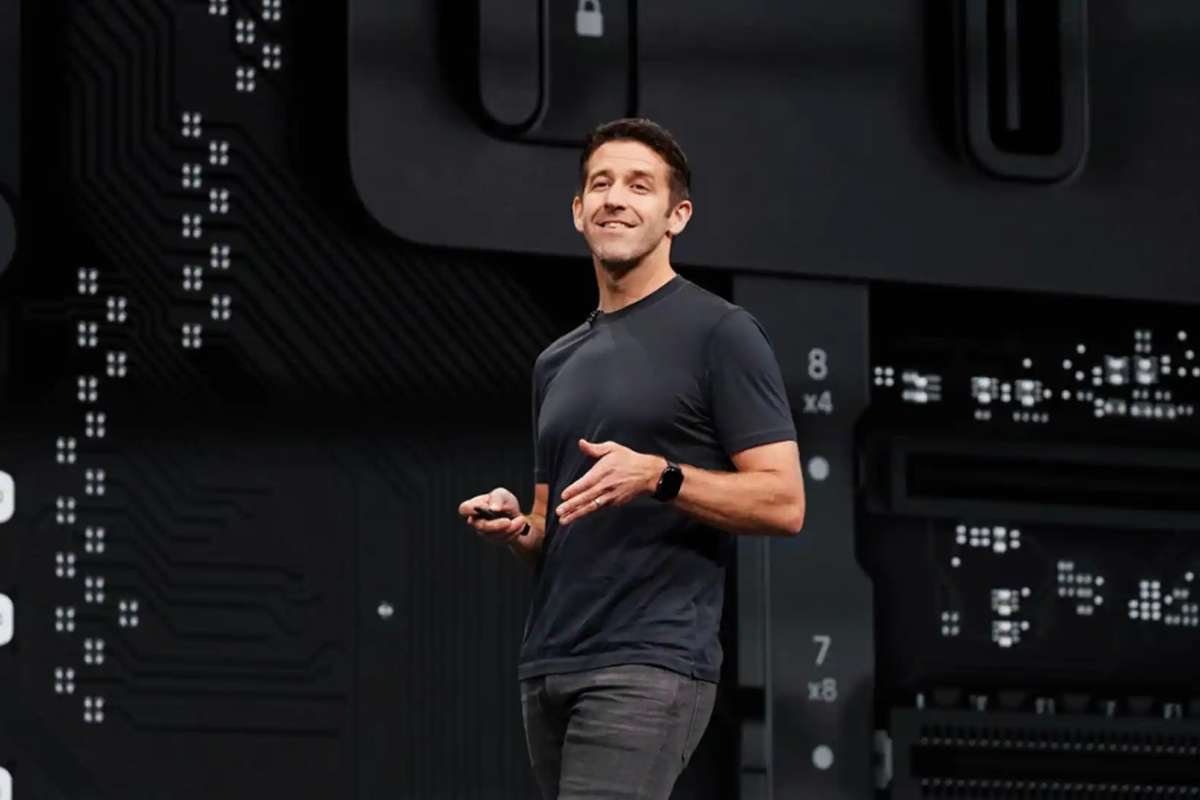
The tech press is currently drowning in a syrup of "steady hands" and "continuity." They see John Ternus taking the helm from Tim Cook and exhale a collective sigh of relief. They see a safe pair of hands. They see a man who looks like he was grown in a Cupertino lab specifically to wear a navy blue sweater and explain thermal dynamics.
They are missing the point. This isn't a victory lap for the world’s most valuable company; it is a defensive crouch.
Appointing John Ternus as CEO isn't a move to conquer the next decade. It is a desperate attempt to protect the margins of the last one. If you think this transition is about innovation, you haven't been paying attention to how hardware empires actually die. They don't go out with a bang. They go out by becoming incredibly efficient at making things that no longer matter.
The Engineering Trap
The common narrative is that Ternus is the "hardware guy." He’s the mind behind the transition to Apple Silicon. He fixed the butterfly keyboard disaster. He streamlined the iPad. On paper, he is the perfect successor because he understands the "guts" of the machine.
But Apple doesn't need a mechanic. It needs a pirate.
The fundamental problem with promoting a hardware-centric lifer to the top spot is the "Inertia of Excellence." When your entire career is built on shaving 0.5mm off a chassis or perfecting the hinge of a laptop, your worldview becomes constrained by physical constraints. Ternus is a master of the incremental. He is the king of the 10% improvement.
In a world where the puck is moving toward spatial computing, localized LLMs, and post-handheld interfaces, Apple has chosen the man who is best at making the iPhone 16 look slightly better than the iPhone 15. This is a classic "Innovator’s Dilemma" play. You put the person who optimized the current cash cow in charge because you are terrified of the person who might slaughter it to build something new.
The Ghost of Operations Still Haunts the Hallway
Tim Cook’s greatest achievement wasn't a product; it was a spreadsheet. He turned Apple into a logistical superpower. He mastered the art of the "inventory turn" and the "component squeeze."
Ternus is essentially "Cook 2.0," but with a prettier CAD file.
The industry is cheering because they want stability. Investors want predictable buybacks. But stability is the precursor to irrelevance in tech. Look at the history of Microsoft under Steve Ballmer. Ballmer was a "safe" pick who understood the business, protected the Windows/Office monopoly, and grew revenue for a decade while completely missing mobile, search, and social. He optimized a dying star.
By the time Microsoft realized they were irrelevant, they had to spend ten years and billions of dollars in "catch-up" capital just to get back to the starting line. Ternus is Apple’s Ballmer. He will keep the iPhone margins high. He will make sure the supply chain in India matures. And while he is doing that, the actual frontier of computing—ambient AI and wearable intelligence—will be colonized by companies that aren't afraid to break their own hardware cycles.
The Design Vacuum
Let’s talk about what Apple has actually produced under Ternus’s hardware leadership.
The Vision Pro is technically impressive and commercially stagnant. It is a "spec-sheet" product. It has the best screens, the best sensors, and the best materials. Yet, it lacks a soul. It lacks the "why" that Steve Jobs or even Jony Ive used to provide.
When Ive left, the "Design" era of Apple died. When Cook hands over the keys, the "Operations" era will peak. We are entering the "Maintenance" era.
In the Maintenance era, products become iterative to a fault. We’ve seen this before with the late-stage iPod. They kept making it smaller, thinner, and more colorful until the iPhone arrived and made the entire category a joke. Ternus is the guy who would have designed a truly incredible iPod Nano in 2008 while ignoring the fact that the world had moved on.
The Cost of the "Safe" Bet
If you analyze the hardware specs of the last four iPhone generations, the curve is flattening.
- Year 1: Massive jump in processing power ($M_1$ to $M_2$ level shifts).
- Year 2: Camera sensor size increases.
- Year 3: Refresh rate and bezel reduction.
- Year 4: Titanium frames and "Action Buttons."
We are now in the "Titanium and Buttons" phase of the iPhone. This is where Ternus excels. He can find a new alloy. He can make a button feel more tactile. But can he envision a world where the iPhone is a secondary device?
The data suggests he can't. Apple’s R&D spend has ballooned, but the output has become increasingly narrow. They are spending more to get less. A CEO who comes from the hardware engineering department is genetically predisposed to solve problems with more hardware. But the problems of 2026 and beyond—agentic AI, decentralized services, and intuitive software—are not hardware problems.
The Internal Brain Drain
I have talked to people who have left Cupertino in the last 24 months. The story is always the same: it’s a culture of "don't mess it up."
When a company becomes as large as Apple, the primary goal shifts from "create" to "protect." Ternus was chosen because he is the ultimate protector. He won’t pull a "Project Titan" and blow $10 billion on a car that might fail. He’ll cancel it. He’ll play it safe.
But playing it safe is the most dangerous thing a tech company can do.
The "People Also Ask" sections on search engines are already hinting at the public's boredom: "Is it worth upgrading to the iPhone 16?" "What is the difference between iPhone 14 and 15?" When the consumer starts asking if there is a difference, the brand is in trouble. Ternus is not the man to answer those questions with a revolutionary "Yes." He is the man who will explain why the 3% improvement in power efficiency is a miracle of modern engineering.
The Strategy of Diminishing Returns
Imagine a scenario where a startup launches a wearable that actually replaces 80% of iPhone utility using a voice-and-gesture AI interface.
What does Apple do?
Under Ternus, they will wait. They will watch the market. They will wait for the technology to mature. Then, they will release a "Pro" version of that device three years late, made of reclaimed aluminum, with a beautiful screen that no one asked for.
This is the "Second Mover Advantage" trap. It worked for the Apple Watch because the hardware was the barrier to entry. But in the age of software-defined intelligence, hardware is no longer the moat. The moat is the model. The moat is the data. The moat is the speed of iteration.
Ternus is a hardware guy in a software world. He is a waterfall developer in an agile world. He is a tactician being asked to be a visionary.
The Hidden Risk of "Nice"
The press loves Ternus because he is "likable." He is the "anti-Elon." He doesn't tweet nonsense; he doesn't pick fights. He is the corporate ideal of a leader.
But great leaps in technology rarely come from "nice" or "likable" leadership. They come from the abrasive, the obsessed, and the deeply unreasonable. Jobs was unreasonable. Gates was unreasonable. Even Cook, in his early days, was an absolute tyrant about supply chain efficiency.
Ternus represents the "Professionalization" of Apple. The company is now a utility. It’s the digital equivalent of the water company or the electric grid. You need it, you pay for it, but you aren't excited about it.
Why You Should Be Worried
If you are an investor, you love this. Ternus will ensure the dividends keep flowing. He will ensure the stock remains a "safe haven."
But if you are a user—someone who remembers the feeling of seeing the original iPhone or the first MacBook Air—you should be terrified. This appointment confirms that Apple has no intention of disrupting itself. They have chosen to manage the decline of the smartphone era rather than invent whatever comes after it.
The "lazy consensus" says Ternus is the natural choice. They are right. He is the natural choice for a company that has reached its peak and is looking for a smooth way down.
Stop looking for the "next big thing" from Apple. It’s not coming. Not under this leadership. The "Think Different" era is officially over. Welcome to the "Think Consistently" era.
The crown is on his head. The treasury is full. The walls are high. But there are no more worlds to conquer, and Ternus isn't the type to build a ship to find a new one. He’s just here to make sure the castle is well-dusted.