The death or capture of a Tier 1 high-value target (HVT) within a non-state armed group does not signify the cessation of violence; rather, it triggers a predictable sequence of structural destabilization. In the case of Nemesio "El Mencho" Oseguera Cervantes, the leader of the Jalisco New Generation Cartel (CJNG), his removal from the command structure initiates a "Succession Crisis-Fragmentation Loop." This process transforms a centralized vertical hierarchy into a horizontal battlefield of competing factions, turning civilian infrastructure—airports, highways, and tourist hubs—into tactical leverage points.
Understanding the current volatility in Mexico requires moving beyond sensationalist reporting and analyzing the three functional mechanics of cartel succession: internal purging, external encroachment, and state-targeted "narcobloqueos."
The Mechanics of Structural Collapse
When a dominant leader like Oseguera Cervantes is removed, the organization's internal stability is compromised by the "Information Asymmetry of Power." Lower-level commanders lack clear data on who holds the financial keys or the loyalty of the various "plazas" (territorial commands). This leads to a three-phase escalation:
- The Internal Purge: Sub-commanders preemptively eliminate rivals within the CJNG to consolidate regional control.
- The Boundary Test: Rival organizations, such as the Sinaloa Cartel or the Cartel Santa Rosa de Lima, initiate incursions into weakened CJNG territories to seize supply lines.
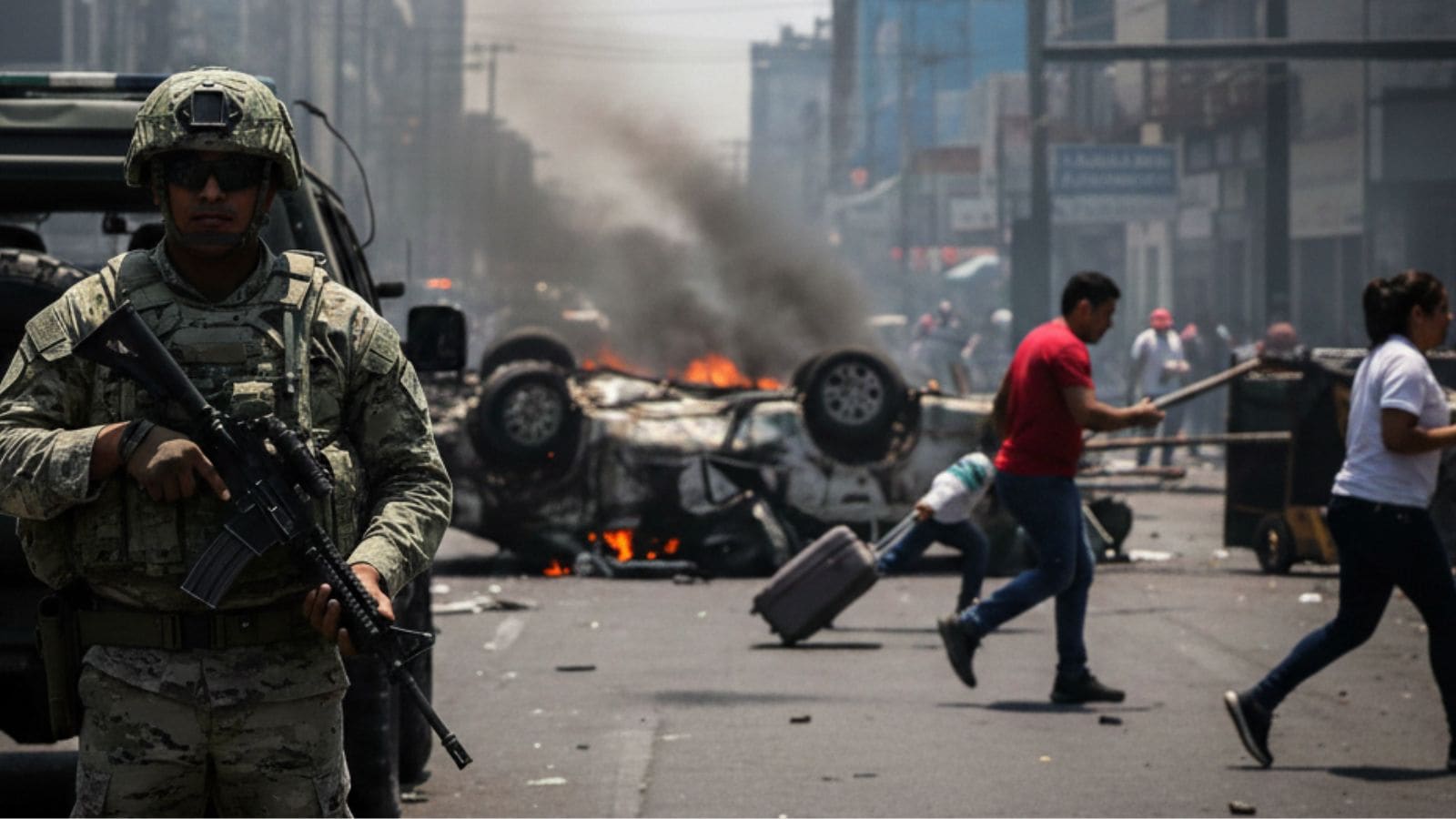
- The Kinetic Response: To prevent military intervention during this reorganization, cartels deploy "narcobloqueos"—the burning of vehicles and blocking of arterial roads—to paralyze state response times and force a focus on civilian safety over tactical pursuit.
Infrastructure as a Tactical Variable
The cancellation of flights and the stranding of tourists in regions like Jalisco, Colima, or Guanajuato are not collateral accidents. They are the result of a deliberate "Area Denial" strategy. For a cartel, controlling the flow of traffic on a major highway or forcing an airport closure serves as a massive signaling device to the federal government.
The logistical impact on the Bajío region—a critical hub for both international tourism and automotive manufacturing—creates an immediate economic cost-function. By disrupting the "Golden Triangle" of Mexican logistics (the routes connecting Mexico City, Guadalajara, and Monterrey), the remaining cartel elements exert pressure on the state to withdraw its kinetic operations.
The Geography of Risk
Travelers often fail to distinguish between "Targeted Violence" and "Structural Volatility." While tourists are rarely the primary targets of cartel hits, they are highly susceptible to the structural volatility that follows a leadership vacuum. This manifests in specific high-risk zones:
- Federal Highways (Carreteras Federales): These are the primary sites for "narcobloqueos." Cartels hijack commercial trucks to create barriers, often setting them on fire to prevent the movement of the National Guard (Guardia Nacional).
- Aviation Hubs: While airports like Guadalajara (GDL) or Puerto Vallarta (PVR) have high security, the access roads leading to them are vulnerable. A single blockade on a primary access road can effectively isolate an international terminal for 12 to 24 hours.
- Urban Transit Corridors: In cities like Zapopan or Tlaquepaque, violence often shifts to public squares to maximize visibility and sow psychological terror, which is the primary currency of a fragmented cartel.
Quantifying the Security Deficit
The primary error in travel risk assessment is relying on retrospective data. Yesterday’s safety record in a city is irrelevant when a Tier 1 HVT is neutralized today. Instead, one must look at the "Volatility Index," which measures the ratio of decentralized cells to central command.
A centralized CJNG was arguably "safer" for a traveler because the violence was disciplined and predictable. A fragmented CJNG is a multi-headed entity where local "jefes" may implement their own tolls, checkpoints, and aggressive tactics without oversight from the top. This creates an environment of "Micro-Level Predation," where the rules of engagement for civilians change every 50 kilometers.
Operational Protocols for High-Volatility Environments
In the wake of a leadership vacuum, standard travel precautions are insufficient. The operational reality requires a "Hardened Logistics" approach.
Real-Time Intelligence Integration
Relying on government travel advisories is a lagging indicator. These documents often take days to update. For real-time navigation, one must monitor "Cuentas de Riesgo" (Risk Accounts) on social media platforms and local "SDR" (Situaciones de Riesgo) channels. These provide granular data on blockades often hours before official sources acknowledge them.
Transit Hardening
If movement is mandatory during a succession crisis, the following structural changes to travel plans are necessary:
- The Daylight Constraint: Operations must be restricted to the window of 08:00 to 16:00. Nighttime travel increases the probability of encountering "Retenes" (illegal checkpoints) where the risk of vehicle theft or kidnapping rises exponentially.
- The Highway Tier System: Always prioritize "Cuotas" (toll roads) over "Libres" (free roads). Toll roads generally have better surveillance and fewer access points, making it harder for disorganized factions to set up effective blockades without immediate detection.
- Communication Redundancy: Satellite communication devices or local SIM cards with prioritized data roaming are essential. In high-conflict zones, cell towers are frequently overwhelmed or occasionally disabled during cartel operations.
The Succession Crisis Timeline
Based on historical precedents—such as the fall of the Beltrán-Leyva organization or the capture of "El Chapo" Guzmán—the period of peak instability lasts between three and nine months. This window represents the time required for a new dominant hierarchy to emerge or for the territory to be fully absorbed by a rival.
The "Hot Zone" usually radiates from the epicenter of the arrest or death. In the case of El Mencho, the primary risk radius encompasses:
- Guadalajara Metropolitan Area: The financial and administrative heart of the CJNG.
- The Michoacán-Jalisco Border: A perennially contested zone where fragmented cells fight for control of the avocado and lime industry extortions.
- The Port of Manzanillo: The vital entry point for chemical precursors, making it the most valuable economic asset in the region and thus the site of the most intense tactical fighting.
Strategic Decision Matrix for Personnel in the Region
For those currently in the affected zones, the decision-making process should be dictated by a "Shelter-in-Place" vs. "Tactical Evacuation" framework.
- Shelter-in-Place: If the traveler is within a high-security resort or a gated residential zone in a major city, the risk of remaining stationary is lower than the risk of traversing a highway system that may be under blockade.
- Tactical Evacuation: This is only advised if the current location lacks basic security infrastructure or if there is a verified threat of "Suelo Parejo" (scorched earth) tactics in the immediate vicinity. This must be done via air travel if possible, bypassing the road network entirely.
The removal of a figurehead like El Mencho does not "solve" the issue of organized crime in Mexico; it merely changes the physics of the conflict. The shift from a "Monopolistic Cartel Model" to a "Warlordism Model" increases the frequency of low-level kinetic events. Security is no longer a state to be achieved but a variable to be managed through constant data intake and the rejection of standard transit patterns.
The most effective strategy in this environment is the immediate suspension of all non-essential road travel within the affected states for a minimum of 72 hours following the initial report of the HVT removal. This allows the first wave of "narcobloqueos" to clear and provides a window to observe which sub-factions are asserting control over the primary transit arteries.