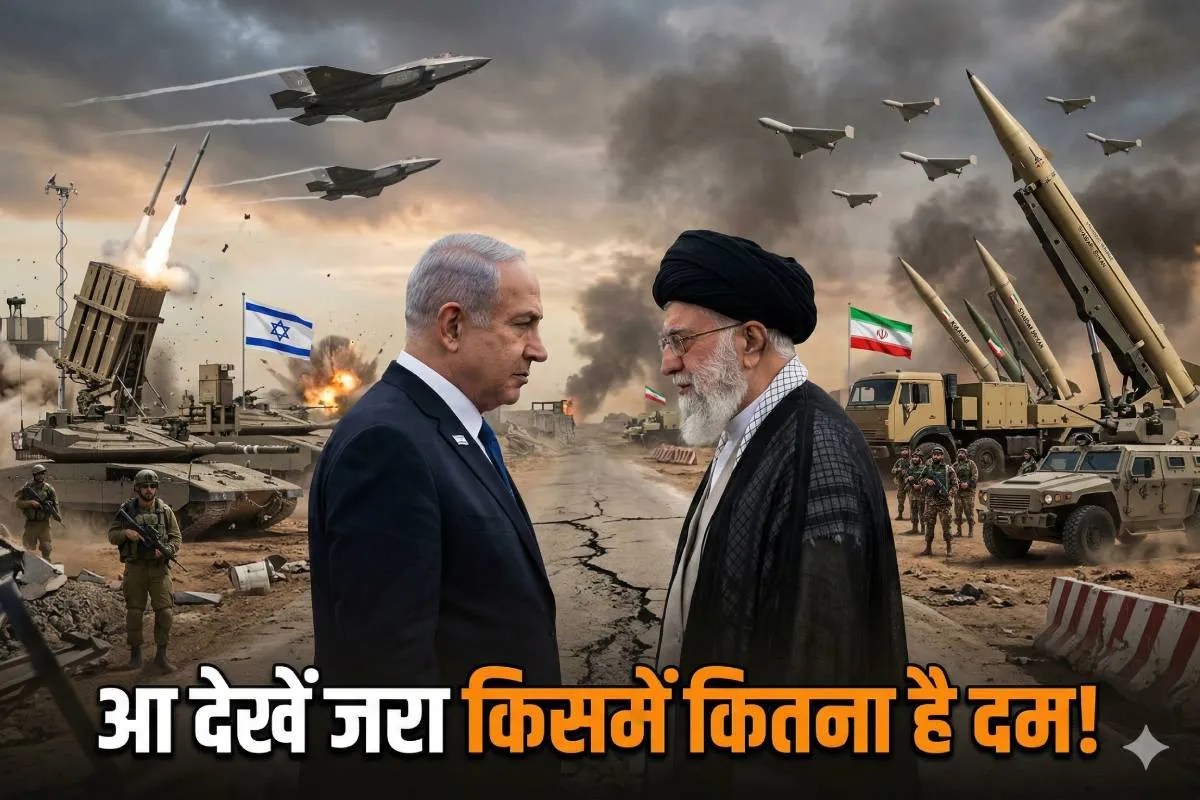
The Middle East is sitting on a powder keg that’s been smoldering for decades, but the math of a full-scale war between Israel and Iran isn't as simple as counting tanks or planes. You see headlines comparing troop numbers or missile ranges every day. Most of them miss the point. A conflict between these two isn't a traditional border war because they don't actually share a border. It’s a high-stakes chess match played with long-range strikes, cyber warfare, and proxy fighters.
If you’re wondering who’s actually stronger, you have to look past the raw data. On paper, Iran has more boots on the ground. In reality, Israel has a technological edge that makes those numbers look almost irrelevant in a modern dogfight.
The Myth of Raw Troop Numbers
People love to point out that Iran has over 600,000 active-duty soldiers while Israel maintains a smaller standing army of around 170,000. That sounds like a massive disadvantage for the Israelis. It’s not. In a conflict where 1,000 miles of Iraqi and Jordanian desert separate the two combatants, having a million infantrymen doesn't help you unless you can move them. Iran can't. They lack the transport aircraft and the logistical sealift capacity to move a massive invasion force to Israel's doorstep.
Israel, meanwhile, relies on its reserve system. Within 48 to 72 hours, they can swell their ranks to over 600,000. These aren't just warm bodies; they’re highly trained citizens who’ve already served and know their specific roles. When you factor in the Israeli Air Force (IAF), the ground troop disparity starts to vanish. A single squadron of F-35s can do more damage to an advancing column than a whole division of aging T-72 tanks.
Iran’s strength lies in its "Axis of Resistance." They don't need to send their own soldiers to the border when they have Hezbollah in Lebanon, various militias in Syria and Iraq, and the Houthis in Yemen. This is asymmetrical warfare 101. Iran stays behind the curtain while its proxies bleed the opponent.
High Tech vs High Volume
Israel’s military philosophy is built on one word: "Quality." They know they’ll never have the population of their neighbors, so they’ve invested billions into becoming a global tech hub for defense. The IAF is arguably the most capable air force in the world outside of the United States. They fly the F-35 Lightning II, a stealth fighter that can bypass most radar systems. Iran’s air force is a flying museum. They’re still operating F-14 Tomcats and F-4 Phantoms from the 1970s. In a direct aerial engagement, the Iranian air force wouldn't last an afternoon.
But Iran knows this. They aren't trying to win a dogfight. They’ve spent forty years building the largest and most diverse missile arsenal in the Middle East. We're talking thousands of ballistic and cruise missiles like the Shahab-3 and the Kheibar Shekan. These things have the range to hit Tel Aviv or the Dimona nuclear reactor.
To counter this, Israel built the world’s most sophisticated multi-layered missile defense system. You’ve heard of the Iron Dome, but that’s just for short-range rockets. For the big stuff, they use:
- David’s Sling: Handles medium-to-long-range threats.
- Arrow 2 and Arrow 3: Designed to intercept ballistic missiles outside the Earth’s atmosphere.
During the April 2024 escalation, Iran launched over 300 drones and missiles. Israel, with help from allies, intercepted 99% of them. It was a massive demonstration of technological superiority. However, there’s a catch. Interceptors cost millions. The drones they’re shooting down cost a few thousand. Iran is betting they can bankrupt Israel or simply overwhelm the "magical" defenses through sheer volume.
The Silent War in the Wires
The real fighting happens where you can't see it. Israel’s Unit 8200 is legendary for a reason. They’re basically a mix of the NSA and a startup incubator. They’ve successfully sabotaged Iranian nuclear facilities multiple times without firing a single bullet. Remember Stuxnet? That was a wake-up call for the entire world.
Iran isn't a slouch here either. They’ve ramped up their cyber capabilities significantly. They target Israeli infrastructure—water systems, power grids, and private companies. They don't need a stealth jet to cause chaos in a city; they just need a few talented hackers in a basement in Tehran. This constant back-and-forth is the "War Between Wars." It’s happening right now as you read this.
The Geography Problem
If Iran wants to attack Israel on the ground, they have to go through Iraq and Syria. That’s a long, exposed road. Israel’s intelligence is so deep in those countries that any major troop movement is spotted instantly. The Israeli Air Force has turned Syria into a graveyard for Iranian shipments. They call it "mowing the grass." Every time Iran tries to set up a permanent base or move advanced GPS-guided kits to Hezbollah, Israel blows it up.
Iran’s geographic advantage is the Strait of Hormuz. They can't easily hit Israel’s mainland with a ground force, but they can choke the world’s oil supply. If things go south, Iran can mine the strait, driving global oil prices through the roof. This is their ultimate leverage against the West. They’re telling the world, "If you let Israel hit us too hard, everyone’s gas prices triple tomorrow."
The Nuclear Elephant in the Room
This is the baseline for everything. Israel is widely believed to have a significant nuclear stockpile, though they never admit it. Iran is a "threshold" state, meaning they have the tech and the material to build a bomb very quickly if they choose to.
Israel views a nuclear Iran as an existential threat. Period. They’ve shown they are willing to take preemptive action, like the 1981 strike on Iraq’s Osirak reactor or the 2007 strike on Syria’s Al-Kibar site. If Israeli intelligence concludes that Iran is 24 hours away from a functional weapon, they will strike. It doesn't matter who is in the White House or what the UN says.
Intelligence and the Human Element
The Mossad has a terrifying reputation inside Iran. Over the last decade, Iranian nuclear scientists have been assassinated in broad daylight in the heart of Tehran. Highly classified documents have been stolen from "secure" warehouses and driven across the border. This psychological warfare is devastating. It creates paranoia within the Iranian leadership. When you can't trust your own security detail, it’s hard to plan a war.
On the flip side, the Iranian Revolutionary Guard Corps (IRGC) is incredibly resilient. They’ve survived decades of sanctions. They’ve built an underground "missile city" network that is hardened against even the heaviest bunker-buster bombs. They are experts at hiding their assets. You can't destroy what you can't find.
What it Means for the Region
A full-blown war wouldn't look like World War II. It would be a month of intense missile exchanges, followed by a global economic meltdown. Israel’s economy is tech-driven and fragile to long-term disruptions. If the population has to live in bunkers for six months, the economy craters. Iran’s economy is already struggling, but they are more "used" to hardship. They have a higher tolerance for pain because the regime doesn't have to answer to a disgruntled voting public in the same way.
The real losers in this scenario are the "in-between" countries. Lebanon is already on the brink of collapse. A war would finish it. Jordan and Iraq would become a highway for missiles and jets.
Keep an eye on the Red Sea and the Mediterranean. Iran’s navy is small but focuses on "swarm tactics"—fast boats with missiles that can overwhelm larger destroyers. Israel has moved more of its naval assets to the south to protect its shipping lanes. This isn't just about the Levant anymore; it’s about the entire trade route from Europe to Asia.
The reality is that neither side wants a total war because the costs are catastrophic. But in a region where "deterrence" is the only currency, one mistake or one over-successful strike could trigger the very thing everyone is trying to avoid.
Next Steps for Following This Conflict
- Watch the enrichment levels reported by the IAEA; 60% purity is the red line for "breakout" capacity.
- Track "unattributed" explosions in Iranian industrial zones; these are often the first signs of a new cyber or sabotage campaign.
- Monitor the delivery of S-400 missile systems from Russia to Iran, as this would significantly change the IAF’s risk assessment for any future strike.