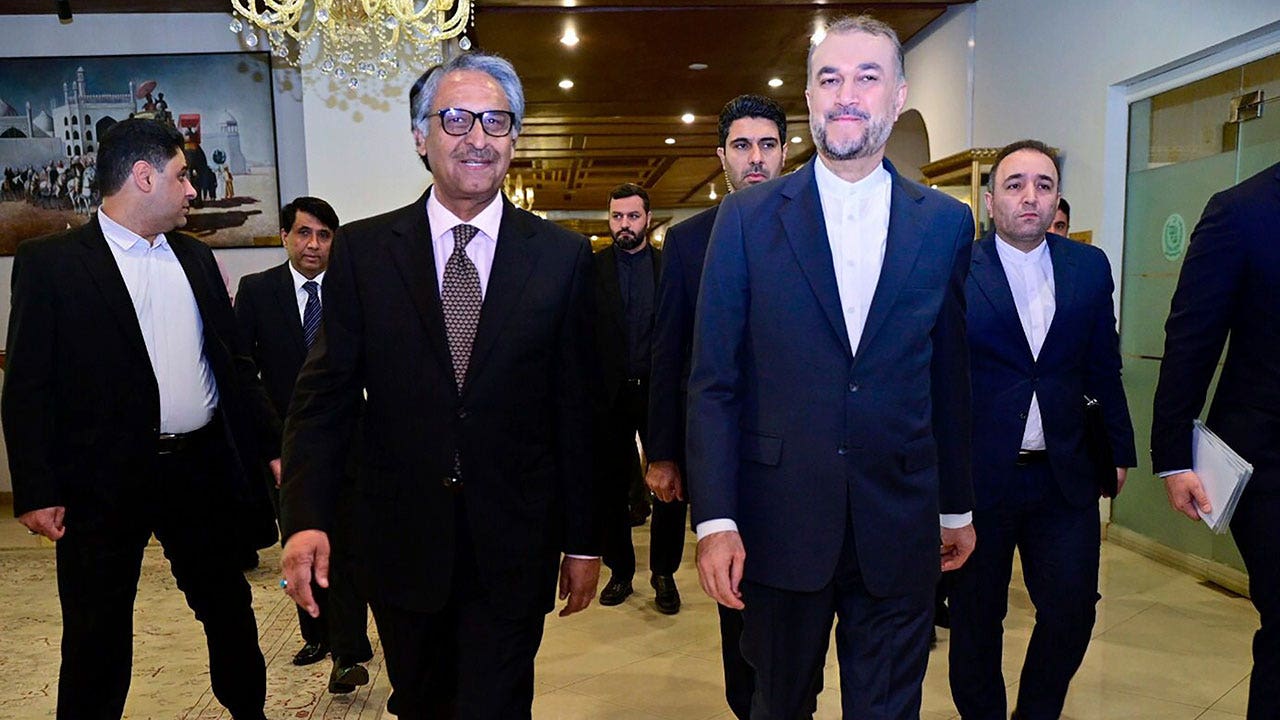
Diplomacy is often the art of lying loudly while acting quietly. When Iranian Foreign Minister Abbas Araghchi stands in Islamabad alongside Pakistan’s Army Chief, General Asim Munir, speaking of "shared commitments to stability," he isn't describing a new era of cooperation. He is managing a controlled burn.
The competitor narrative suggests this is a "pivotal" moment for regional security. It isn’t. It is a desperate performance by two states that share a border they cannot control, ideologies they cannot reconcile, and "allies" that want them at each other's throats. If you believe the press releases about a unified front against terrorism, you are missing the fundamental mechanics of the Sistan-Baluchestan gap.
The Myth of the Shared Enemy
The central fallacy of the Araghchi-Munir dialogue is the idea that "terrorism" is a monolith they both want to dismantle. It isn’t. Terrorism, in the context of the 560-mile Iran-Pakistan border, is a localized commodity used by both sides as leverage.
Pakistan views the Baloch Liberation Army (BLA) as a thorn backed by external Indian influence. Iran views Jaish al-Adl as a Sunni militant threat backed by Gulf interests or the West. Here is the reality: one man’s terrorist is the other state’s strategic depth. When Iran launched missiles into Pakistan’s Panjgur district in January 2024, followed by Pakistan’s retaliatory strikes in Saravan, it wasn't a "miscommunication." It was a structural revelation. Both states proved they would rather violate each other’s sovereignty than trust the other to police their own backyard.
General Munir is a pragmatist. He knows that the Pakistani military’s primary concern isn't "peace" with Iran; it is the management of a two-front dilemma. With the Taliban-led Afghanistan to the west and India to the east, Pakistan cannot afford a hot border with Iran. But "cannot afford a war" is not the same as "sharing a vision."
Why the Gas Pipeline is a Ghost
You will hear the "experts" talk about the Iran-Pakistan (IP) gas pipeline as the glue that will eventually bind these nations. This is a fairy tale. I have tracked energy infrastructure projects across the Middle East for over a decade, and the IP pipeline is the most expensive piece of fiction in the industry.
The project has been "nearing completion" since the 1990s. Pakistan faces massive fines for failing to complete its side of the bargain, yet it refuses to move. Why? Because the United States holds the sanctions hammer. Pakistan is currently surviving on IMF lifelines and Gulf bailouts. It will not risk its financial existence for Iranian gas, no matter how many times Araghchi smiles for the cameras.
The "commitment" to the pipeline is a diplomatic placeholder. Iran keeps it on the table to show it isn't isolated; Pakistan keeps it on the table to use as a bargaining chip with Washington. Neither side expects a single therm of gas to flow through those pipes in this decade.
The China Factor is a Distraction
There is a lazy consensus that China will swoop in, fund the infrastructure, and force these two into a "Sinocentric" peace. This ignores how Beijing actually operates. China wants stability for its China-Pakistan Economic Corridor (CPEC), particularly the port of Gwadar.
However, Gwadar sits right next to Iran’s Chabahar port—a project India has invested in heavily. China doesn't want to mediate a messy sectarian and ethnic border dispute between a revolutionary Shia theocracy and a cash-strapped Sunni military power. Beijing prefers to let the local powers exhaust themselves while it picks up the resource rights. Relying on "Chinese mediation" is a strategy for people who don't understand that China hates getting its hands dirty in tribal insurgencies.
The Intelligence Gap
If you want to understand the true state of Iran-Pakistan relations, look at their intelligence sharing—or the lack thereof.
In a functional security pact, intelligence is proactive. Between Tehran and Islamabad, it is reactive and accusatory. After every major bombing in Zahedan or Quetta, the first instinct of the victimized state is to blame the "safe havens" across the border.
- Iran’s Perspective: Pakistan is a sieve. Its border guards are either incompetent or complicit in letting Sunni militants cross into Iranian Sistan.
- Pakistan’s Perspective: Iran provides a sanctuary for Baloch separatists who target CPEC projects and Pakistani soldiers.
This isn't a "trust deficit" that can be fixed with a high-level visit. It is a geographic and demographic reality. The Baloch people live on both sides of a line drawn by British colonialists (the Goldsmith Line). Neither Tehran nor Islamabad has ever successfully integrated this population. Until they solve the "Baloch Question" domestically, the security pact is just paper.
The Hard Truth of Sectarian Friction
We are told that Araghchi’s visit proves that "sectarianism is taking a backseat to statecraft." This is a dangerous oversimplification. Iran’s "Forward Defense" doctrine relies on proxy networks. Pakistan’s domestic stability relies on balancing its own hardline Sunni factions, many of whom view Iran’s regional influence with extreme hostility.
General Munir cannot get "too close" to Iran without risking blowback from his own domestic religious base and his patrons in Riyadh. Araghchi cannot stop supporting revolutionary ideals without undermining the very foundation of the Iranian state. They are shaking hands across a chasm that neither is willing to bridge.
Stop Asking if the Dialogue Will Work
The question isn't whether the Araghchi-Munir dialogue will lead to peace. It won't. The real question is: how long can they maintain the illusion of cooperation before the next border skirmish forces them to choose between their domestic optics and regional reality?
This isn't a partnership. It’s a standoff where both guys are too tired to keep their guns leveled, so they’ve agreed to put them in their holsters—for now.
Don't buy the hype. Watch the border. Watch the sanctions. When the first cubic foot of gas flows or the first Baloch insurgent is extradited without a fuss, then we can talk about "stability." Until then, it's just two men in expensive suits trying to survive another fiscal quarter in a neighborhood that's on fire.
The "strong and shared commitment" Araghchi speaks of is a commitment to not collapsing simultaneously. That is the ceiling of this relationship. Anyone telling you there is a floor of genuine cooperation hasn't been paying attention to the last forty years of history.
Trust the friction, not the photos.