A standard ceramic mug sits on your kitchen table. It’s filled with coffee, likely sourced from beans that traveled four thousand miles to reach your spoon. You probably didn't think about the price of the gasoline that powered the truck delivering those beans, or the massive container ship that carried them across the ocean. You certainly didn't think about a narrow, jagged strip of water between the Persian Gulf and the Gulf of Oman.
But you should.
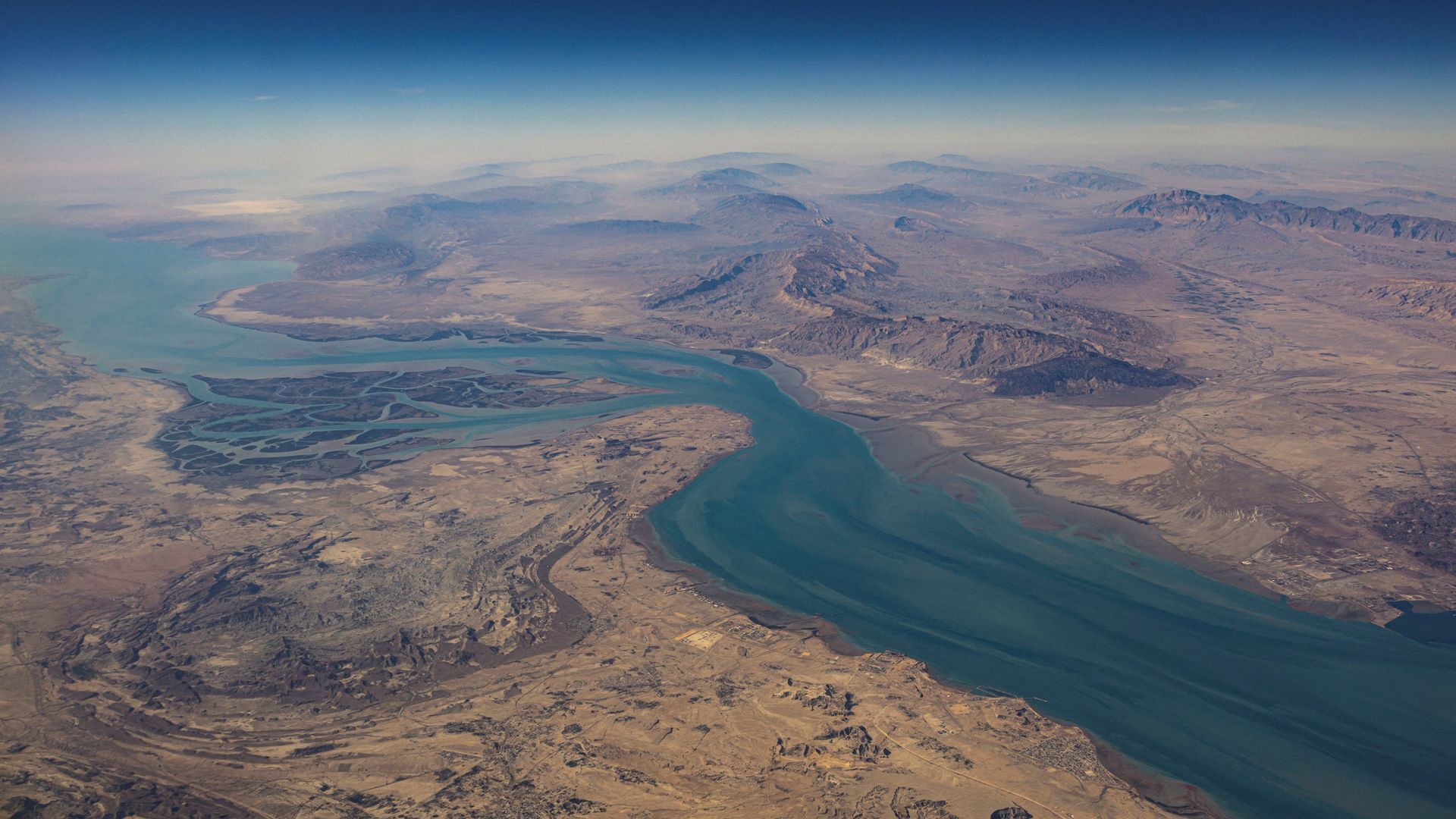
That strip is the Strait of Hormuz. At its narrowest point, it is only twenty-one miles wide. To put that in perspective, a professional marathon runner could cross its width in about two hours. Yet, through this tiny needle’s eye, nearly 21 million barrels of oil flow every single day. That is roughly one-fifth of the world’s entire liquid petroleum consumption.
If that flow stops, your world changes in forty-eight hours.
The Geography of a Nightmare
Imagine a man named Elias. Elias owns a small trucking company in Ohio. He’s not a geopolitical strategist. He doesn't follow the inner workings of the Iranian Revolutionary Guard Corps. He cares about tire pressure, driver retention, and the razor-thin margins of his contracts.
When the news breaks that a tanker has been seized or a mine has detonated in the Strait, Elias doesn't feel it immediately. But the markets do. The price of Brent Crude—the global benchmark—spikes instantly. Traders don't wait for the oil to actually stop moving; they bet on the fear that it might.
Within days, the "risk premium" trickles down to a gas station in Columbus. Elias watches his fuel costs jump by thirty percent. Suddenly, the contract he signed last month is a suicide note for his business. He has to tell his drivers they can’t have their bonuses. He has to tell his wife they might need to delay the kitchen renovation.
This is how a conflict in a desert thousands of miles away becomes a domestic crisis. The Strait of Hormuz is not just a geographic feature; it is the jugular vein of the global economy.
The Architecture of the Blockade
Iran knows exactly how much power this geography grants them. They don't need a navy that can match the United States in a traditional broadside battle. They don't need nuclear-powered aircraft carriers or stealth destroyers. Instead, they have perfected the art of "asymmetric warfare."
Think of it like a swarm of hornets versus a bear. The bear is immensely powerful, but the hornets are many, fast, and lethal in coordination.
Iran’s strategy relies on three main pillars:
- The Swarm: Hundreds of small, fast-attack boats equipped with cruise missiles or heavy machine guns. These boats can hide in the rocky coves along the Iranian coastline, darting out to strike a slow-moving tanker and vanishing before a larger warship can respond.
- The Hidden Threat: Thousands of naval mines. Some are sophisticated and acoustic; others are "dumb" contact mines that cost a few hundred dollars to make but can cause hundreds of millions of dollars in damage to a hull.
- The High Ground: Land-based anti-ship missiles stationed along the coast. These are mobile. They can be fired from the back of a truck, which then disappears into a tunnel or under a camouflage net.
The math is brutal. A modern oil tanker can be over 1,200 feet long. It is a massive, slow-moving target. It cannot dodge. It cannot hide. If Iran decides to "close" the Strait, they don't need to sink every ship. They only need to sink one or two and scatter a few dozen mines.
The insurance companies do the rest of the work for them. No captain will sail into a literal minefield if their insurance provider revokes coverage. The Strait closes not because of a physical wall, but because the risk becomes uncalculable.
The Mathematical Ripple Effect
We often talk about "energy independence," but that is a comforting myth in a globalized market. Even if a country produces every drop of oil it consumes, it still buys and sells that oil at the global price.
When the Strait of Hormuz is threatened, the price of oil doesn't just go up in the Middle East. It goes up everywhere.
$$P_{global} = \frac{Supply}{Demand} + Fear$$
This isn't just a formula; it’s a social contract. Most of the oil flowing through the Strait goes to Asia—China, India, Japan, and South Korea. These are the manufacturing hubs of the planet. If Japan’s energy costs double, the price of the semiconductors they export to Germany goes up. If China’s factories slow down because they are rationing power, the price of the smartphone in your pocket climbs.
Inflation is a ghost that haunts the halls of history, and its favorite fuel is expensive oil.
The Ghost in the Machine
Consider a hypothetical naval officer named Commander Sarah Jenkins. She sits in a darkened room on a Destroyer, staring at a green-and-blue radar screen. Her job is to ensure the "freedom of navigation." It sounds like a dry, legalistic phrase from a textbook.
In reality, it means Sarah is playing a high-stakes game of chicken.
She sees a dozen small Iranian craft approaching her convoy. Are they just conducting a drill? Are they trying to provoke her into firing first? If she fires, she starts a war. If she doesn't, and they are carrying explosives, she loses a ship and hundreds of lives.
This tension is the daily reality of the Persian Gulf. It is a place where a single nervous finger on a trigger could trigger a global depression. Iran uses this tension as a tool of diplomacy. By demonstrating their ability to turn off the world’s lights, they gain leverage in every negotiation, from nuclear deals to regional borders.
The Fragility of the Alternatives
There are pipelines, of course. Saudi Arabia and the United Arab Emirates have built massive overland routes to bypass the Strait, aiming to move oil to the Red Sea or the Gulf of Oman.
But these pipelines have a limit.
They can handle perhaps 6 or 7 million barrels a day. That leaves 14 million barrels with nowhere to go. There is no "Plan B" for 14 million barrels of oil. It simply stays in the ground, and the world goes without.
We live in a "just-in-time" civilization. Our grocery stores only have three days of food on the shelves. Our factories only have a few days of raw materials. We have traded resilience for efficiency. The Strait of Hormuz is the place where that trade-off is most visible—and most dangerous.
The Silence of the Sea
If the Strait were to be blocked for a month, the consequences would move from the financial to the existential. It starts with the price of gas. Then it moves to the price of food, as fertilizers (often made from natural gas components) and shipping costs soar. Then comes the social unrest.
Governments have fallen over the price of bread. Bread becomes expensive when oil is scarce.
We like to think of ourselves as living in a digital age, powered by "the cloud" and invisible streams of data. It’s a clean, sterile image. But the cloud runs on servers, and those servers run on electricity, and a massive portion of the world's electricity still begins as a liquid being pumped through a twenty-one-mile gap in the rocks.
As the sun sets over the Persian Gulf, the water turns a deep, bruised purple. Somewhere out there, a captain is gripping a railing, watching the horizon for the small, fast silhouette of a boat that shouldn't be there. He isn't thinking about global GDP. He's thinking about his crew, his ship, and the weight of the cargo beneath his feet.
He knows what the rest of us often forget: that the entire structure of our modern lives is balanced on a razor's edge, held together by the hope that the ships keep moving through the dark.
The mug of coffee on your table is cold now. You take a sip anyway. It’s bitter. You think about the marathon-length distance between two coasts, and for the first time, the map feels very, very small.