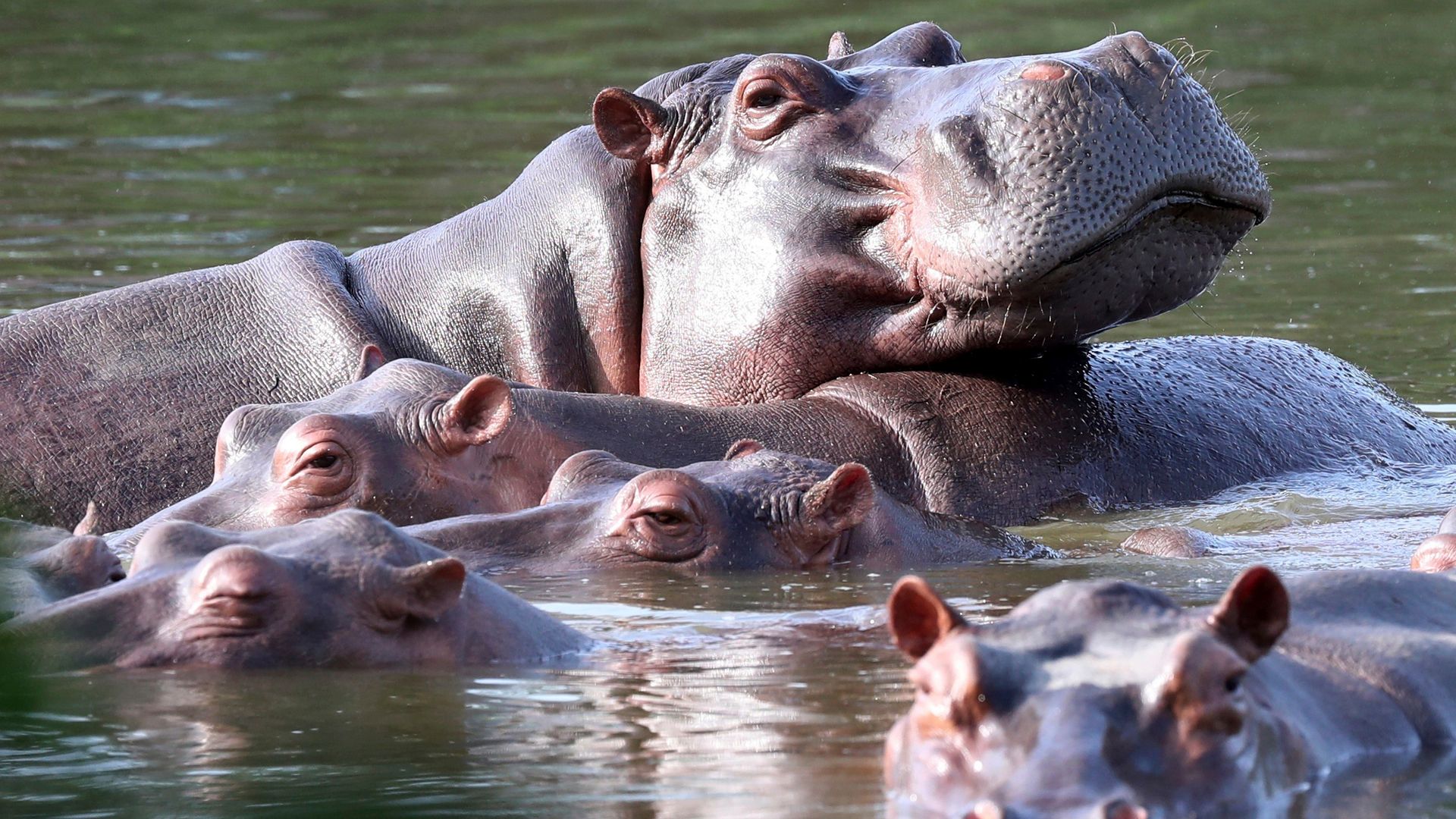
Colombia is currently grappling with a biological ticking time bomb that was planted decades ago by a man who thought himself above the laws of nature. The "cocaine hippos," a herd of more than 170 territorial giants roaming the Magdalena River basin, have officially moved from a quirky curiosity to an existential threat. The Colombian government recently shifted its stance toward a culling program, a move that is as politically radioactive as it is scientifically necessary. The primary goal is simple: halt the exponential growth of a population that could reach 1,000 individuals by 2035 if left unchecked.
This is no longer a story about a drug lord’s eccentricities. It is a case study in how bureaucratic inertia and emotional public sentiment can paralyze environmental policy until the only remaining options are violent and expensive. The hippos are destroying local ecosystems, displacing native manatees and otters, and terrorizing fishing communities that have lived along the river for generations. Recently making waves in this space: The Great Himalayan Standoff and the Illusion of Normalcy.
The Myth of the Gentle Giant
The public perception of hippos is often skewed by childhood cartoons and distant zoo enclosures. In reality, Hippopotamus amphibius is one of the most aggressive large mammals on Earth. In Africa, they are responsible for more human deaths annually than lions or elephants. In the lush, predator-free environment of the Magdalena River, these animals have become "super-charged."
Without the seasonal droughts and natural predators like crocodiles or lions that keep populations in check in Africa, the Colombian hippos reach sexual maturity much earlier. They are breeding faster than their ancestors. They are also larger. The abundance of water and forage means they don't have to expend energy searching for resources, allowing them to focus entirely on reproduction and territorial expansion. More information on this are covered by Al Jazeera.
The impact on the river’s chemistry is profound. A single hippo can dump up to 20 pounds of waste into the water daily. Multiply that by nearly 200 animals, and you have a massive influx of nitrogen and phosphorus that triggers toxic algae blooms. These blooms deplete oxygen levels, leading to massive fish kills. For the local pescadores, the hippos aren't a tourist attraction; they are a direct threat to their livelihood and their lives.
Why Sterilization Failed
For years, the Colombian government attempted to appease animal rights groups by pursuing a strategy of surgical sterilization and the use of GonaCon, a chemical contraceptive. On paper, it sounded like a humane compromise. In the field, it was a logistical nightmare that bordered on the absurd.
To sterilize a wild hippo, you first have to catch it. These are three-ton animals that live in murky water and thick mud. Sedating them is incredibly risky; if the dose is too low, the animal remains dangerous, but if it's too high, the hippo might slip into the water and drown while unconscious. Once sedated, a team of veterinarians must perform complex surgery in a humid, muddy environment. The cost per animal is astronomical—up to $50,000 when you factor in helicopters, specialized equipment, and expert labor.
While the government celebrated every dozen or so successful procedures, the rest of the herd continued to breed at a rate that made the effort irrelevant. It was like trying to empty the ocean with a thimble. The numbers simply don't add up. Projections from the Ministry of Environment suggest that even if 40 hippos were sterilized every year, the population would still continue to grow for decades.
The Export Illusion
Whenever the word "cull" is mentioned, critics point to the possibility of relocation. Why not just send them back to Africa or to zoos around the world?
The logistics are staggering. Transporting a single hippo across international borders requires a mountain of CITES (Convention on International Trade in Endangered Species) paperwork and a massive shipping container. Most African nations have declined the offer. They have their own hippo populations to manage and are wary of introducing animals that have spent decades in a different environment, potentially carrying pathogens or genetic mutations.
As for zoos, the market is saturated. A hippo lives for 40 to 50 years. Once a zoo has one, they aren't looking for another one for half a century. In 2023, there were reports of a deal to send dozens of hippos to sanctuaries in India and Mexico. While a few animals have moved, the sheer volume of the herd makes this a drop in the bucket. Moving 60 hippos is a headline; it is not a management strategy for a population of 170 that is doubling every few years.
The Political Minefield of Culling
The decision to authorize a cull is the ultimate "lose-lose" for Colombian politicians. On one side, you have the international scientific community and local biologists who are practically screaming for the removal of the animals to save the Magdalena's biodiversity. On the other, you have a vocal segment of the public and the lucrative tourism industry in Doradal, the town nearest to Escobar’s former estate, Hacienda Nápoles.
For Doradal, the hippos are a mascot. They appear on signs, in murals, and on souvenir t-shirts. Local hotels rely on "hippo safaris" to fill rooms. When the government suggests killing the animals, these communities see a threat to their economy. This has created a bizarre situation where an invasive species is being protected by the very people it might eventually kill.
There is also the "Bibi" factor. In 2009, the Colombian army tracked down and shot a rogue male hippo named Pepe. A photo of soldiers posing with the dead animal went viral, sparking a national outcry that resulted in a legal ban on culling that lasted for years. That ban is the primary reason the population exploded from a manageable dozen to the current crisis level.
The Economic Reality of Environmental Neglect
The cost of inaction is hidden but immense. Beyond the direct cost of sterilization programs, there is the long-term degradation of the Magdalena River, which is the arterial heart of Colombia’s economy. The river supports thousands of families through fishing and transport. If the ecosystem collapses due to eutrophication—the over-enrichment of water by nutrients from hippo waste—the economic fallout will dwarf the tourism revenue generated by a few hippo sightings.
Furthermore, the hippos are moving. They have been spotted more than 100 miles away from Hacienda Nápoles. They are colonizing new tributaries and moving closer to more populated areas. It is no longer a localized problem; it is a regional invasion.
Environmental management often requires making hard choices between two "bad" options. The "good" option—catching all the hippos and putting them in a magical sanctuary—doesn't exist. The choice now is between a controlled, professional cull or a slow-motion ecological disaster followed by a chaotic, unplanned slaughter when a hippo inevitably kills a child or a group of tourists.
Implementation of a Professional Cull
The Ministry of Environment has signaled that the cull will be carried out by professional marksmen, focusing on individuals that pose the highest risk to human life or those moving into new territories. It will not be a public spectacle. The carcasses must be handled with extreme care, as they are biological waste that can contaminate water sources if left to rot.
This process requires a level of transparency that the Colombian government has struggled with in the past. To maintain public trust, every step must be documented, and the scientific data must be shared openly. There must be an admission that this is a failure of governance—a failure that allowed a criminal's pet project to become a national crisis.
The hippos of Pablo Escobar are a stark reminder that nature does not care about our sentimentality. An animal can be both magnificent and a menace. We are now witnessing the inevitable conclusion of a forty-year experiment in negligence. The bullets that will eventually end this saga are not being fired out of cruelty, but out of a desperate, late-stage attempt to restore a balance that should never have been broken.
Stop looking at the hippos as characters in a story. Start looking at them as a biological wildfire. You don't negotiate with a wildfire; you contain it before it consumes everything in its path. The time for containment passed ten years ago. Now, all that is left is the cleanup.