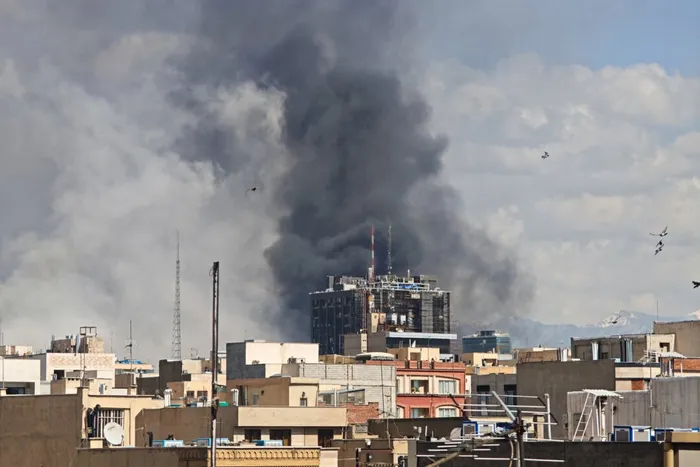
The headlines are predictable. A politician stands behind a podium, beats their chest, and promises that the United States will "destroy" any Iranian missile that dares to take flight. The public eats it up. They imagine a high-tech shield, a digital umbrella of invincibility that renders enemy ballistic threats as harmless as bottle rockets. It sounds like strength. It feels like security.
It is actually a recipe for strategic bankruptcy.
The obsession with interception—the "bullet hitting a bullet" mythology—is the lazy consensus of a defense establishment that prefers expensive toys over uncomfortable math. When we talk about destroying Iranian missiles, we aren't talking about a simple act of defense. We are talking about entering an asymmetric attrition war where the United States pays $4 million to stop a $50,000 piece of flying scrap metal.
The Mathematical Collapse of the Interceptor Myth
To understand why "destroying the missile" is a losing game, you have to look at the kinematic cost exchange. The media portrays missile defense as a triumph of engineering. I see it as a catastrophic failure of accounting.
Iran’s missile program, specifically the Fateh-110 and its derivatives, is built on a philosophy of "good enough." They use solid-fuel motors that are cheap to manufacture and easy to hide. They don’t need surgical precision; they just need to arrive.
In contrast, the American response relies on systems like the Patriot (PAC-3) or the Terminal High Altitude Area Defense (THAAD).
Each PAC-3 MSE interceptor costs roughly $4.1 million. To ensure a "kill," doctrine usually dictates firing two interceptors at a single incoming target. That is $8 million spent to negate a threat that likely cost Iran less than the price of a luxury SUV.
If Iran launches a swarm of 50 missiles—a drop in the bucket for their arsenal—it costs the U.S. taxpayer nearly half a billion dollars to say "no." Iran can afford to lose 50 missiles every week. The U.S. cannot afford to burn through its limited inventory of interceptors at that rate. We are winning the tactical engagement and losing the war of sustainability.
The "Perfect Shield" Delusion
Politicians love to promise 100% efficacy. In the real world of physics, "perfect" is a fairy tale. Ballistic missile defense (BMD) is a series of nested probabilities, not a hard wall.
When a missile is in its terminal phase, it is screaming toward the earth at several times the speed of sound. The window for detection, tracking, and engagement is measured in heartbeats. Even if the interceptor hits the target, the debris—often containing unspent fuel or warhead fragments—doesn't just vanish. It falls. If you intercept a missile over a densely populated area in Iraq, Saudi Arabia, or Israel, you are still raining supersonic metal onto a city.
The industry insider secret no one wants to admit? We are terrified of "leakers." A 90% success rate is an "A" in a classroom, but in a missile exchange involving twenty projectiles, two leakers hitting a command center or an oil refinery makes the entire $200 million defense operation a failure.
The False Comfort of Aegis Ashore
We’ve spent decades and billions stationing Aegis Ashore and Arleigh Burke-class destroyers in the region. We tell ourselves these are the sentinels of the Gulf.
But look at the physics of saturation. An Arleigh Burke-class destroyer has 96 Vertical Launch System (VLS) cells. Not all of those are filled with SM-3 or SM-6 interceptors; some are Tomahawks, some are anti-submarine rockets. Once those tubes are empty, that ship is a billion-dollar paperweight. It cannot reload at sea. It has to return to a specialized port, a process that takes days or weeks.
Iran knows this. Their strategy isn't to out-tech us; it’s to out-number us. By forcing the U.S. to "destroy" every missile, they aren't trying to hit the target on the first try. They are trying to drain the magazine. They want us to use our best, most expensive arrows on their cheapest wooden sticks.
Intelligence Is Not an Interceptor
The "People Also Ask" sections of the internet are filled with variations of: "Can the US stop an Iranian nuclear missile?"
The brutal, honest answer is that relying on an interceptor to stop a nuclear-tipped missile is a gambler's move. If you are at the stage where the missile is in the air, you have already lost. True defense isn't a kinetic kill vehicle; it is the systematic dismantling of the launch chain before the key is ever turned.
The obsession with the "hit" distracts from the "hunt." We should be talking about "left of launch"—the cyber, electronic, and kinetic strikes that prevent the missile from ever leaving the rail. But "we disrupted their command and control via a sub-threshold cyber operation" doesn't sound as cool on the nightly news as a video of a fireball in the sky.
The Fragility of Forward Bases
We act as if our bases in Qatar, Bahrain, and the UAE are protected by an invisible dome. They aren't. They are static targets.
In 2020, during the Al-Asad Airbase strike, Iran proved they could achieve high accuracy with ballistic missiles. We didn't even attempt to intercept many of them because we didn't have the right assets in the right place at the right time. The lesson shouldn't have been "we need more Patriots." The lesson should have been "stop putting thousands of troops in the crosshairs of a missile power without a plan that isn't dependent on a $4 million lucky shot."
If we continue to signal that our only response to Iranian proliferation is to buy more Raytheon and Lockheed Martin interceptors, we are essentially giving Tehran the remote control to our national treasury.
The Counter-Intuitive Reality
The status quo says: Build more interceptors. Deploy more batteries. Protect every inch of dirt.
The disruptor says: Interception is a tactical luxury we can no longer afford as a primary strategy.
We need to stop lying to the public about the "destruction" of Iranian missiles. We need to admit that defense is a losing game of attrition. The real strength isn't in catching the punch; it’s in making sure the puncher is too afraid—or too broken—to swing.
Stop asking if the Patriot works. It does. Start asking if it matters when the enemy has more missiles than you have money.
Accept the reality that in a modern missile theater, some things will get hit. Design for resilience. Distribute your forces so no single missile can cause a strategic catastrophe. Harden your infrastructure so a "leaker" doesn't take out the power grid for a month.
The era of the "unbreakable shield" is dead. Anyone telling you otherwise is either selling interceptors or running for office.
Stop trying to catch the rain. Move the house.
Would you like me to analyze the specific failure rates of the SM-3 interceptor in high-clutter environments?