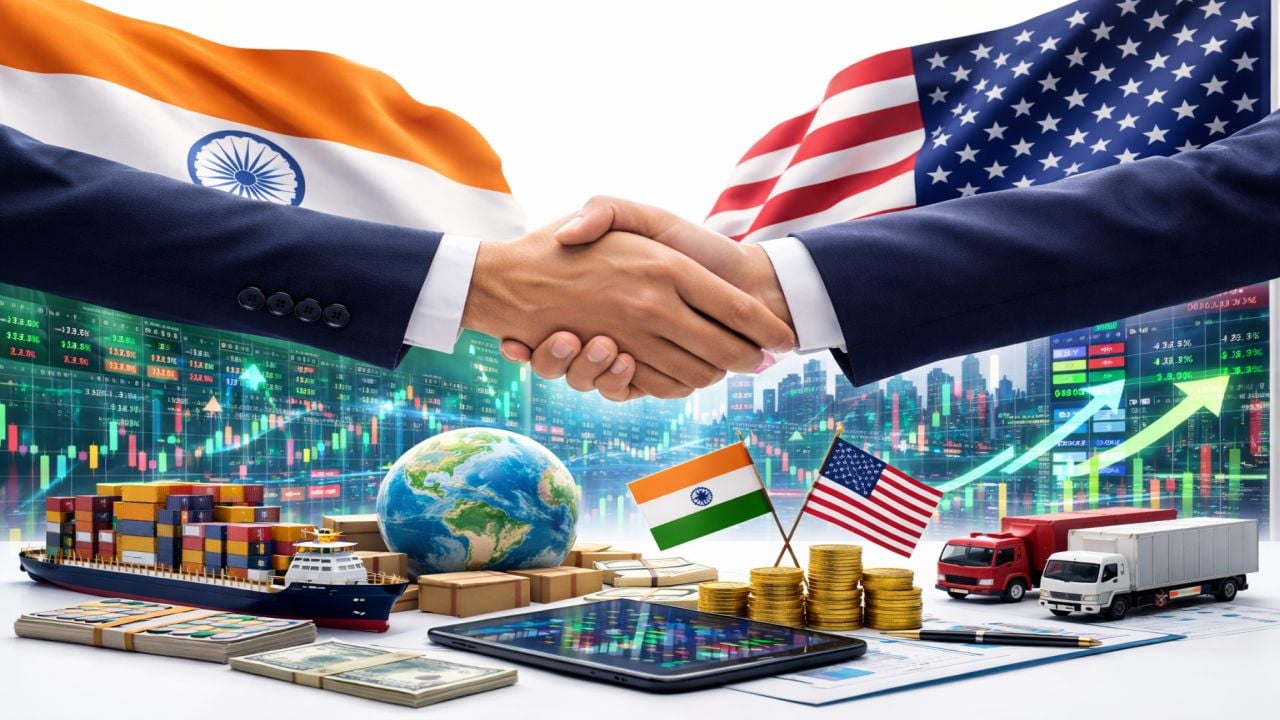
The Indian negotiating team landing in Washington on April 20 is not there to celebrate a victory. They are arriving to salvage a relationship that has been battered by months of aggressive tariff brinkmanship and a fundamental shift in how the United States views its trading partners. While public statements will likely focus on a "decisive phase" and a march toward a $500 billion trade target, the reality on the ground is a gritty, transactional scramble to fix a deal that began to crack before the ink was even dry.
At the heart of the upcoming talks from April 20–22 is a desperate attempt to reconcile India’s need for market access with the new American "reciprocal" reality. In February, a tentative truce was struck, ostensibly lowering the staggering 50% average tariff load on Indian goods down to 18%. But that 18% figure is a double-edged sword. It is far higher than the historical norms that built the bilateral trade relationship, and for many Indian exporters in low-margin sectors like textiles and leather, it remains a barrier that could prove terminal.
The Illusion of the Eighteen Percent
For decades, trade between New Delhi and Washington was built on the back of strategic patience. The U.S. tolerated India’s protectionist tendencies in exchange for a democratic counterweight in Asia. That era is over. The current American administration has replaced strategic patience with a ledger.
The 18% tariff rate currently being discussed is not a generous concession; it is a stay of execution. Earlier this year, the U.S. Supreme Court upended the trade landscape by striking down specific executive tariff policies, leading to a temporary 10% flat tariff on all imports. This move effectively wiped out the "preferential" advantage India thought it had secured in February. When everyone pays the same 10%, India's hard-won 18% "special rate" looks less like a deal and more like a penalty.
The Washington meetings must now address this mathematical absurdity. Indian negotiators, led by the Commerce Ministry’s top brass, are tasked with moving the needle back toward zero, or at the very least, securing exemptions that the new U.S. legal framework will actually allow to stand.
Energy as a Bargaining Chip
The "how" of this negotiation is increasingly tied to what India pumps into its refineries. Washington has made it clear that trade concessions are directly linked to India’s energy portfolio. The removal of a previous 25% "punitive" duty was contingent on New Delhi scaling back its reliance on Russian oil—a pivot that carries massive domestic economic risks for Prime Minister Modi.
Energy Diversification is no longer a policy preference; it is a line item in a trade contract.
- The Russian Factor: India has used discounted Russian crude to keep its inflation in check. Giving that up for more expensive U.S. shale or Middle Eastern barrels is a direct hit to the Indian taxpayer.
- The $500 Billion Target: To hit the ambitious trade goals touted by Commerce Minister Piyush Goyal, India has effectively committed to buying massive quantities of U.S. coal, gas, and agricultural products.
- The Strategic Squeeze: By tying energy imports to textile tariffs, Washington is forcing India to choose between its industrial export sector and its energy security.
The Information Technology Bottleneck
While energy and agriculture dominate the headlines, a more quiet and potentially more damaging conflict is brewing over Information and Communication Technology (ICT). The U.S. is demanding that India eliminate restrictive import licensing and "discriminatory" digital trade rules.
India’s "Make in India" initiative relies heavily on protecting local electronics manufacturing. If New Delhi caves to U.S. demands for zero-duty access for high-tech goods, it risks hollowed-out domestic factories. Conversely, if it maintains the barriers, Washington has threatened to reimpose the very tariffs the April 20 delegation is trying to remove.
This is the central friction of the 2026 trade talks. India wants to be a global manufacturing hub, but the U.S. wants India to be a primary consumer of American-made tech. There is very little middle ground. The Indian delegation is heading into a room where the U.S. Trade Representative, Jamieson Greer, has a clear mandate: "Reciprocity or Bust."
Why the Interim Deal is Failing Small Business
The most overlooked factor in this high-level diplomacy is the fate of the small and medium enterprises (SMEs) in hubs like Tiruppur and Ludhiana. These businesses operate on razor-thin margins. A shift from a 10% tariff to an 18% tariff—even if it's called a "reduction" from a theoretical 50%—can be the difference between a profitable quarter and bankruptcy.
The February framework was hailed as a breakthrough, but for the owner of a small engineering firm in Pune, the "breakthrough" hasn't resulted in a single new order. Instead, it has created a climate of "wait and see." Buyers in the U.S. are hesitant to sign long-term contracts when the tariff regime changes based on a court ruling or a midnight tweet from the White House.
The April 20–22 talks are a race against time to provide "predictability." Without a locked-in, legally durable agreement that survives the volatile U.S. political cycle, the strategic partnership is just a collection of press releases.
The European Alternative
New Delhi is not without options, and the negotiators in Washington know this. The India-EU Free Trade Agreement is nearing its final stages. Europe has watched the friction between the U.S. and India and moved in to offer more traditional, stable trade terms.
If the Washington talks stall over poultry imports or Russian oil, India has shown it is willing to pivot. The delegation’s presence in D.C. is as much a test of American willingness to keep a partner as it is a test of Indian flexibility. The U.S. must decide if an 18% tariff is worth the potential loss of a massive market to European competitors who are offering zero-duty access for Indian textiles and leather in exchange for a more predictable regulatory environment.
The outcome of the April 20 meetings will determine if the U.S.-India relationship remains a "defining partnership" or devolves into a series of transactional skirmishes. The stakes go far beyond the price of walnuts or the duty on iPhones; they involve the fundamental alignment of the world’s two largest democracies in an increasingly fragmented global economy.
Negotiators have three days to turn a fragile truce into a sustainable peace. If they fail, the 18% "deal" will be remembered not as a milestone, but as the high-water mark of a relationship that couldn't survive its own complexity.