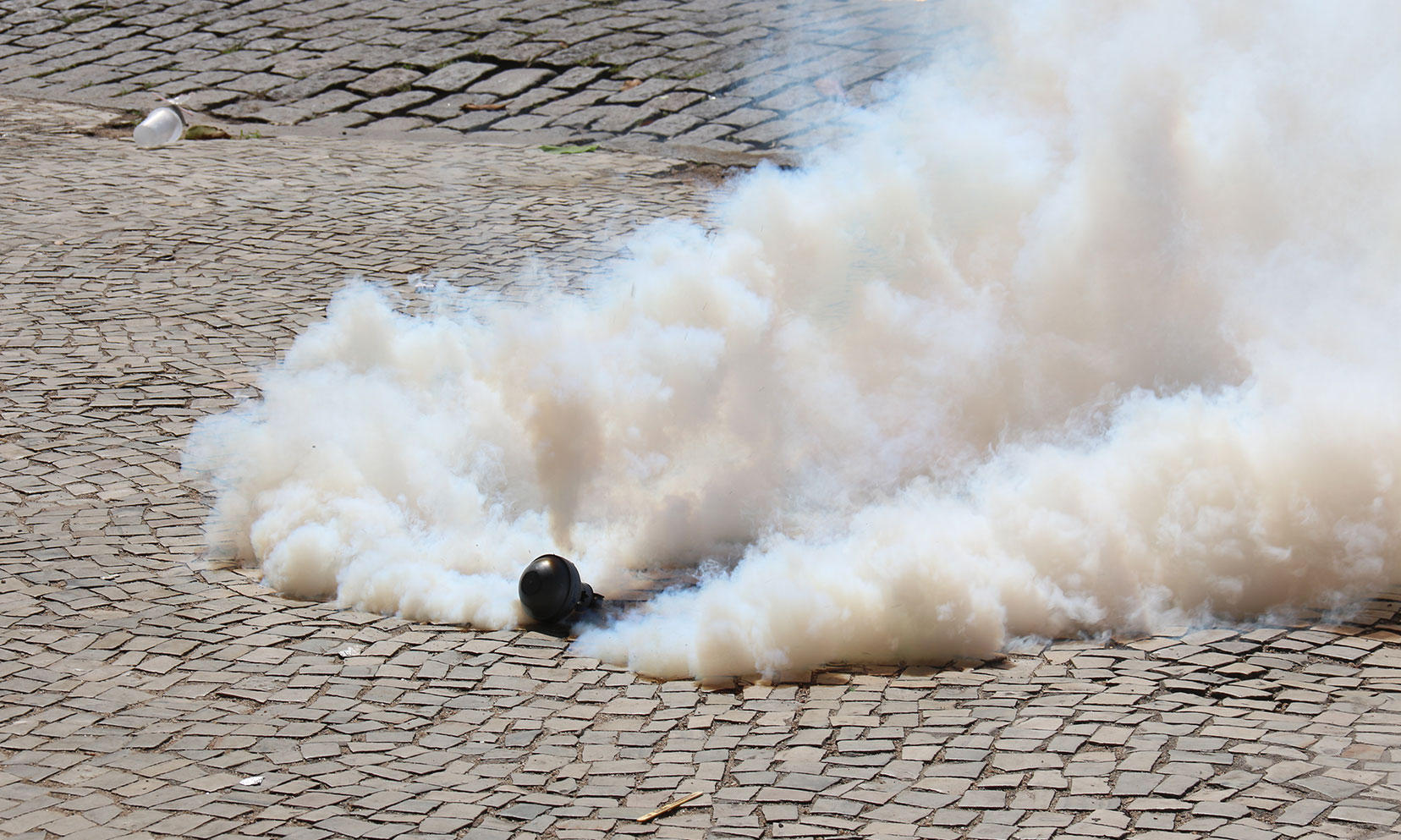
The sight of white smoke drifting through a school courtyard isn't just a visual disruption. It's a chemical assault on the lungs of children. When Israeli forces fire tear gas near Palestinian schoolchildren, the conversation usually shifts immediately to the "security" justification or the specific clash that triggered the event. We're missing the bigger picture here. This isn't just about a singular afternoon of chaos in Hebron or Bethlehem. It’s about the long-term physiological and psychological erosion of a generation trying to learn under the constant threat of respiratory distress.
I’ve looked at the reports from NGOs and medical professionals who work in the West Bank. They don't just see "incidents." They see a pattern of structural interference. When a canister lands in a classroom, the school day doesn't just pause. It ends. The residue stays on the desks. The smell lingers in the curtains. The fear stays in the kids' heads. You can't just open a window and expect the educational environment to return to normal. For a more detailed analysis into this area, we suggest: this related article.
Why tear gas is more than just a temporary irritant
Most people think of tear gas as a "non-lethal" tool that makes your eyes sting for ten minutes. That's a dangerous oversimplification. CS gas (2-chlorobenzalmalononitrile) is a chemical weapon. While it's marketed as a crowd-control agent, its effects on pediatric populations are significantly more severe than on healthy adults. Children have smaller airways and faster breathing rates. They take in more of the toxin relative to their body mass.
When a canister is fired near a school, you're not just dealing with watery eyes. You're dealing with "tear gas pneumonia" and severe bronchospasms. In cramped urban environments like the Aida Refugee Camp or the H2 area of Hebron, the gas doesn't dissipate quickly. It gets trapped in narrow alleys and poorly ventilated classrooms. Medical studies, including those published by organizations like Physicians for Human Rights, show that repeated exposure leads to chronic respiratory issues and, in some cases, miscarriages among teachers and residents in the immediate vicinity. To get more context on this topic, comprehensive analysis is available at TIME.
The technical reality is that "non-lethal" is a misnomer. Experts prefer the term "less-lethal," but even that feels hollow when you see a ten-year-old struggling to breathe. The long-term impact on the respiratory system of a child who is exposed to these chemicals weekly—sometimes daily—is a medical crisis that isn't getting enough international attention.
The psychological cost of militarized school zones
Imagine trying to take a math test while listening for the specific thwack of a gas canister launcher. You can't focus. You shouldn't have to. The presence of military forces near schools creates a "toxic stress" environment. This isn't some buzzword. It's a clinical reality where the body's stress response stays permanently "on," flooding the brain with cortisol.
Education is supposed to be a safe harbor. When that harbor is breached by chemical irritants and armed soldiers, the foundation of learning collapses. Palestinian students frequently report symptoms of PTSD, bedwetting, and severe anxiety. Teachers in these zones spend more time on "gas drills"—closing windows, grabbing onions or vinegar-soaked rags to mask the sting—than they do on the actual curriculum.
It's a form of collective punishment that rarely makes the evening news unless there's a particularly graphic video. The daily grind of being "gassed" out of a classroom is a quiet, suffocating routine. If this happened in any other school system in the world, there would be a global outcry about the violation of the right to education.
Legal frameworks and the violation of protected spaces
Under international law, schools are supposed to be protected spaces. The Fourth Geneva Convention is pretty clear about the protection of civilians and the rights of children. However, the reality on the ground suggests these protections are often treated as optional suggestions.
Israeli forces often cite "stone-throwing" as the reason for deploying tear gas near schools. Even if you take that justification at face value, the response is almost always disproportionate. Firing a chemical agent that drifts into a building full of hundreds of uninvolved children to catch two or three kids throwing stones is a failure of tactical restraint. It's using a sledgehammer to crack a nut, and the children are the ones getting crushed.
Amnesty International and Human Rights Watch have documented dozens of cases where canisters were fired directly into school property. This isn't "drift" or "accidental exposure." It's direct targeting of a civilian infrastructure. When a canister hits a child—which happens because these canisters are heavy metal projectiles—the injury isn't just from the gas. It's a blunt-force trauma that can be, and has been, fatal.
The failure of the international community to act
We’ve seen the statements. "Deep concern." "Urging restraint." They don't do anything. The international community’s refusal to hold anyone accountable for the militarization of Palestinian education is why this keeps happening. There's a clear paper trail of these incidents, yet the supply of tear gas—much of it manufactured in the United States—continues unabated.
If we're serious about human rights, we have to talk about the supply chain of this "less-lethal" weaponry. Organizations like Defense for Children International - Palestine (DCIP) provide rigorous documentation of these events. They track the dates, the locations, and the medical outcomes. Yet, the policy of using gas as a first-resort tool of intimidation remains standard operating procedure.
What happens when the smoke clears
The smoke eventually disappears, but the school is changed. The trust between the student and the idea of "safety" is broken. You end up with a generation that views the world through a lens of justified resentment. Honestly, what else would you expect? If your childhood was defined by the sting of CS gas in your eyes while you were trying to learn your ABCs, your worldview is going to be shaped by that trauma.
We need to stop treating these as isolated "clashes." They are part of a systemic pressure campaign that uses chemical irritants to make life—and education—unbearable in specific zones.
If you want to support change, stop looking at the "both sides" narrative and look at the data on pediatric chemical exposure. Support organizations that provide independent medical clinics in the West Bank. Demand that your representatives question the export of crowd-control chemicals to units with a documented history of firing them into schools. The next time you read a headline about "clashes" near a school, remember that for the kids inside, it's not a clash. It's a lung-burning, terrifying disruption of their future.
Check the reports from the UN OCHA (Office for the Coordination of Humanitarian Affairs) for real-time tracking of school interference. Read the medical briefs from Palestinian Red Crescent Society. Don't let the white smoke hide the reality of what's happening on the ground. The kids deserve a classroom where the only thing they have to worry about is the material on the chalkboard.