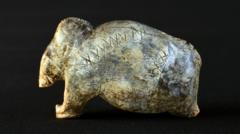
History books tell you that writing began in Mesopotamia around 3,300 BCE. They point to clay tablets, cuneiform, and tax records as the "dawn" of civilization. They're wrong. Or, at the very least, they’re missing a 30,000-year prelude that happened in the flickering torchlight of European caves.
Recent breakthroughs in archaeoastronomy and cognitive archaeology suggest that Paleolithic hunter-gatherers weren't just painting pretty pictures of horses and bison. They were using a sophisticated system of proto-writing to track time and biological cycles. We’re talking about a leap in human intelligence that predates the Pyramids by tens of millennia. If this holds up—and the data is looking increasingly solid—we need to stop calling these people "primitive."
The symbols hiding in plain sight
For over a century, archaeologists obsessed over the animals. The "Sistine Chapel of Prehistory" at Lascaux is famous for its massive bulls and galloping horses. But ignored in the corners or superimposed on the animals are tiny, repetitive marks. Lines, dots, and a "Y" symbol.
Researchers traditionally dismissed these as "doodles" or stylistic flourishes. That changed when an independent researcher named Ben Bacon teamed up with academics from Durham University and University College London. They looked at the marks not as art, but as data. By analyzing over 800 instances of these symbols, they found a pattern that’s way too consistent to be random.
The Y symbol and the biology of survival
The most compelling part of this study centers on the "Y" mark. It’s a simple fork, almost like a bird's foot. When you look at where it appears, it's often placed near a specific animal image—a horse, a bison, or a mammoth.
The researchers hypothesized that the "Y" symbol meant "to give birth." Why? Because it represents a fork in the road—two legs opening up. When you map these symbols against the lunar calendar and the known breeding cycles of those animals, the math works out perfectly. These people weren't just recording that they saw a horse. They were recording when the horse would have foals.
It's essentially a prehistoric spreadsheet.
Tracking time by the moon
These hunter-gatherers didn’t have watches, but they had the sky. They used a "phenological" calendar, which means they tracked events in nature (like the first snowfall or the blooming of a certain flower) alongside the phases of the moon.
The dots and lines found in caves like Altamira and Chauvet correlate with the number of months in the lunar year. If you see three dots next to a deer, it likely means the deer migrates or mates in the third lunar month after the start of spring.
Why this isn't "true" writing yet
Look, we have to be careful with the word "writing." Linguists define writing as a system that records spoken language—phonemes and syntax. These cave marks are "proto-writing." They communicate a specific, shared meaning without necessarily representing sounds.
Think of it like a "No Smoking" sign. You don't need to know the English words to understand the concept. These symbols communicated across generations. They were a way for a group to store collective knowledge about the environment outside of one person's memory. It’s the first external hard drive for the human brain.
The problem with our view of the Stone Age
The biggest hurdle to accepting this isn't the data. It's our own ego. We like to think of ourselves as the pinnacle of evolution. We view the Ice Age people as grunting nomads who barely scraped by.
Actually, they were us.
Anatomically modern humans have been around for about 300,000 years. Their brains were the same size as yours. They lived in complex social structures, wore tailored clothing, and clearly understood high-level concepts like astronomical cycles and reproductive biology.
The fact that it took us this long to realize they were writing things down says more about our narrow-mindedness than their lack of ability. We looked at these symbols for a hundred years and didn't see them because we didn't want to see them.
The controversy in the field
Not everyone is buying this theory. Some archaeologists, like those at the University of Bordeaux, argue that the "Y" symbol could mean dozens of other things. Maybe it’s a spear mark. Maybe it’s a stylized plant.
But the statistical correlation found in the Durham study is hard to ignore. When you apply the lunar-cycle model to hundreds of different cave paintings across Europe, the patterns hold. It’s not just a fluke in one cave. It’s a regional, multi-generational system of communication.
What this means for the future of archaeology
If we accept that writing (or its precursor) is 40,000 years old, it changes the timeline of human development. It means the "Cognitive Revolution" wasn't a slow burn—it was a forest fire.
We need to re-examine every piece of portable art—every carved bone and etched stone—with a fresh eye. There are thousands of artifacts in museum basements right now that are likely covered in data we’ve been ignoring.
How to explore this for yourself
If you're skeptical, go look at the high-resolution scans of the Chauvet Cave or Lascaux online. Don't look at the animals. Look at the margins. Look for the rows of dots. Look for the "Y" symbols.
Once you see them, you can't un-see them.
The next step for researchers is to see if these symbols exist outside of Europe. Did the early humans in Africa or Australia use similar marks? If this was a universal human trait, it means we’ve been "literate" since before we even left the African continent.
Stop thinking of history as a straight line from stupid to smart. It’s more like a series of peaks. Those people in the caves weren't just surviving; they were masters of their environment, and they were desperate to pass that mastery down to their children. They left us a message. We’re finally starting to read it.