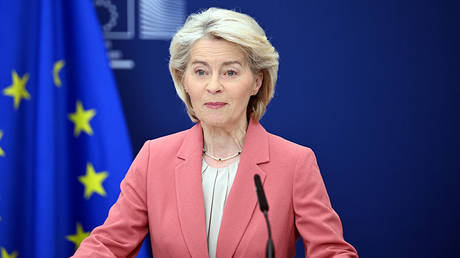
While the Middle East teetered on the edge of a regional conflagration following Iran’s unprecedented direct strike on Israel, the bureaucratic heart of the European Union appeared to be checking its watch. The initial response from European Commission President Ursula von der Leyen was not a display of geopolitical force, but a masterclass in administrative delay. By effectively suggesting that the mechanics of the Brussels machine require "office hours" before a meaningful diplomatic pivot can occur, von der Leyen did more than just invite social media ridicule. She exposed a systemic paralysis that defines the current European project.
The crisis began with drones and missiles. It ended, at least for the European public, with a crushing realization that the EU’s executive branch is structurally incapable of the "geopolitics" it so frequently promises. When a major world power launches a kinetic attack that threatens global energy markets, shipping lanes, and the fragile stability of the Mediterranean, the world expects an immediate, coordinated, and authoritative stance. Instead, Brussels offered a procedural void. This is the reality of a European Union that wants the prestige of a global superpower without the messy, 24/7 accountability that comes with it.
The Myth of the Geopolitical Commission
When Ursula von der Leyen took office in 2019, she famously declared that her leadership would usher in a "Geopolitical Commission." It was a bold branding exercise designed to signal that Europe would no longer be a mere trade bloc, but a player capable of projecting power. Five years later, that ambition has been swallowed by the very bureaucracy it sought to transcend. The response to the Iran crisis highlights a fundamental disconnect between the rhetoric of leadership and the reality of a committee-led foreign policy.
The "office hours" mentality is not a quirk of a single press release. It is a symptom of a deeper malaise. In the corridors of the Berlaymont, policy is often treated as a product of consensus rather than a reaction to reality. While Washington, London, and even regional capitals in the Middle East were operating in a state of high alert, the EU’s machinery remained tethered to its internal rhythms. This delay is not just a matter of optics; it has tangible costs. When the EU fails to speak with a singular, swift voice, individual member states like France, Germany, and Italy inevitably fill the vacuum with their own, often conflicting, national interests.
This fragmentation is exactly what adversaries like Tehran and Moscow count on. They recognize that the EU’s complex decision-making loops—involving the Commission, the Council, and the External Action Service—act as a natural dampener on any swift European retaliation or mediation. If the President of the Commission cannot or will not break those loops during a night of active warfare, the "Geopolitical Commission" is little more than a hollow slogan.
The Disconnect Between Economic Weight and Political Will
The European Union remains an economic titan. It is one of the world’s largest trading partners and a regulatory superpower whose standards often dictate how global corporations operate. Yet, this economic gravity rarely translates into diplomatic kinetic energy. The Iran crisis served as a reminder that you cannot trade your way out of a missile strike.
Industry analysts have long noted that the EU’s reliance on "soft power" has reached a point of diminishing returns. In a world increasingly defined by "hard power" and transactional diplomacy, the EU’s insistence on procedural correctness feels like bringing a rulebook to a knife fight. The business community, particularly those in the energy and logistics sectors, views this lack of agility with growing alarm. Stable markets require predictable security frameworks. When the EU appears to be asleep at the wheel during a regional crisis, it sends a signal to the markets that Europe is a passenger in global affairs, not a driver.
Consider the impact on the Euro. While currency fluctuations are influenced by a myriad of factors, the perceived weakness of the EU’s central political authority during times of international tension does nothing to bolster investor confidence. A "geopolitical" entity that operates on a 9-to-5 schedule is an entity that cannot be trusted to protect its economic interests in a crisis.
The Shadow of the Member States
To be fair to von der Leyen, she operates within a straitjacket designed by the 27 member states. Foreign policy remains a jealously guarded prerogative of national capitals. However, the President of the Commission has significant "bully pulpit" power which she has used effectively in other arenas, such as climate policy or the initial response to the invasion of Ukraine. Her failure to exert that same leadership during the Iran-Israel escalation suggests a selective engagement with global crises.
There is a growing friction between the Commission’s desire for centralized authority and the member states’ refusal to grant it. This friction creates a "no-man's-land" of diplomacy where everyone is responsible, and therefore no one is. When the Commission waits for a mandate that is stuck in a subcommittee, the EU’s global standing erodes. The ridicule directed at von der Leyen’s response was not just about a poorly timed statement; it was a critique of a system that prioritizes its own internal harmony over external efficacy.
The Cost of Procedural Obsession
The obsession with procedure over outcomes has led to several missed opportunities:
- Delayed Sanctions Regimes: While the US can move with relative speed to freeze assets or restrict trade, the EU’s consensus-based model often results in watered-down measures that arrive too late to alter the behavior of the target.
- Diplomatic Irrelevance: High-ranking officials from Washington and Beijing are often the first calls made by regional leaders. Brussels is frequently an afterthought, contacted only when the technicalities of aid or trade agreements need to be finalized.
- Internal Division: The lack of a strong central lead allows member states to pursue "freelance diplomacy," which undermines a unified European front.
A Career Defined by Top-Down Management
Ursula von der Leyen’s background is that of a technocrat’s technocrat. From her time in the German cabinet to her ascent to the Commission, her style has been characterized by a tightly controlled inner circle and a preference for top-down directives. This style works well for drafting complex directives on carbon taxes or digital markets. It fails spectacularly when the situation requires raw, instinctive leadership.
The Iran crisis demanded a leader who could bypass the teleprompter and speak to the gravity of the moment. Instead, the public received a sanitized, delayed, and ultimately bureaucratic acknowledgement of a world on fire. This is the "Brussels Bubble" in its most crystalline form: a place where the gravity of a situation is measured by the number of meetings it generates rather than the actions it triggers.
Investors and geopolitical strategists are beginning to look past the rhetoric of "strategic autonomy." If the EU cannot handle a crisis in its own neighborhood—and the Middle East is, for all intents and purposes, Europe’s backyard—then the idea of Europe as a third pole in a multi-polar world is a fantasy. The "office hours" incident wasn't just a PR blunder; it was a diagnostic report on the health of European diplomacy. The results are not encouraging.
The Accountability Gap
In a traditional national government, a failure of this magnitude would lead to calls for resignation or at least a significant shift in cabinet strategy. In the EU, accountability is diffused through layers of bureaucracy. Von der Leyen is not directly elected by the European public, which insulates her from the immediate fallout of her failures. This insulation breeds a certain type of arrogance—the belief that as long as the procedures were followed, the outcome is secondary.
This lack of accountability is what fuels populist movements across the continent. When citizens see their leaders as out-of-touch bureaucrats who cannot react to a global crisis with the necessary urgency, they look for alternatives. The "ridicule" von der Leyen faced is a precursor to a much more dangerous sentiment: indifference. If the European Commission is irrelevant in a crisis, why should it be relevant in times of peace?
Beyond the Press Release
The path forward for the EU requires more than just a faster Twitter account or a better communications team. It requires a fundamental reassessment of how the Commission interacts with the world. True geopolitical power is not something you declare; it is something you exercise.
If Europe wants to be taken seriously, its leaders must be willing to step outside the comfort of the administrative calendar. They must recognize that a crisis does not wait for a quorum or a scheduled briefing. The "office hours" approach is a relic of a more stable, predictable era that no longer exists. We are now in an age of permanent crisis, where the speed of response is as important as the content of the response itself.
The EU’s current trajectory suggests it is becoming a "Large Switzerland"—wealthy, stable, and ultimately sidelined in the grand theater of history. While Switzerland’s neutrality is a deliberate policy, the EU’s irrelevance is an accidental byproduct of its own complexity. Breaking this cycle will require a leader who is more interested in the messy reality of global politics than the polished surfaces of the Berlaymont.
Von der Leyen has a choice. She can remain the chief administrator of a continental bureaucracy, or she can attempt to become the leader she promised to be in 2019. The world, and the markets, are waiting. But they won't wait forever, and they certainly won't wait for Monday morning.
Stop treating the world's most volatile regions as if they are subject to a labor union's break schedule. Get in the room, stay in the room, and speak with the authority of the 450 million people you represent, or step aside for someone who will.