American farmers are currently caught in a high-stakes squeeze between falling commodity prices and a shifting regulatory environment that has turned green energy into a political minefield. For a decade, the promise of "harvesting the sun" was sold as the ultimate hedge against bad crop years and volatile markets. But as federal and state administrations flip-flop on subsidies, grid access, and land-use permits, those who bet their legacies on solar panels are finding that the sun doesn't shine on everyone equally. This isn't just about climate policy; it is a fundamental breakdown of the contract between the government and the people who feed the country.
The Financial Trap of the Solar Gold Rush
For generations, the math of farming was simple, if brutal. You managed your input costs, prayed for rain, and hoped the global market didn't collapse before harvest. When solar developers started knocking on doors in the Midwest and the South, they offered a third option. They offered guaranteed, long-term lease payments that often doubled or tripled the per-acre revenue of corn or soybeans.
It seemed like a lifeline. Farmers saw a way to keep the land in the family without having to work it until they dropped dead. However, the economics changed the moment federal trade protections and shifting tariffs on imported components entered the mix. When the rules of the game are rewritten in Washington, the ripples turn into tidal waves by the time they hit a gravel road in Iowa.
The actual mechanism of these deals is often buried in 40-year contracts that most farmers are ill-equipped to audit. These agreements frequently include "decommissioning clauses" that are underfunded or entirely speculative. If a solar company goes bankrupt or the federal incentives vanish, the farmer is left with a field full of glass and silicon and a massive bill to return the soil to a plantable state.
The Grid Lock and the Policy Whip
While the public debate focuses on "saving the planet," the private struggle is about the grid. Most rural electrical infrastructure was designed to push power out to remote areas, not to pull massive amounts of energy back into the metropolitan centers. Upgrading this infrastructure costs billions.
Under recent shifts in federal oversight, the burden of these costs has increasingly shifted toward the developers and, by extension, the landowners. When a project gets "stalled in the queue," it usually means the utility company is demanding a multi-million dollar substation upgrade that the project can no longer afford. Farmers who have already signed away their land rights find themselves in a state of suspended animation—they can't farm the land because of the pending lease, and they aren't getting paid because the project isn't "online."
Tariffs and the Supply Chain Squeeze
The previous administration's focus on "America First" manufacturing sounds good in a stump speech, but in practice, it spiked the cost of the very panels needed to make these rural projects viable. By slapping heavy duties on imported cells, the government effectively choked the pipeline of small-to-mid-sized rural solar developments.
Large-scale utility projects can absorb these costs or wait out the market. A 500-acre family farm cannot. This created a two-tier system where only the largest corporate entities could navigate the regulatory sludge, leaving the independent farmer out in the cold. It was a classic case of policy intended to protect domestic industry actually punishing the domestic producer.
The Cultural Civil War Over Acreage
Drive through any rural county in Ohio or Indiana and you will see the signs: "No Solar on Prime Farmland." This isn't just NIMBYism. It is a profound cultural anxiety about the death of the American small town.
When thousands of acres are taken out of production, the entire local economy feels the hit. The seed dealer loses a client. The tractor mechanic sees fewer repairs. The local grain elevator loses volume. This "economic hollowing" is the invisible cost of the solar transition.
Critics argue that solar is a temporary use of land, but soil health is a delicate balance. Compacting the earth with heavy machinery to install pilings and then leaving it under shade for thirty years fundamentally changes the microbiology of the dirt. We are conducting a massive, uncontrolled experiment on some of the most productive topsoil on Earth, and we are doing it without a backup plan.
The Myth of Dual Use
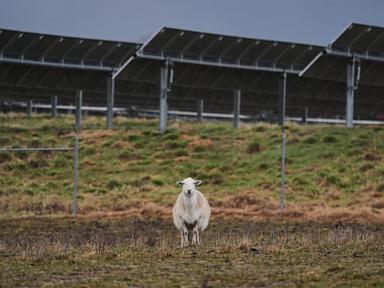
Proponents often point to "agrivoltaics"—the practice of grazing sheep or growing shade-tolerant crops under panels—as a solution. In reality, this is largely a PR stunt. The equipment required for modern, industrial-scale farming is too large to navigate between rows of solar racking. Grazing sheep is a niche solution that doesn't scale to the millions of acres currently under lease.
Farmers are being told they can have their cake and eat it too, but the industry experts know better. You are either a power producer or a food producer. Trying to be both usually results in doing both poorly.
The Looming Debt Crisis in the Sun Belt
Many farmers used their solar lease agreements as collateral for other loans. They bought new equipment or expanded their operations based on the "guaranteed" income of a 20-year power purchase agreement.
When policy shifts—such as the rolling back of "net metering" or the expiration of investment tax credits—cause these projects to be canceled, the financial house of cards collapses. Banks don't care if the Department of Energy changed its mind; they want their interest. We are seeing a quiet surge in rural foreclosures tied directly to failed energy bets.
This is the dark side of the "energy transition" that doesn't make it into the glossy brochures. It is a story of predatory speculation masked as environmental progress. The developers get their management fees, the politicians get their photo ops, and the farmer gets the risk.
Regulatory Whiplash and the Death of Predictability
The most damaging aspect of the current environment is the total lack of a long-term, stable federal energy policy. Every four to eight years, the "rules of the road" are completely demolished and rebuilt.
- Tax Credits: One year they are a certainty; the next, they are on the chopping block as "corporate welfare."
- Permitting: Federal agencies fluctuate between fast-tracking environmental reviews and adding layers of bureaucratic red tape that can add years to a project’s timeline.
- Foreign Investment: Rules regarding who can own the companies building these arrays change with the geopolitical wind, often stranding projects mid-construction.
This volatility is the enemy of the farm. Agriculture is an industry that operates on decades-long cycles. You don't just "pivot" a thousand-acre operation because a new administration took office in D.C.
The Corporate Land Grab
We are witnessing the greatest transfer of land control since the 1980s farm crisis. Only this time, the buyers aren't other farmers or even local banks. They are multinational investment firms and energy conglomerates.
When a farmer signs a solar lease, they are often signing away more than just the surface rights. They are giving up control over who enters the property, how the land is managed, and in some cases, the water rights associated with the parcel. These companies have legal teams that dwarf the resources of a local township board. They can out-wait, out-litigate, and out-lobby any local opposition.
The promise of solar was that it would democratize energy production and provide a "new crop" for the independent producer. Instead, it has become a tool for further consolidating land into the hands of non-operating entities. The "farmer" in this scenario becomes little more than a glorified groundskeeper for a utility company's asset.
Reclaiming the Narrative
If we want a functional rural energy policy, it has to start with the soil, not the panel. This means prioritizing "brownfield" sites—disturbed land, old mines, and industrial zones—over prime Class A farmland. It means creating "solar easements" that actually protect the landowner from the bankruptcy of the developer.
Most importantly, it requires a federal commitment to the grid that doesn't treat rural America as a giant battery for the cities. Without a massive, federally-funded overhaul of high-voltage transmission lines, these rural solar projects will remain nothing more than expensive ornaments in a landscape of broken promises.
The farmers who bet on solar weren't being "woke" or even particularly "green." They were being pragmatic. They saw a way to survive in an industry that has been trying to kill them for forty years. By turning their pragmatism into a political football, the government hasn't just failed the farmers; it has jeopardized the stability of the entire American food and energy system.
Fixing this doesn't require more subsidies or more flowery rhetoric about a "green future." It requires a hard, honest look at the physical realities of the grid and a legal framework that treats land as a finite resource rather than a disposable commodity. Until the risk is shifted away from the person holding the deed and onto the companies and politicians making the promises, the "solar bet" will remain a losing hand for the American farmer.
Stop looking at the panels and start looking at the contracts. The future of the American heartland depends on seeing the difference between a sustainable harvest and a predatory one.