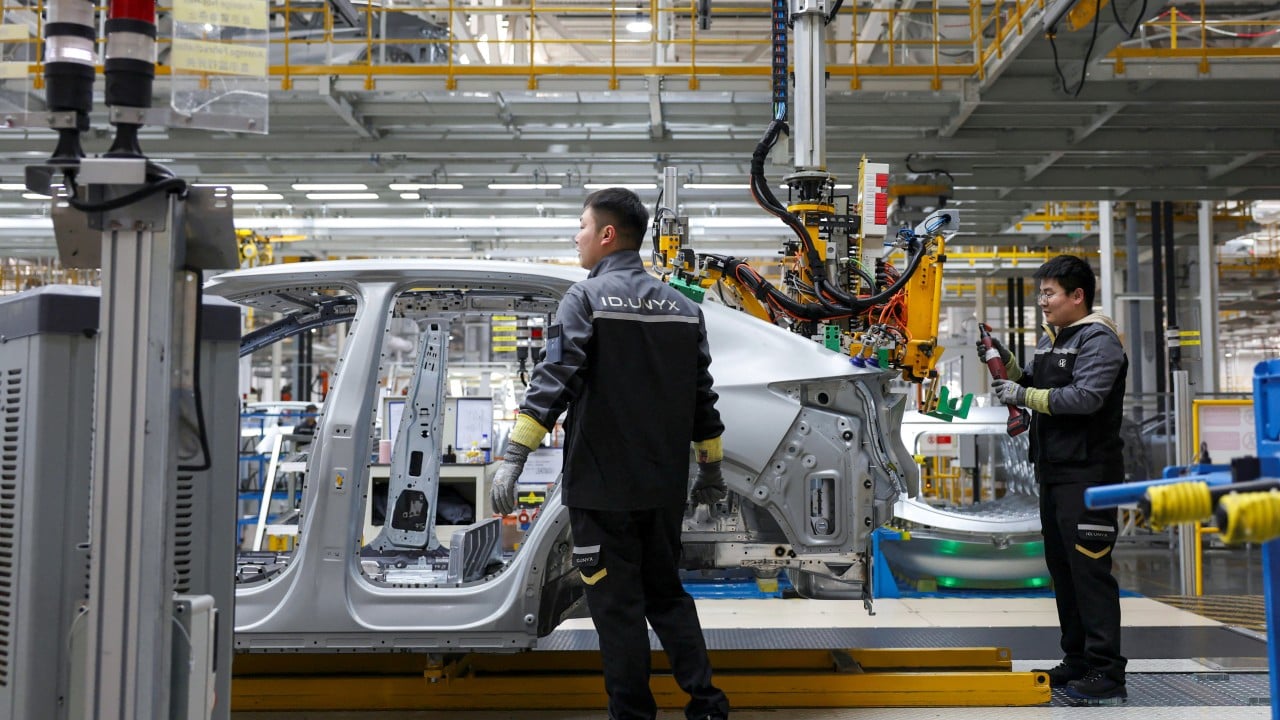
China’s elite graduates are abandoning the plush office towers of Shenzhen and Beijing for the greasy, high-stakes floors of advanced manufacturing plants. This is not a temporary trend or a romanticized return to "hard work" by a disillusioned youth. It is a calculated, state-backed migration driven by a collapsing tech sector and a national mandate to dominate the global hardware supply chain. For the first time in decades, a degree from Tsinghua University is more likely to lead to a semiconductor cleanroom than a venture capital boardroom.
The shift is structural. It is a response to the "Great Tech Squeeze" and the realization that software, while profitable, does not win trade wars. China’s youth are following the money, and right now, the money is flowing into "hard tech"—batteries, chips, and robotics.
The Death of the Coding Dream
A decade ago, the path to wealth in China was clear. You learned to code, joined an internet giant like Alibaba or Tencent, and waited for the IPO. That path has been dynamited. A combination of aggressive regulatory crackdowns on consumer internet platforms and a saturated domestic market has stripped the sheen off the "996" work culture.
The internet sector no longer offers the same upward mobility. Layoffs are frequent. Salaries have flattened. In contrast, the manufacturing sector—specifically high-end, automated production—is seeing an infusion of capital and prestige. The government’s "Little Giants" program, which identifies and supports specialized small-to-medium enterprises in the industrial space, has created thousands of new, high-paying roles that require advanced engineering knowledge.
Graduates are not choosing factories because they want to perform manual labor. They are choosing them because the factory is where the innovation is actually happening. Modern Chinese manufacturing looks less like a Victorian sweatshop and more like a laboratory.
The Silicon Shield Mentality
Geopolitics is the primary engine behind this labor shift. As the United States and its allies tighten export controls on critical technologies, Beijing has shifted its focus to "choke point" industries. If you are a brilliant mechanical engineer or a materials scientist, you are no longer just an employee; you are a national asset.
There is a palpable sense of mission among these young workers. It is a blend of pragmatism and patriotism. They see the vulnerability of their country’s supply chains and recognize that their career longevity is tied to solving these technical bottlenecks. This isn't just about making shoes or toys for the West anymore. It is about building the machines that build the world.
The Salary Flip
While entry-level roles in traditional finance or media have seen stagnant wages, specialized manufacturing roles are seeing double-digit growth. A graduate specializing in lithium-ion battery chemistry or silicon carbide wafers can now command a starting package that rivals or exceeds what a junior product manager at a social media firm would make.
Consider the "Hard Tech" premium. Companies like CATL, BYD, and SMIC are recruiting aggressively on campuses, offering not just competitive pay but also subsidized housing and a level of job security that the volatile internet sector can no longer provide. The math is simple for a 22-year-old with student debt or high aspirations: go where the state wants you to go, and you will be protected.
The Reality of the Industrial Life
Despite the high-tech veneer, the transition is not without friction. Moving from a shiny office in a Tier-1 city to an industrial park in an interior province is a culture shock. These graduates are trading coffee shops and coworking spaces for dormitories and canteen food.
The work is grueling. It requires a level of physical presence that the "work from anywhere" generation finds jarring. You cannot troubleshoot a malfunctioning industrial laser from your living room. You have to be there, in the heat, on the floor, until the problem is solved.
- The Environment: Sterile, high-pressure, and strictly disciplined.
- The Schedule: Often follows the production cycle, not the sun.
- The Social Cost: Industrial hubs are often isolated from the cultural centers of the country.
This is a generation of "Blue-Collar Scholars." They are overqualified for the roles they are taking, which leads to a unique kind of tension. They are bringing a white-collar mindset to a blue-collar environment, demanding better management practices and more intellectual autonomy.
Reforming the Educational Pipeline
For years, the Chinese education system was criticized for being a "degree factory" that produced millions of graduates with theoretical knowledge but zero practical skills. That is changing under duress. Universities are rapidly pivoting their curricula to align with the needs of the "Real Economy."
Theoretical physics majors are being pushed into material science. Mathematicians are being rerouted into algorithm design for industrial automation. The "useless" degree is becoming a relic of the past as the state tightens its grip on university funding, tying it directly to employment rates in strategic sectors.
The Risk of Overcapacity
The danger in this mass migration is the creation of a massive talent bubble. When the state directs everyone toward a specific sector, overinvestment and overcapacity usually follow. We saw it in the real estate market. We saw it in the peer-to-peer lending craze.
If China produces five times as many battery engineers as the world needs, the resulting wage collapse will be spectacular. These elite graduates are betting their entire futures on the idea that the "Hard Tech" boom will last decades. If global trade continues to fragment, or if a breakthrough in another country renders Chinese tech obsolete, these young engineers will find themselves with highly specialized skills and nowhere to sell them.
Competition and the "Involution"
The Chinese term neijuan, or "involution," describes a process where people compete intensely for limited resources, leading to exhaustion without progress. This has already infected the manufacturing sector. As more elite graduates enter the field, the bar for entry rises. A master’s degree from a top-tier school is now becoming the baseline for roles that previously required only a vocational certificate.
This hyper-competition is driving down the quality of life even as it drives up the quality of the workforce. Companies are the beneficiaries, getting world-class talent for a fraction of what it would cost in the West, while the workers themselves find themselves in a new kind of rat race.
Why the West Should Be Worried
While Western nations struggle to revitalize their manufacturing bases and convince their youth that trade schools are a viable path, China is effectively militarizing its intellectual capital. They are not just building factories; they are staffing them with the brightest minds of a generation.
This is a competitive advantage that is difficult to quantify but impossible to ignore. A factory staffed by PhDs and top-tier engineers iterates faster. It solves production errors more efficiently. It innovates on the fly. This isn't just about lower labor costs; it's about a higher "IQ density" on the production line.
The gap between "design" and "making" is disappearing in China. In the West, we often design in one country and manufacture in another. In the new Chinese model, the person who designed the component is standing next to the person who is casting it. That proximity creates a feedback loop that Western firms, reliant on long-distance logistics and fragmented teams, struggle to match.
The Cultural Pivot
The most significant change is the shift in social status. For decades, "factory worker" was a term associated with the rural poor, the "migrant workers" who fueled China’s initial rise. That stigma is being methodically dismantled by state media and economic reality.
The new hero of the Chinese economy is the "Technician Elite." They are portrayed as the vanguard of national rejuvenation. This cultural rebranding is essential for the long-term success of the pivot. If the youth don't see manufacturing as "cool" or at least "prestigious," they will eventually revolt against the grind.
The Limits of State Control
Can you force a generation to love the factory floor? Beijing is betting that economic necessity combined with a sense of national purpose will be enough. But the "Lying Flat" (tang ping) movement among Chinese youth suggests a growing resistance to the relentless pressure of the state’s economic goals.
The elite graduates currently entering the manufacturing sector are doing so because it is the best option available, not necessarily because it is their passion. If a more lucrative or less demanding path opens up—perhaps in a revitalized service sector or abroad—the brain drain from the factories could be just as swift as the influx.
The New Industrial Standard
We are witnessing the birth of a new economic model where the distinction between "service economy" and "manufacturing economy" is irrelevant. In this landscape, the factory is the laboratory, and the worker is the researcher. The success of this experiment will determine who controls the physical infrastructure of the 21st century.
Companies globally need to ask themselves how they can compete with a production line operated by the top 1% of a nation's graduates. The answer isn't just more automation; it’s a fundamental rethinking of how talent is deployed.
Examine your own supply chain and identify where the "talent gap" is widening. If your competitors are moving their best minds to the floor while yours are stuck in middle-management meetings, you have already lost the next decade of innovation.