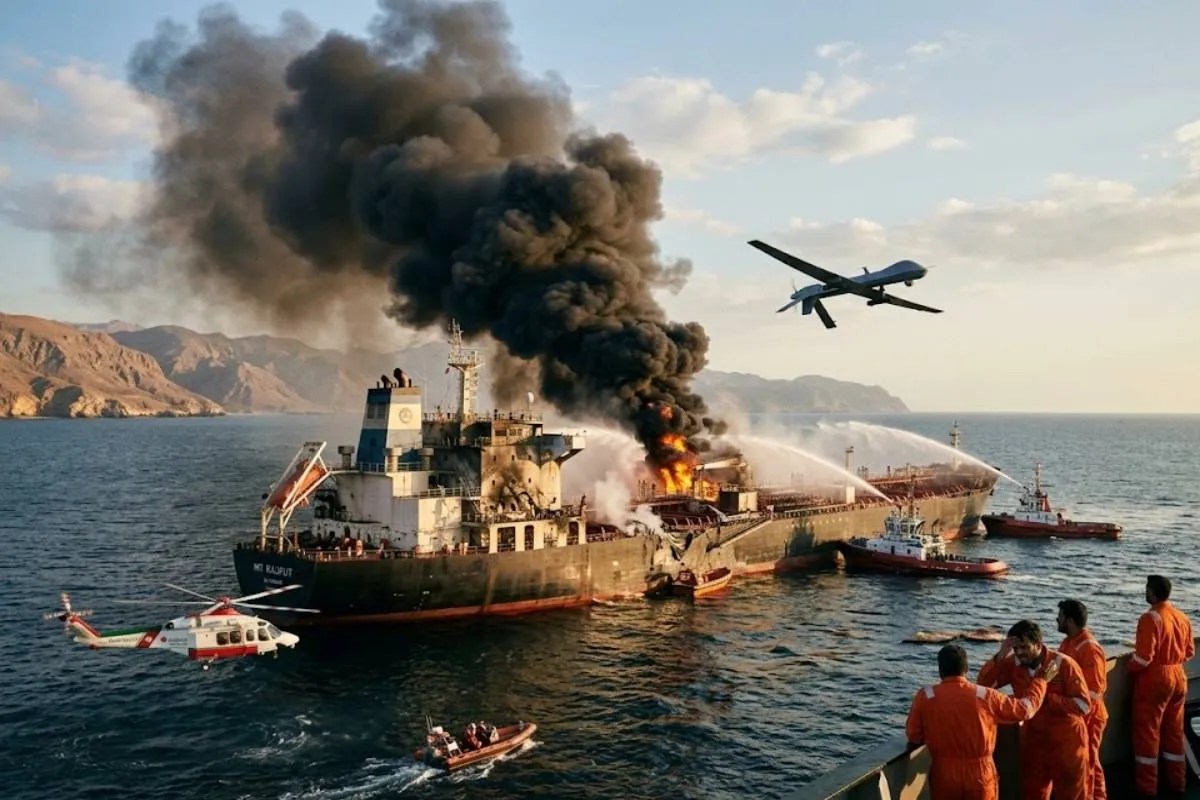
The headlines are bleeding again. Another drone, another tanker, another tragic loss of life—this time an Indian national caught in the crossfire near Oman. The mainstream media is currently recycling its favorite script: "Madman state attacks innocent commercial vessel." They want you to believe this is a localized tragedy, a random act of piracy, or a desperate cry for attention from Tehran.
They are wrong.
If you think this is about a single drone strike, you’re missing the forest for a single charred tree. The "innocent merchant vessel" is a myth. In the current theater of global trade, every hull is a chess piece, and every flag of convenience is a camouflage net. We aren’t seeing the breakdown of global trade; we are seeing its evolution into a permanent, low-intensity kinetic conflict where the boardroom and the battlefield have finally merged.
The Myth of the Neutral Tanker
Mainstream analysts love to talk about "freedom of navigation" as if it’s a natural law like gravity. It isn't. It’s a temporary privilege bought with carrier strike groups and subsidized by the very insurance markets now screaming in agony.
When a tanker associated with Israeli interests—or any geopolitical rival—sails through the Gulf of Oman, it is not a neutral actor. In the eyes of the IRGC (Islamic Revolutionary Guard Corps) and other regional disruptors, that ship is a floating piece of sovereign territory. Targeting it isn't "senseless violence"; it’s a calculated, high-ROI surgical strike on a supply chain.
I have spent years watching logistics giants scramble to reroute assets. They always act surprised. They shouldn't be. If you operate a vessel in a high-tension corridor without acknowledging that your GPS coordinates are a political statement, you aren't a victim. You’re a liability.
The Insurance Shell Game is Rigged
The "People Also Ask" sections of the internet are currently flooded with queries about how this affects oil prices. You're asking the wrong question. Don't look at the price per barrel; look at the War Risk Surcharges.
London’s Joint War Committee doesn't care about the tragedy of a lost life. They care about the math. Every time a drone hits a deck, the premiums for every vessel in the region spike. This is a tax on existence. Iran knows they don't need to sink the entire fleet to win. They just need to make the cost of insurance higher than the profit margin of the cargo.
- Asymmetric Math: A $20,000 loitering munition (the "Shahed" variety) can cause $50 million in damage and $500 million in cumulative insurance hikes across the sector.
- The Math of Attrition: We are seeing the "Uber-ization" of warfare. Cheap, scalable, and impossible to fully defend against without spending billions on AEGIS-level protection for every single tugboat.
The industry response? More "Security Guards." I’ve seen companies waste millions hiring former SBS or SEAL operators to stand on decks with rifles. A rifle does nothing against a drone diving at 180 km/h from the sun. It’s security theater. It’s a comfort blanket for shareholders while the real war is fought in the electromagnetic spectrum.
The "Indian National" Narrative is a Distraction
The media pivots to the death of the Indian crew member because it’s a human interest story that garners clicks in Delhi and Mumbai. It frames the incident as an affront to a specific nation. This is a tactical error in analysis.
The nationality of the crew is a byproduct of the shipping industry’s race to the bottom in labor costs. India, the Philippines, and Ukraine provide the backbone of global maritime labor because they are affordable. The perpetrators of these strikes aren't targeting Indians; they are targeting the system that relies on them. By framing this as a "tragedy for India," we ignore the fact that the entire global labor model for shipping is designed to place "expendable" nationals in the line of fire to protect Western and Middle Eastern capital.
Electronic Warfare is the New Hull
If you want to understand why these strikes are successful, stop looking at the drones and start looking at the bridge. We are operating 20th-century hunks of steel with 21st-century vulnerabilities.
- AIS Spoofing: Vessels are "ghosting"—turning off their Automatic Identification Systems—to avoid detection.
- GPS Jamming: The entire North Arabian Sea is currently an electronic graveyard.
- The Result: Ships are sailing blind, making them more likely to collide or be misidentified.
The industry is obsessed with "Cyber Security" for their databases, yet they leave the steering of a 300,000-ton VLCC (Very Large Crude Carrier) dependent on a signal that can be spoofed by a graduate student with a $500 software-defined radio.
Stop Calling for De-escalation
The most "lazy consensus" take is the call for "increased patrols" and "international condemnation." This is useless.
The Strait of Hormuz and the Gulf of Oman cannot be "policed" in the traditional sense. The geography favors the disruptor. You have a narrow chokepoint flanked by mountainous coastlines perfect for hiding mobile launchers. You could put the entire US Navy in the Gulf, and a drone launched from a civilian fishing dhow would still get through.
The hard truth? This is the new baseline. There is no "going back" to a time of peaceful transit. We are entering an era of Fractionalized Shipping.
Imagine a scenario where trade routes are no longer determined by the shortest distance, but by the "Electronic Shield" capacity of the fleet. We are moving toward a tiered system:
- Tier 1: State-protected convoys with active electronic warfare suites (Extremely expensive).
- Tier 2: The "Dark Fleet"—vessels with obscured ownership, flying flags of convenience, taking massive risks for massive payouts.
- Tier 3: The sacrificial lambs—standard commercial vessels hoping they aren't the next headline.
The "Indian Response" Fallacy
There is a lot of talk about India needing to "send a message." With what? A destroyer? Two? India’s naval presence in the region is significant, but it’s a reactive force. You cannot "message" a drone. You cannot deter an adversary that views your presence as an opportunity for more target practice.
The real power play isn't military; it's logistical. If India wants to protect its citizens, it needs to stop being the world’s leading provider of low-cost maritime labor until the IMO (International Maritime Organization) mandates hard-kill defensive systems on all commercial vessels in high-risk zones. But that would raise costs. And in global trade, a human life is still cheaper than a Close-In Weapon System (CIWS).
The Industrialized Disruption
We need to stop viewing these attacks as "interruptions" to business. They are the business. There is an entire economy built around this instability. Private intelligence firms, specialized insurers, and "security consultants" thrive on these strikes.
The drone strike near Oman wasn't a failure of the system. It was the system functioning exactly as it is currently designed—a high-stakes game of chicken where the crew pays the ultimate price so the oil keeps flowing and the dividends keep clearing.
If you're waiting for "stability" to return to the Gulf, you're going to be waiting forever. Stability is bad for the people selling the solution. The chaos is the product.
Get used to the smoke. It’s the only honest thing in the water.
Quit looking for a "peaceful resolution" that doesn't exist. Start arming the hulls or stop sending the ships. Everything else is just expensive mourning.