The blue light hits Sarah’s face at 4:14 AM. It isn't a fire alarm or a child’s cry that woke her, but a Pavlovian response to a phantom vibration. She reaches out, her thumb finding the smooth, cold surface of her smartphone. Within seconds, she isn't in her bedroom in Manchester anymore. She is standing in the middle of a dust storm in Khartoum. She is sitting in a briefing room in Washington. She is watching the fluctuating price of grain in Chicago.
We used to wait for the world to come to us. We waited for the paper to thud against the door or the evening news anchor to adjust their tie and tell us what kind of day it had been. Now, the world lives in our pockets, breathing, screaming, and evolving in real-time. The BBC News app isn't just a piece of software. It is a digital nervous system. It connects the individual cell—you—to the global body.
The Weight of Every Second
Imagine a newsroom. Not the sanitized, quiet version you see on a television set, but the actual engine room. It is a place of controlled friction. There is a specific kind of silence that happens when a major story breaks—a collective intake of breath before the shouting starts. Reporters on the ground are scrambling for signal, editors are verifying grainy footage, and data analysts are watching the traffic spikes.
When you receive a notification on your phone, you are seeing the result of a thousand micro-decisions. For the user, it’s a banner that disappears with a swipe. For the organization, it’s the culmination of a rigorous, often exhausting process of verification. In an era where a lie can travel halfway around the world before the truth has even put its boots on, that delay—the few minutes it takes to confirm a source—is the most valuable thing the BBC offers. It is the cost of being right.
But why do we look? Why does Sarah, at 4:14 AM, need to know about a legislative shift three thousand miles away?
It’s because information has become our primary survival tool. We are no longer scanning the horizon for predators; we are scanning the headlines for instability. We seek the BBC because it provides a baseline. In a sea of algorithmic noise designed to make us angry, there is a profound, almost primal need for a voice that simply says: "This is what happened. No more, no less."
The Architecture of Your Attention
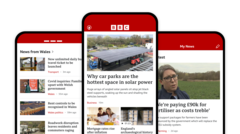
The app itself is a study in invisible design. It doesn't want to trap you in an endless scroll of outrage. If you look closely at the interface, you’ll notice it’s built for efficiency rather than addiction. There are the "Top Stories"—the unavoidable pillars of the day. Then there is "My News," a space where the global becomes personal.
Consider a hypothetical user named David. David is a small-scale coffee roaster. To the rest of the world, a change in climate policy in Brazil is a "world news" bullet point. To David, it’s his mortgage. By filtering the firehose of global events through his specific interests, David isn't just "consuming content." He is performing reconnaissance for his life.
The app uses a vertical stack. It’s a hierarchy of importance that mirrors how the human brain prioritizes threats and opportunities.
- The Breaking News banner: The immediate "now."
- The Top Stories: The context of the "today."
- Video and Analysis: The "why" and the "how."
This structure serves a psychological purpose. It moves the reader from the high-cortisol state of a headline into the slower, more deliberative state of long-form analysis. It’s an attempt to move us from panic to understanding.
The Invisible Reporters
Behind the interface are the people we never see. There is the stringer in a conflict zone who has to climb a hill to get enough bars of service to send a three-paragraph update. There is the translator in London working through the night to ensure a quote hasn't lost its nuance. There are the developers who ensure that even on a low-end device with a shaky 3G connection in a rural village, the app still opens.
Access to information is a form of wealth. For much of human history, the "news" was something that happened to you, not something you could prepare for. The democratization of this data through a free, accessible app is a quiet revolution. It levels the playing field. Whether you are a CEO in a glass tower or a student on a bus, you are looking at the same data points.
This creates a shared reality. In a fractured world, having a common set of facts is the only way we can even begin to have a conversation. Without that shared foundation, we aren't just disagreeing on policy; we are living in different universes.
The Personal Cost of Global Awareness
There is, of course, a burden to this. To carry the world in your pocket is to carry its grief, its chaos, and its relentless pace. We were not evolved to process the tragedies of eight billion people simultaneously.
Sarah feels this. As she scrolls through the app in the dark of her room, she feels a tightness in her chest. A flood in Jakarta. A protest in Paris. A bankruptcy in the city. The sheer scale of it can feel paralyzing.
But then, she finds an "Explainer."
This is where the BBC's approach differs from the "hot take" culture of social media. The Explainer doesn't tell her how to feel. It breaks down the mechanics of the event. It uses maps, charts, and simple prose to strip away the mystery. Knowledge is the antidote to anxiety. When Sarah understands why the flood happened and what is being done about it, the world feels slightly less like a chaotic storm and more like a complex, but navigable, system.
The app also offers "Video Lab" and "Shorts," recognizing that our brains process visual information differently than text. Sometimes, seeing the expression on a survivor's face or the scale of a mountain range tells a story that ten thousand words could never capture. It’s about meeting the human eye where it naturally wanders.
The Pulse of the Machine
Technically, the app is a marvel of compression and distribution. It has to serve millions of simultaneous requests without flickering. When a royal wedding or a major election happens, the load on the servers is equivalent to a digital tsunami.
But for the user, that complexity is masked. It’s just a button.
We often talk about "the media" as if it’s a monolith, a shadowy entity with a singular goal. In reality, it’s a collection of tools. The BBC News app is perhaps the most refined tool in that shed. It doesn't rely on the "engagement" metrics that drive other platforms—the ones that prioritize whatever makes you the angriest. Because it is funded by the public, its "customer" is the truth itself.
This doesn't mean it’s perfect. No human endeavor is. But there is a fundamental difference between an app designed to sell your attention to advertisers and an app designed to provide you with the information you need to be a citizen.
Beyond the Screen
As the sun begins to rise, Sarah puts her phone down. She has been awake for twenty minutes. In 그 time, she has traveled across six continents. She knows about a medical breakthrough in Japan and a diplomatic standoff in the Arctic.
She feels heavier, yes, but she also feels grounded. She isn't guessing about the state of the world; she has seen the receipts. She gets out of bed, ready to face her own small corner of the planet, equipped with the context of everyone else's.
The phone sits on the nightstand, dark now, but still pulse-beating with the rhythm of billions of lives. It is a window, a shield, and a map. It’s the weight of the world, compressed into 180 grams of glass and silicon, waiting for the next vibration to bridge the gap between the individual and the infinite.
The light stays off, but the world is already wide awake.