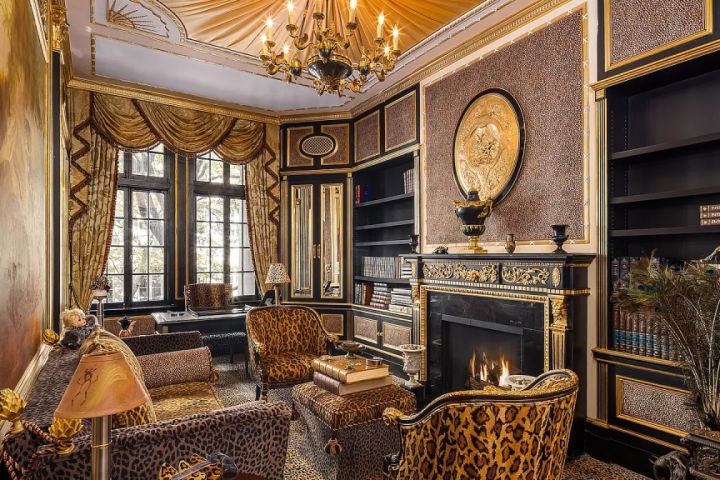
The air inside the limestone townhouse at 10 East 64th Street didn't move like the air outside on the sidewalk of the Upper East Side. It felt heavy, weighted down by the sheer density of gold leaf, red velvet, and the lingering scent of a specific, vanished era of New York power. For two years, this house stood as a silent monument to a woman who refused to be small. It was a 20-foot-wide, five-story vertical palace that the real estate market, in its cold, analytical wisdom, had deemed "unsellable."
Brokers whispered about the "Ivana Tax." It wasn't a literal fee, but a psychological one. To buy the house was to buy a biography. You weren't just purchasing 8,725 square feet of prime Manhattan dirt; you were inheriting a leopard-print library, a gold-veined marble staircase, and a bathroom so pink and mirrored it felt like standing inside a pressurized bottle of vintage Pepto-Bismol.
The Weight of a Golden Legacy
Ivana Trump bought this mansion in 1992 for $2.5 million. It was her first major act of independence following her scorched-earth divorce from Donald Trump. She didn't just decorate it; she fortified it with her personality. Every inch of the property screamed "Versailles via Queens." It featured a grand salon with twenty-foot ceilings, murals of cherubs, and enough gold molding to sink a small yacht.
When she passed away in 2022, the house was thrust onto a market that had moved on. Modern luxury in the 2020s is defined by "quiet luxury"—beige linens, matte oak, and hidden technology. Ivana’s home was loud. It was a scream in a room full of polite whispers. Originally listed for $26.5 million, the price began a slow, painful crawl downward.
Potential buyers would walk through the front doors, look at the crystal chandeliers the size of Volkswagens, and see only one thing: a demolition bill. They saw a "gut renovation." They didn't see a home; they saw a project that would require five years and a small army of contractors to erase the woman who lived there.
The Psychology of the "Unsellable" Home
Why does a property like this sit? It isn’t just the price. In the stratosphere of the ultra-wealthy, $20 million is a rounding error. The real obstacle was the soul of the building.
Imagine a hypothetical buyer: a tech mogul from Palo Alto. He wants a New York pied-à-terre. He values efficiency. He walks into the dining room—the "Versailles Room"—and sees walls covered in gold cloth and floor-to-ceiling mirrors. He feels like an interloper. He feels like he’s wearing someone else's warm coat. There is a profound psychological friction in moving into a space that was so deeply curated to reflect a single, dominant ego.
Real estate is usually sold on the promise of a "blank canvas." Ivana’s house was a finished masterpiece of 1980s maximalism. You couldn't paint over it; you had to kill it.
The market waited. The price dropped to $22.5 million. Then $19.5 million. The narrative shifted from "glamorous estate" to "stubborn relic." Each month it sat, the more the "unsellable" label hardened like drying concrete. People began to wonder if the house was cursed, or if the era of the grand, eccentric New York townhouse was simply dead.
The Pivot Toward the Finish Line
Then, the news broke. A buyer emerged. The "unsellable" palace finally found its match, reportedly closing for around $15 million.
To the casual observer, a $10 million price cut looks like a failure. To a seasoned negotiator, it looks like a correction of reality. The buyer isn't just paying for the bricks; they are paying for the privilege of the location—steps from Central Park—and the sheer volume of the structure.
But consider the invisible stakes for the heirs. Holding a property like this is an expensive burden. Taxes, insurance, and the climate control required to keep decades-old silk wallpaper from peeling cost hundreds of thousands of dollars a year. The sale isn't just a financial transaction; it's an exorcism of responsibility. It allows the Trump children to finally close the door on the physical embodiment of their mother’s public persona.
The Cost of Being Unforgettable
There is a lesson here about the permanence of taste. We spend our lives building environments that make us feel safe, powerful, or seen. Ivana Trump succeeded in that more than perhaps any other socialite of her time. She built a fortress of gold that protected her image as the queen of New York high society.
Yet, the very things that made the house hers are the things that made it a liability. The leopard-print carpets and the gilded moldings were her armor. Once she was gone, the armor was just heavy metal.
The new owner will almost certainly strip the walls. The gold leaf will be scraped away. The pink marble will be replaced by something neutral, something "safe," something that fits the contemporary aesthetic of a world that fears being too much.
The era of the unapologetic, gold-plated mansion is receding into the history books, replaced by a sanitized version of wealth that hides behind glass and grey stone. We are witnessing the end of a certain kind of New York theatricality.
The movers will come. The furniture that hosted decades of gala dinners and high-stakes gossip will be wrapped in plastic and hauled away. The cherubs on the ceiling will be painted over with "Cloud White" or "Swiss Coffee."
Eventually, the 64th Street townhouse will look like every other luxury listing on the internet. It will be beautiful, functional, and utterly devoid of the ghost that made it famous. The "unsellable" house has been sold, but in the process, the last piece of a specific, glittery, messy, and loud New York history is being quietly erased.
The gold is gone. The silence that remains is the most expensive thing in the room.