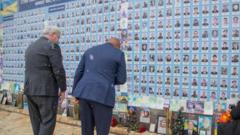
The headlines are predictable, dripping with a mixture of nationalistic grief and moral outrage. "55 Ghanaians killed in Russia-Ukraine war," the Minister says, and the public responds with a collective gasp. We treat these deaths as a tragic anomaly, a freak accident of geography where innocent West Africans were caught in a European meat grinder.
That narrative is a comfortable lie. It’s the "lazy consensus" of a media class that doesn’t want to talk about the global labor market or the failure of domestic economic policy. You might also find this related story interesting: Strategic Asymmetry and the Kinetic Deconstruction of Iranian Integrated Air Defense.
Those 55 men weren't just victims of a stray missile. They were participants in a high-stakes, high-risk economic migration that the Ghanaian government is too embarrassed to define for what it is. We are witnessing the commodification of desperation. If you want to understand why a young man from Kumasi or Accra ends up in a trench in the Donbas, stop looking at maps of Ukraine and start looking at the balance sheets of the Ghanaian youth.
The Mercenary Label is a Distraction
The international community loves the word "mercenary." It carries a specific legal weight under the Geneva Convention, stripping fighters of certain protections. But using it here is intellectually dishonest. As discussed in recent coverage by BBC News, the effects are significant.
Traditional mercenaries are elite, specialized killers-for-hire. The Ghanaians dying on the front lines are often "economic combatants." There is a massive difference between a professional soldier of fortune and a guy who realized his degree in Accra earns him $200 a month while a Russian "security contract" or a Ukrainian "International Legion" spot offers $2,000 to $3,000 plus bonuses.
When the Minister reports these deaths, he focuses on the tragedy. He should be focusing on the arbitrage. The Russian-Ukraine war has created a massive demand for low-cost, high-expendability infantry. In an era of hyper-inflation and devalued currencies, the risk-to-reward ratio of dying in a foreign war starts to look like a rational business decision for some.
The Myth of the "Tricked" Volunteer
There is a persistent story that these men are "tricked" into fighting—promised jobs as security guards or construction workers only to be handed an AK-47. While human trafficking exists and is a scourge, it’s a convenient scapegoat for a much darker reality: many of them knew exactly what they were doing.
They chose the gamble.
In my years analyzing labor trends in emerging markets, I’ve seen this pattern repeatedly. When a state fails to provide a viable path to the middle class, the citizens will find the most volatile shortcuts available. Whether it’s crossing the Sahara, boarding a leaky boat to Lampedusa, or signing a contract with a Russian PMC, the root cause is the same.
To say they were simply "tricked" robs them of their agency and absolves the Ghanaian state of its failure. It’s much easier for a politician to blame "foreign recruiters" than to admit that the local economy is so stifled that a 10% chance of death in a frozen wasteland is more attractive than a 100% chance of poverty at home.
The Geopolitics of Human Capital
Russia and Ukraine are currently conducting the largest A/B test of human endurance in modern history. Russia, in particular, has mastered the art of sourcing "disposable" manpower from the Global South. By offering fast-tracked citizenship and salaries that look like lottery wins in Cedi, they are effectively outsourcing their casualty list.
This isn't just "war." This is a predatory labor acquisition strategy.
- The Russian Side: Offers citizenship and cash to men from Central Asia, Cuba, and Africa.
- The Ukrainian Side: Leverages ideological "freedom" narratives to attract volunteers, though the underlying economic support for foreign fighters is still a major draw.
The 55 deaths reported are likely a floor, not a ceiling. Official government numbers in these scenarios are notoriously lagging. They rely on families reporting missing persons or foreign ministries confirming remains—a logistical nightmare in a high-intensity conflict zone where "Missing in Action" is often a euphemism for "vaporized by an FPV drone."
Why the "Protect Our Citizens" Rhetoric Fails
The Ghanaian government’s response—warning citizens not to go—is the equivalent of telling a starving man not to eat spoiled food. It’s technically correct but practically useless.
If the government actually wanted to stop the flow of bodies to the front lines, they wouldn't issue press releases. They would address the structural unemployment that makes a trench in Bakhmut look like a career move.
We see the same "protect our citizens" theater in the Gulf States' domestic worker crisis. Governments express "concern" while quietly relying on the remittances these workers send back. Every Ghanaian fighting abroad is a potential source of foreign exchange, provided they live long enough to send it home. When they die, they become a diplomatic talking point.
The Cost of the "Neutral" Stance
Ghana, like many African nations, tries to walk a tightrope of non-alignment. This "neutrality" is often just a mask for paralysis. By failing to take a hard stance on the recruitment of its citizens by foreign powers, the state essentially leaves its people to the wolves of the private military market.
Is it a violation of sovereignty when a foreign power recruits your citizens to die in their territorial dispute? Legally, it’s murky. Morally, it’s an indictment of the state's protective capacity.
Stop Asking "Why Did They Go?"
People Also Ask: "How can we stop Ghanaians from joining the war?"
That is the wrong question. It assumes the problem is a lack of information. These men have internet access. They see the videos. They know the risks.
The real question is: "What is the price of a Ghanaian life in the current global order?"
Right now, the market has set that price at roughly $2,500 a month. That is the number we should be talking about. If you want to "fix" this, you have to outbid the war. You have to create an environment where staying alive in Accra is more profitable than dying in Donetsk.
The Brutal Reality of the Aftermath
For every one of the 55 confirmed dead, there are dozens more who will return with PTSD, missing limbs, and no social safety net to catch them. The government isn't prepared for the "veterans" of a war they weren't supposed to be in.
We are importing a trauma debt that will be paid back in the form of social instability for decades. These men are learning modern drone warfare, urban insurgency, and high-intensity combat. Bringing that skill set back to a country with high youth unemployment is a recipe for a domestic security nightmare.
The Ministry’s report is a footnote. The real story is the silent exodus of men who have decided that their own country is a slower death than a Russian bullet.
Address the economy or keep counting the coffins. There is no third option.