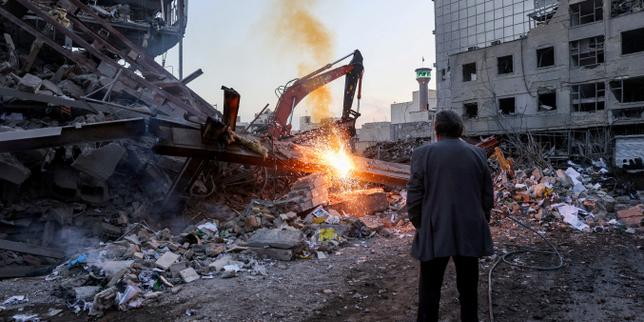
The fourth day of any regional conflict is usually when the fog of war begins to lift, only to reveal a much grimmer reality underneath. While initial reports focused on the immediate borders and the shock of the breach, the situation has now bypassed the phase of a localized skirmish. We are witnessing the deliberate expansion of a multi-front theater where the objective is no longer just tactical advantage, but the total recalibration of power in the Levant. This is not a contained fire. It is a calculated push to see who flinches first in a room full of gasoline.
By now, the standard narrative of "escalation" has become a cliché that hides the actual mechanics of the crisis. To understand why this is happening, we have to look past the troop movements and toward the strategic void that opened years ago. The expansion of this conflict to the northern border and the mobilization of regional proxies are not accidents. They are the result of a specific gamble. Actors in Tehran, Beirut, and beyond are testing the limits of a global order that looks increasingly distracted and fragmented.
The Northern Pressure Valve
The most immediate danger is the shifting gravity toward the north. For decades, the border between Israel and Lebanon has functioned as a high-stakes pressure valve. Everyone knows the rules of the game there, or at least they thought they did. But as of day four, those rules are being shredded. Small-scale mortar exchanges have transitioned into targeted anti-tank missile strikes and drone incursions.
This isn't just about solidarity. It is about strategic overextension. By forcing a massive deployment of reserves to the northern frontier, regional adversaries are pinning down a significant portion of the IDF's combat power. This prevents a singular focus on the southern front and creates a psychological strain on a civilian population already reeling from the events of the weekend.
If Hezbollah decides to fully commit its arsenal—estimated at over 150,000 rockets—the conflict stops being a regional war and becomes a global security crisis. The Mediterranean, once a site of burgeoning energy cooperation, would turn into a dead zone for international shipping and offshore gas extraction. The logic here is brutal. If the status quo is shattered in the south, the north will be used to ensure that no one returns to the old "quiet" without a massive price.
The Intelligence Failure as a Policy Result
Critics are screaming about an intelligence failure. They are right, but they are focusing on the wrong thing. It wasn't just a failure of sensors or human intelligence. It was a failure of conception. The prevailing theory among the political elite for the last decade was that economic incentives could "buy" security. The idea was that by allowing work permits and limited trade, the desire for conflict would be dampened by the need for stability.
That theory is dead.
What the analysts missed was the ideological resilience that outpaces economic pragmatism. When an organization spends years building a subterranean city and perfecting glider-borne infantry tactics, they aren't looking for a better trade deal. They are looking for a historical inflection point. The intelligence apparatus became addicted to high-tech signals and neglected the low-tech reality of a motivated adversary. They watched the screens while the real movement happened in the shadows where the cameras couldn't reach.
The Collapse of the Normalization Dream
For the past three years, the buzz in diplomatic circles was all about the Abraham Accords and the potential for a grand bargain between Israel and Saudi Arabia. This was supposed to be the "New Middle East." It was a vision of high-speed rail, tech hubs, and shared defense against common threats.
As the smoke rises on day four, that vision is on life support.
The timing of this escalation was designed to kill the normalization process. It places the Arab signatories in an impossible position. On one hand, they have invested billions into a future of regional integration. On the other, the images coming out of the conflict zones are radicalizing their domestic populations. No leader in Riyadh or Cairo can ignore the street.
The "New Middle East" depended on the Palestinian issue being sidelined or managed through "shrinking the conflict." That strategy has failed spectacularly. You cannot build a five-star hotel on a fault line and act surprised when an earthquake happens. The geopolitical reality is that any regional architecture that ignores the core friction points is a house of cards.
The Weaponization of Information
We are also seeing the first truly post-truth war in the region. In previous conflicts, there was a delay. Information filtered through news desks and government spokespeople. Now, the battlefield is mapped in real-time on Telegram and X.
- Raw footage is released within minutes to demoralize the enemy.
- Disinformation campaigns are launched to confuse the chain of command.
- Psychological warfare is targeted directly at the families of those involved.
This transparency doesn't lead to more truth. It leads to more chaos. By the time a government issues a clarification, three new narratives have already taken hold. This speed prevents any attempt at de-escalation because the emotional temperature of the public is kept at a permanent boil.
The Logistics of a Prolonged Siege
While the headlines focus on the air strikes, the real story of the coming weeks will be the logistics of the blockade. Gaza is a strip of land roughly the size of Philadelphia, but with two million people trapped inside. When you cut off electricity, fuel, and water to a territory that dense, the timeline for a humanitarian catastrophe is measured in days, not weeks.
The international community is currently in a state of shock, but that will shift. As the water runs out, the pressure on Israel’s allies will become immense. The United States has sent a carrier strike group to the Eastern Mediterranean, a clear signal to Iran and Hezbollah to stay out. But a carrier group cannot provide water or medicine.
The logistical challenge is twofold. First, how does a military conduct a high-intensity urban operation without causing a complete societal collapse in the targeted area? Second, how does the international community provide aid without that aid being diverted? There are no good answers here. Only varying degrees of tragedy.
The Iranian Shadow
You cannot discuss day four without discussing Tehran. While the White House has been cautious about drawing a direct line of command, the fingerprints of Iranian training and funding are all over this operation. This is the Axis of Resistance in full bloom.
For Iran, this is a low-cost, high-reward strategy. They don't have to fire a single shot from their own soil to disrupt the entire US-led security framework in the Middle East. By empowering proxies, they create a ring of fire around their primary regional rival. This forces the West back to the negotiating table from a position of weakness.
The real danger is a miscalculation. If a stray rocket hits a sensitive target, or if a preemptive strike is launched against Hezbollah’s long-range missile sites, the conflict scales into a direct confrontation between regional powers. We are currently closer to that reality than at any point since 1973.
The Role of Domestic Instability
We must also look at the internal state of the actors involved. Israel has spent the last year in a state of near-civil war over judicial reforms. The military was distracted, the reserves were protesting, and the social fabric was frayed.
Adversaries don't ignore that kind of weakness. They exploit it.
The assumption was that "in the moment of truth, we will unite." While that has largely happened on a military level, the political bitterness remains. This war is being fought by a government that many of its own citizens don't trust. That lack of trust creates a brittle leadership. If the ground operation goes sideways, or if casualties mount without a clear "victory," the internal blowback will be more severe than anything seen in the country's history.
The Mirage of the "Surgical Strike"
The myth of the "clean war" is being buried in the rubble. Modern militaries love to talk about precision-guided munitions and surgical strikes. But in the densely packed corridors of Gaza, there is no such thing as a surgical operation. Every strike has a ripple effect.
The use of "roof knocking" and warning shots has largely been abandoned in favor of a much more aggressive doctrine. This shift reflects a change in the Israeli public's appetite for risk. They are no longer interested in "managing" the threat; they want it removed. But removing an embedded paramilitary force from a sympathetic civilian population is a task that has stumped every modern military from the US in Fallujah to the Russians in Grozny.
It requires a level of brutality that inevitably erodes international support. The clock is ticking. Every day the war continues, the moral clarity of the first 24 hours becomes muddied by the grim reality of urban combat.
The Economic Aftershocks
The markets are already beginning to twitch. Oil prices are volatile, not because of a current supply disruption, but because of the threat to the Strait of Hormuz. If Iran feels backed into a corner, they have the capability to shut down one of the world’s most vital energy arteries.
For a global economy already struggling with inflation and the fallout from the war in Ukraine, a Middle Eastern conflagration is the worst-case scenario. We are looking at:
- Increased defense spending across the West, further straining budgets.
- Energy price spikes that could trigger a global recession.
- A refugee crisis that could destabilize the Mediterranean rim.
This is why the diplomatic scramble in Washington and Brussels is so frantic. They aren't just worried about the regional map; they are worried about their own domestic stability.
The Ground Operation Dilemma
The massing of tanks on the border suggests a massive ground invasion is imminent. But a ground war in Gaza is a nightmare. It is a three-dimensional battlefield. There are the streets, the ruined buildings above, and the "Gaza Metro"—the hundreds of miles of tunnels below.
A ground invasion means house-to-house fighting. It means drones, snipers, and IEDs. It means a high body count for both sides. Most importantly, it requires an exit strategy.
If you destroy the governing body of a territory, you are responsible for what comes next. Who takes over? Who cleans the streets and runs the hospitals? History shows that nature abhors a power vacuum, and what fills that vacuum is usually more radical than what preceded it. The military objective of "destroying" an enemy is simple. The political objective of "what happens on day 100" is where most wars are lost.
The expansion of this conflict isn't just about geography. It's about the expansion of the stakes. We have moved from a border dispute to a fundamental question of whether the current regional order can survive. As the casualties mount and the rhetoric hardens, the space for a middle ground is vanishing. The next 48 hours will determine if this remains a brutal war of attrition or if it ignites a fire that the world is not prepared to put out.
Watch the northern border. If the "red line" there is crossed, the map of the Middle East will be redrawn in real-time, and not in a way that anyone in Washington, Riyadh, or Jerusalem will find comfortable.


