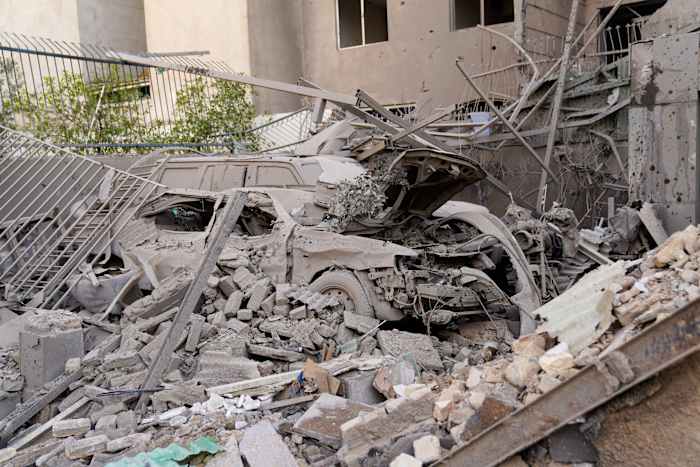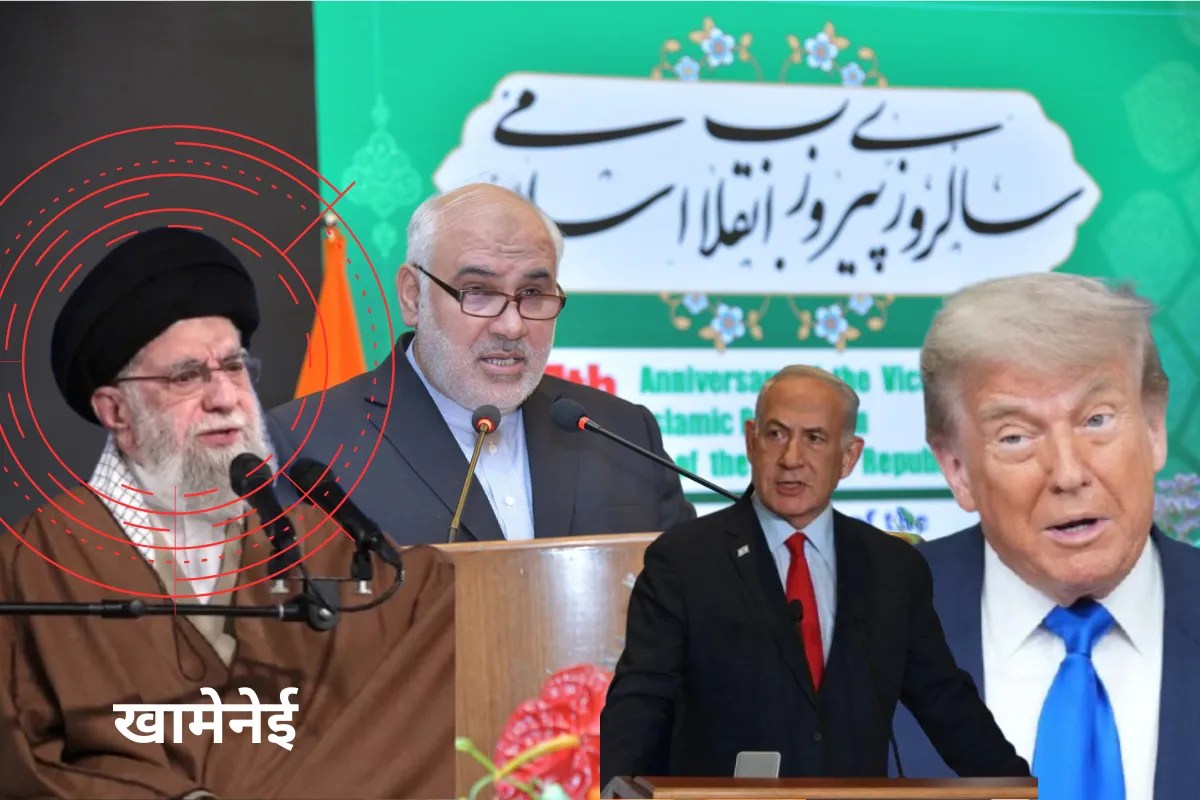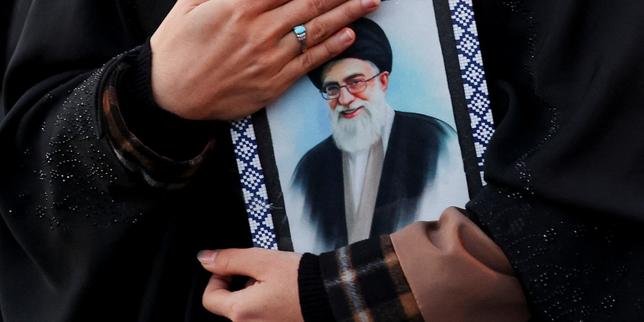
The Middle East has officially crossed the threshold from shadow war to a direct, high-stakes conflagration. Following the reported death of Supreme Leader Ali Khamenei—a figure who anchored the Islamic Republic’s identity for over three decades—Iran has initiated a multi-axis retaliatory strike targeting Israeli infrastructure and maritime assets in the Persian Gulf. This is not the measured, telegraphic signaling we saw in years past. This is a desperate, existential gamble by a regime facing an internal vacuum and external encirclement.
The immediate response from Washington has been visceral. Donald Trump has signaled a policy of "total deterrence," threatening to hit Iranian soil with a level of kinetic power that resets the regional map. The situation is fluid, dangerous, and represents the most significant breakdown of the Westphalian order in the region since the 1979 Revolution. We are no longer discussing "tensions." We are discussing the mechanics of a regional war that could throttle global energy markets and redraw the borders of the Levant. Discover more on a connected topic: this related article.
The Vacuum of Power and the Necessity of Violence
In the rigid hierarchy of the Iranian clerical establishment, the death of the Rahbar (Supreme Leader) is not merely a change in administration. It is a structural failure. Ali Khamenei was the final arbiter between the pragmatic wings of the government and the ideological hardliners of the Islamic Revolutionary Guard Corps (IRGC). Without his stabilizing—if iron-fisted—hand, the IRGC has moved to consolidate power through the only language it speaks fluently: ballistic projection.
The decision to strike Israel and disrupt shipping in the Gulf serves two domestic purposes. First, it preempts any internal dissent or "Velvet Revolution" by placing the country on a permanent war footing. Second, it signals to the "Axis of Resistance"—Hezbollah in Lebanon, the Houthis in Yemen, and various militias in Iraq—that the center still holds. If Tehran remained silent, the entire proxy network would likely fracture. More analysis by Associated Press highlights comparable perspectives on the subject.
The strikes reported involve a mix of Fattah hypersonic missiles and Shahed-series loitering munitions. While Israel’s multi-layered defense system—Arrow 3, David’s Sling, and the Iron Dome—has intercepted a significant percentage of these threats, the sheer volume is designed to saturate the system. The IRGC isn't looking for a "win" in the traditional military sense; they are looking for a breach that proves the "Zionist Entity" is vulnerable.
The Trump Doctrine of Disproportionate Response
The rhetoric coming out of the United States has shifted from the "de-escalation" focus of previous months to a stance of overwhelming retaliation. By threatening "force which has never been seen before," Donald Trump is leaning into a strategy of unpredictability. This isn't just campaign bluster. It is a calculated attempt to restore the "red lines" that Tehran has systematically ignored over the last few years.
However, the "why" behind this specific threat is rooted in the fragility of the global economy. A closed Strait of Hormuz means a global recession. Period. Approximately 20% of the world's liquid petroleum passes through that narrow waterway. If the IRGC succeeds in mining the strait or using anti-ship missiles to sink a major tanker, the price of Brent crude doesn't just go up—it goes vertical.
The American strategy currently rests on two pillars.
- Kinetic Suppression: Using carrier strike groups to neutralize IRGC launch sites before the missiles even leave the rails.
- Economic Decapitation: Total secondary sanctions that prevent even China from providing a financial lifeline to the transition government in Tehran.
The risk is that these "never seen before" threats leave no room for diplomacy. When one side threatens total destruction, the other side often decides they have nothing left to lose. That is where the danger of a nuclear breakout becomes a reality. If the Iranian leadership believes the end is coming, the temptation to rush for a "deterrent of last resort" may become irresistible.
The Proxy Wildcard and the Northern Front
While the world watches the missiles flying from Iranian soil, the real slaughter may happen on Israel’s northern border. Hezbollah remains the most heavily armed non-state actor on the planet. They possess an arsenal of over 150,000 rockets, many of them precision-guided. If the IRGC gives the order for a full-scale ground incursion or a massive rocket barrage from Southern Lebanon, the Israeli Defense Forces (IDF) will be forced to fight a multi-front war that stretches their manpower to the breaking point.
The IDF has already begun mobilizing reserve units and moving heavy armor toward the Blue Line. But a war with Hezbollah is not like a campaign in Gaza. Lebanon’s geography—mountainous, riddled with sophisticated tunnel networks—favors the defender. A ground war there would be a quagmire that could drag on for years, precisely what the IRGC wants to distract from the chaos in Tehran.
The Silent Players in Riyadh and Abu Dhabi
Lost in the headlines of fire and fury are the Gulf monarchies. Saudi Arabia and the United Arab Emirates find themselves in an impossible position. On one hand, they view a nuclear-capable or hyper-aggressive Iran as a permanent threat to their existence. On the other, they know that any American strike launched from bases on their soil will lead to Iranian "counter-value" strikes on their desalination plants and oil refineries.
The "normalization" era of the Abraham Accords is being tested by fire. If the Arab street sees images of American jets taking off from Gulf bases to hit an Islamic nation, the domestic stability of these kingdoms could be at risk. We are seeing a frantic behind-the-scenes diplomatic effort from Riyadh to ensure that any "disproportionate force" used by Trump does not result in the total collapse of regional security.
The Failure of Incrementalism
How did we get here? The brutal truth is that years of incremental diplomacy and half-hearted sanctions failed to address the core of the Iranian military's expansionist ideology. The West treated the Iranian nuclear program as a physics problem to be solved with centrifuges and inspections. In reality, it was always a political problem rooted in the survival of a specific revolutionary cadre.
The death of Khamenei has stripped away the facade of "negotiable" Iranian foreign policy. The IRGC is now the state. There is no longer a "moderate" foreign minister to take calls from European diplomats. The command structure is now purely military and purely ideological.
$$P_{war} = 1 - (D_{ext} \times S_{int})$$
In this simplified model of regional collapse, the probability of war ($P_{war}$) is inversely proportional to the product of external deterrence ($D_{ext}$) and internal stability ($S_{int}$). With Khamenei gone, internal stability has plummeted to near zero. To keep the equation from resulting in total collapse, the United States is attempting to crank the external deterrence to an infinite value. It is a dangerous mathematical gamble with millions of lives in the balance.
The Brink of the Unthinkable
We are now looking at a scenario where the "unthinkable" becomes the baseline. The IRGC has already shown it is willing to hit commercial shipping and launch dozens of drones at civilian centers. If the U.S. follows through on the threat of "unseen force," we are talking about the destruction of the Iranian electrical grid, the sinking of their entire navy, and the potential targeting of leadership bunkers.
This isn't a surgical strike. It's an amputation.
The question remains whether the Iranian military will see this as a reason to back down or a reason to go out in a blaze of "martyrdom" that takes the global economy with it. History suggests that cornered regimes rarely choose the path of quiet submission. They choose the path that ensures their enemies bleed as much as they do.
Watch the oil prices. Watch the movement of the B-2 bombers. The next 72 hours will determine if the 21st century's first great power war begins in the deserts of the Middle East.
Buy gold. Fill your tank. The old world ended with the heartbeat of an 86-year-old man in Tehran.