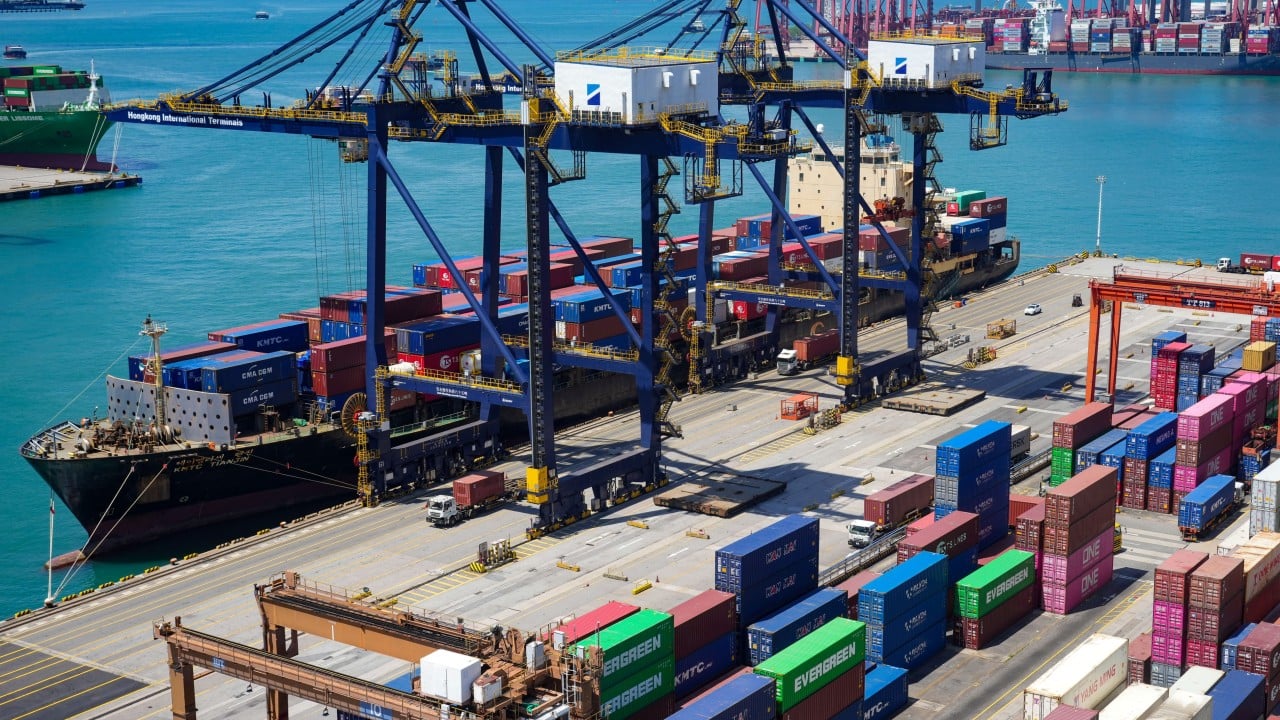
The intersection of Israeli-Iranian kinetic exchange and US-led trade restrictions has created a structural bottleneck for Hong Kong’s re-export economy that traditional risk models fail to capture. While the immediate focus often rests on the volatility of Brent crude or localized supply chain disruptions, the actual threat to Hong Kong’s $500 billion export sector is the compounding effect of increased insurance premiums, logistical rerouting, and the tightening of dual-use technology oversight. This analysis deconstructs the systemic pressures currently squeezing Hong Kong exporters, moving beyond surface-level reporting to examine the mechanics of trade erosion in a high-friction environment.
The Triad of Friction: Shipping, Insurance, and Lead-Time Decay
The escalation of conflict in the Middle East does not merely delay shipments; it fundamentally alters the cost-basis of every unit moved between the Pearl River Delta and the European or Mediterranean markets. We define this through the Triad of Friction, where each variable interacts to compound total landed cost.
- Maritime Insurance Surcharges: In response to drone and missile activity in the Red Sea and surrounding waterways, Joint War Committee (JWC) listed areas have expanded. For a Hong Kong-based SME, this translates to a "War Risk" premium that can fluctuate from 0.05% to 1.0% of the hull value within a 48-hour window. This volatility makes fixed-price contracts for low-margin consumer goods unsustainable.
- The Cape of Good Hope Diversion: Rerouting around Africa adds approximately 10 to 14 days to a standard transit from Hong Kong to Rotterdam. This delay triggers the Inventory Carry Cost Penalty. When goods are in transit longer, capital is locked, interest expenses on trade finance rise, and the "freshness" of seasonal electronics or fashion diminishes.
- Port Congestion Echoes: As vessels arrive out of sequence due to rerouting, transshipment hubs in Singapore and Jebel Ali experience "vessel bunching." For Hong Kong, which relies on high-velocity turnover, this creates a secondary delay in the feeder network that services the Greater Bay Area.
The Bifurcation of Dual-Use Export Controls
While kinetic strikes dominate the headlines, the more insidious threat to Hong Kong’s status is the acceleration of US-led "De-risking" strategies. The conflict in the Middle East provides a catalyst for Western regulators to scrutinize the flow of advanced components through Hong Kong, fearing that these technologies might find their way into Iranian or Russian defense supply chains via third-party intermediaries.
The Mechanism of Restricted Flow
Exporters now face a dual-gate validation process. First, they must comply with the Hong Kong Trade and Industry Department (TID) requirements. Second, they must navigate the expanding "Entity List" managed by the US Bureau of Industry and Security (BIS). The logic of "Guilt by Proximity" now applies to any entity shipping high-end semiconductors, navigational equipment, or specialized chemicals.
The risk for a Hong Kong exhibitor at a global trade show is no longer just finding a buyer; it is the Compliance Liability Burden. If a buyer is flagged three months after a transaction, the exporter risks being blacklisted from the US financial system. This creates a chilling effect where firms preemptively refuse orders from specific jurisdictions, even if those orders are currently legal, to protect long-term access to the USD clearing house.
Exhibitor Erosion and the Loss of Face-to-Face Arbitrage
Trade fairs in Hong Kong have historically functioned as the primary engine for "Trust Discovery." The current geopolitical climate erodes this through two distinct vectors: Physical Risk Perception and Policy Uncertainty.
- The Reliability Discount: International buyers are increasingly applying a "Reliability Discount" to Hong Kong suppliers. If a supplier cannot guarantee a delivery window because their logistics chain is tethered to the Suez Canal or subject to sudden sanctions, the buyer shifts their sourcing to Mexico, Vietnam, or Turkey.
- The Disappearing SME: Small and Medium Enterprises (SMEs) lack the sophisticated hedging instruments required to survive 300% spikes in container rates. At major exhibitions like the HKTDC Electronics Fair, the absence of these players signals a thinning of the supply ecosystem, reducing the overall attractiveness of Hong Kong as a "one-stop shop" for global sourcing.
Operational Constraints in Trade Finance
Trade finance is the lubricant of the Hong Kong economy, yet it is currently facing a Liquidity Contraction Mechanism. Banks are tightening their "Know Your Customer" (KYC) and "Know Your Transaction" (KYT) protocols to an extreme degree.
When an exporter’s shipment is diverted around Africa, the Bill of Lading (BoL) is delayed. Since many trade finance instruments (like Letters of Credit) are triggered by the presentation of these documents, the payment cycle is extended. This creates a working capital gap. For a firm operating on 5% net margins, an additional 15 days of capital lockup can be the difference between solvency and technical default.
Credit Risk in Volatile Corridors
Insurance providers are also becoming more selective. "All Risks" coverage is increasingly subject to exclusions related to state-actor interference or cyber-attacks on maritime infrastructure. This leaves the exporter to bear the Residual Kinetic Risk, which is the portion of potential loss that cannot be economically insured.
The Shift from Just-in-Time to Just-in-Case
The logical response to these pressures is a fundamental shift in the Hong Kong business model. The "Just-in-Time" (JIT) efficiency that defined the last three decades is being replaced by "Just-in-Case" (JIC) redundancy. This shift is not a choice but a survival requirement, and it carries significant costs.
- Buffer Stock Financing: Exporters are now forced to hold larger inventories in overseas warehouses (e.g., in the EU or Dubai) to mitigate transit delays. This increases the cost of warehousing and insurance at the destination.
- Multi-Modal Arbitrage: We are seeing a rise in "Sea-Air" solutions—shipping goods by sea to a stable hub like Dubai and then flying them to Europe. While faster than the Cape of Good Hope route, it increases the carbon footprint and triples the logistics cost per kilogram.
Strategic Pivot: The Middle East as a Market vs. a Throughway
A critical observation missed by generalist analysts is that while the Middle East is a source of transit risk, it is also becoming a primary target for Hong Kong’s "Go South" policy. The HKSAR government is aggressively courting the Gulf Cooperation Council (GCC) to offset the decline in Western trade.
However, this strategy contains a Geopolitical Paradox. To grow trade with the GCC, Hong Kong must align with the region's infrastructure projects. Yet, the closer these ties become, the more scrutiny Hong Kong faces from US regulators concerned about the "leakage" of sensitive technology into the Middle East, which could then be re-exported to sanctioned states.
Quantifying the Strategic Dilemma
- Direct Revenue Growth: High potential in UAE/Saudi infrastructure and fintech.
- Regulatory Friction: High risk of secondary sanctions from the US Department of the Treasury.
- Net Result: A specialized, high-compliance trade corridor that excludes generalist SMEs and favors large, state-aligned conglomerates.
The New Baseline for Global Exporters
The era of "frictionless" trade through Hong Kong is over. In its place is a landscape defined by Strategic Decoupling and Geographical Risk Premiums. Exporters who fail to adapt their pricing models to include the cost of 14-day delays and 200% insurance spikes will see their equity eroded within two fiscal quarters.
To survive, firms must implement a Logistical Diversification Protocol:
- Establish "Mirror Operations" in neutral transshipment hubs outside of the immediate strike zone of Middle Eastern kinetic activity.
- Transition from USD-denominated trade finance to multi-currency facilities where possible to mitigate the risk of sudden US-led financial "de-platforming."
- Embed "Geopolitical Force Majeure" clauses into all supply contracts, specifically defining the closure of the Suez Canal or the expansion of US Entity Lists as triggers for price renegotiation.
The future of Hong Kong’s export economy depends on its ability to transition from a volume-based re-export hub to a high-value, compliance-fortified logistics node. Those who rely on the return of the 2019 status quo are factoring a zero-probability event into their business plans.