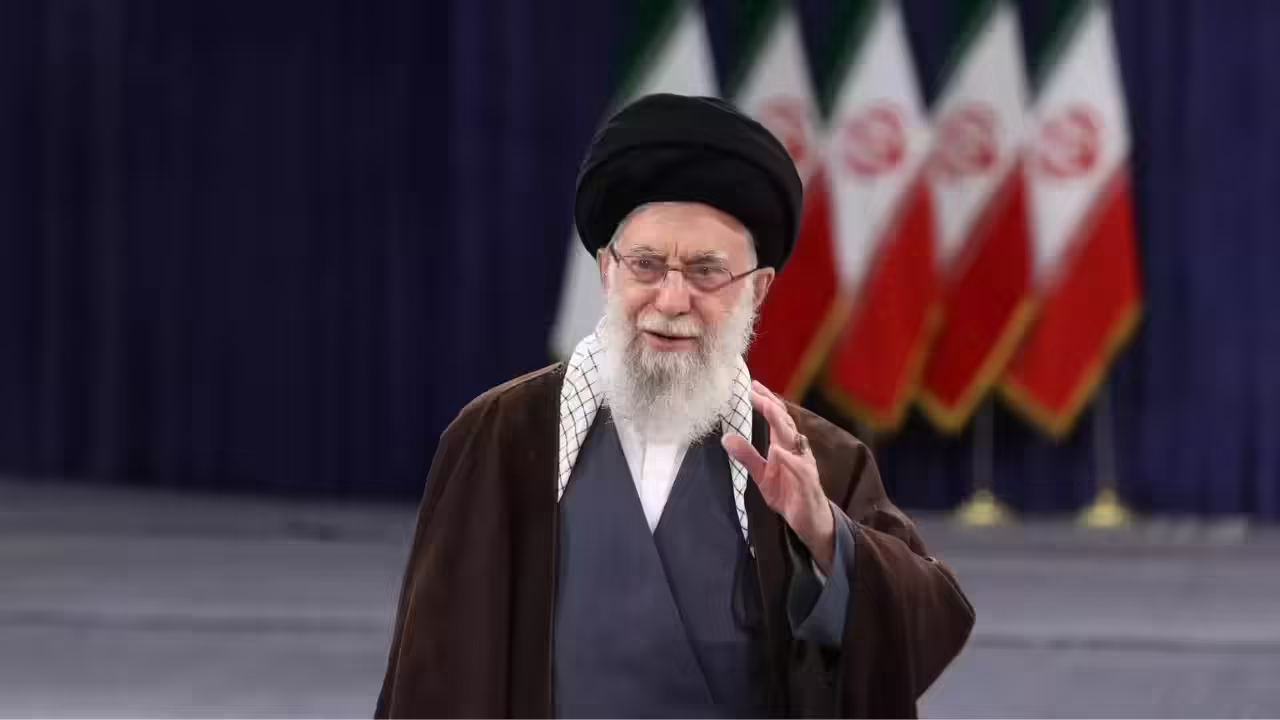
The postponement of Ayatollah Ali Khamenei’s farewell ceremony—a high-stakes transition event—is not merely a scheduling conflict but a calculated response to a multi-front security crisis that threatens the structural continuity of the Islamic Republic. When a revolutionary state faces a leadership transition during a peak kinetic conflict with superior military adversaries, the standard protocols of succession are subsumed by the "Security-Continuity Dilemma." This dilemma posits that the rituals necessary to legitimize a new leader (public gatherings, symbolic transfers of power) are the exact moments of highest vulnerability to external decapitation strikes or internal destabilization.
The Triad of Iranian Strategic Constraints
The current postponement reflects three specific operational bottlenecks that the Iranian leadership must navigate to prevent a systemic collapse.
1. The Decapitation Vulnerability Window
The transition ceremony requires the simultaneous presence of the Assembly of Experts, the Guardian Council, and the high command of the Islamic Revolutionary Guard Corps (IRGC). From a target-acquisition perspective, this creates a "concentration of value" that an adversary like Israel could exploit to achieve total command-and-control erasure. In the context of "Day 5" of an intensifying conflict, the probability of a pre-emptive strike by the Israel Defense Forces (IDF) or U.S. assets increases as Iranian air defense systems are stressed by active engagements.
2. The Signal-to-Noise Ratio in Deterrence
Performing a "farewell" ceremony during an active conflict risks signaling weakness or a "lame duck" status to both domestic proxies and foreign enemies. The Iranian deterrence model relies on the perception of an unwavering, centralized command. An official transition process introduces a period of perceived indecision where the "Red Line" thresholds of the incoming leader are unknown, potentially emboldening the U.S.-Israeli coalition to test those boundaries before the new hierarchy is solidified.
3. Domestic Information Control
A ceremony of this magnitude serves as a lightning rod for civil unrest. In a high-friction environment where resources are diverted to the military, the cost of securing a massive public event against internal subversion—specifically from groups like the Mojahedin-e-Khalq (MEK) or separatist factions—is prohibitively high. The postponement reallocates these security assets to the borders and sensitive nuclear/military sites.
The Kinetic Escalation Ladder: Day 5 Dynamics
The intensification of the conflict on Day 5 follows a predictable escalation ladder where both sides are currently testing the "Threshold of Proportionality." Unlike the scripted exchanges seen in April 2024, the current engagement lacks a predefined "off-ramp."
- Asymmetric Saturation: Iran’s primary tool for managing escalation is the use of the "Axis of Resistance" to create a multi-directional threat environment. By synchronizing strikes from Hezbollah in the North, the Houthis in the Red Sea, and militias in Iraq, Iran attempts to deplete the interceptor inventory (Iron Dome, David’s Sling, and Arrow systems) of the IDF.
- The Intelligence Gap: The postponement suggests that Iranian intelligence has identified a specific credible threat. The mechanics of Israeli intelligence operations often involve "Target Banking," where high-value individuals are monitored for months only to be engaged when they congregate. The Iranian leadership is currently operating under the assumption that their internal communications are compromised, necessitating a "Dark Mode" for top-tier officials.
Structural Risks of the Succession Vacuum
The postponement creates a "Succession Vacuum" that carries specific mathematical risks for the stability of the regime.
The Agency Problem in Proxies
When the supreme leader’s status is in flux, the various proxies (Hezbollah, Hamas, Houthis) face an agency problem. Without a clear, undisputed mandate from Tehran, these groups may begin to act based on local survival instincts rather than the strategic interests of the Iranian state. This leads to "accidental escalation," where a local commander’s decision triggers a full-scale war that the central authority was not yet prepared to fight.
The Economic Cost of Mobilization
The Iranian economy, already constrained by secondary sanctions and a devalued Rial, cannot sustain a "high-alert" status indefinitely. Every day the farewell ceremony is postponed while the military is on high alert, the opportunity cost increases. The diversion of labor and capital to the defense sector accelerates the "Brain Drain" and reduces the state's capacity to subsidize essential goods, which is the primary driver of domestic stability.
Tactical Repercussions of the US-Israel Unified Command
The United States has transitioned from a posture of "restraint enforcement" to "active defense integration" with Israel. This shifts the conflict from a bilateral border skirmish to a regional systemic realignment.
- Electronic Warfare Supremacy: The U.S. provides a "Sensor Fusion" layer that allows Israel to see deep into Iranian territory, negating the advantage of Iran's geography. This makes the physical movement of leadership for a ceremony an act of extreme risk.
- The Interceptor Economics: The U.S. logistical tail ensures that Israel does not run out of interceptors, effectively neutralizing the "saturation" strategy of Iran's missile forces. If Iran cannot overwhelm the defense through volume, their only remaining move is to escalate to "hardened" targets or non-conventional means.
Strategic Playbook for the Next 72 Hours
The immediate priority for the Iranian regime is to re-establish a "Credible Commitment" to the succession without exposing the leadership to kinetic risk. This will likely manifest in a "Distributed Ceremony" model—using digital or secure-link broadcasts rather than a centralized physical gathering.
To regain the strategic initiative, the IRGC must execute a "Disproportionate Non-Kinetic Event." This could involve a significant cyber-attack on regional maritime logistics or the closure of the Strait of Hormuz. However, the closure of the Strait is the "Nuclear Option" of conventional warfare; it would likely trigger an immediate, devastating U.S. conventional response on Iranian soil, bypassing the proxies entirely.
The regime's survival now depends on its ability to decouple the internal transition from the external conflict. If they fail to separate these two tracks, they risk a "Cascading Failure" where a tactical military defeat in the Levant triggers a legitimacy crisis in Tehran that the postponed ceremony was intended to prevent. The current posture of the Iranian leadership indicates they have chosen to prioritize survival over ritual, a move that buys time but signals an unprecedented level of internal anxiety regarding their own security architecture.
Move the succession to a decentralized, clandestine verification process and initiate a limited, verifiable de-escalation through Omani or Qatari intermediaries to secure the domestic transition. Failure to do so by Day 10 of the current kinetic conflict will likely lead to a "Forced Transition" dictated by the internal security apparatus of the IRGC rather than the religious and legal frameworks of the Assembly of Experts.