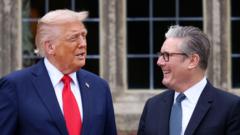
The UK-US relationship has shifted from a partnership defined by shared democratic norms to a high-friction transaction governed by opposing economic and security doctrines. While political commentary often focuses on the personality clash between Keir Starmer and Donald Trump, the true rift lies in the structural incompatibility of their core policy frameworks. This divergence is not a temporary diplomatic chill; it is a fundamental misalignment of two sovereign strategies: the UK’s pursuit of "Securonomics" and the US’s shift toward aggressive protectionist isolationism.
The Trilemma of UK Foreign Policy
The British government currently operates within a strategic trilemma where it must balance three competing requirements: maintaining the "Special Relationship" for intelligence and security, reintegrating economically with the European Union, and upholding a commitment to international law and multilateralism. Trump’s "America First" 2.0 creates a bottleneck for all three.
- Security Dependency: The UK relies on US integration for the AUKUS pact and the Trident nuclear deterrent.
- Trade Vulnerability: The UK’s services-led economy is uniquely exposed to the blanket tariffs proposed by the Trump administration.
- Diplomatic Orthodoxy: Starmer’s legalistic approach to international governance directly contradicts Trump’s preference for bilateral transactionalism.
The Tariff Function and British Economic Exposure
The most immediate point of contention is the economic impact of US protectionism. The Trump administration’s proposed 10% to 20% universal baseline tariff acts as a regressive tax on British exports, particularly in the high-value automotive, pharmaceutical, and scotch whisky sectors.
The economic friction can be modeled through the relationship between tariff height and export volume. For the UK, the "cost of alignment" becomes a calculation of whether to follow US lead on China—potentially losing a massive trade partner—or face US secondary sanctions and tariffs. Starmer’s government has attempted to signal stability to the markets, but the volatility of US executive orders makes long-term industrial planning nearly impossible for British firms.
The UK’s "Securonomics" model—building resilient supply chains with trusted partners—assumes that the US remains the ultimate trusted partner. If the US weaponizes trade against its allies to reduce its own trade deficit, the British strategy loses its primary anchor. This creates an "adjustment gap" where the UK must either pivot more aggressively toward the EU Single Market—a move fraught with domestic political risk—or accept a permanent reduction in GDP growth.
Defense Spending and the NATO Burden-Sharing Equation
A secondary but equally volatile friction point is the 2.5% GDP defense spending target. The Starmer administration has committed to this figure "when fiscal conditions allow," a caveat that the Trump team views as a lack of resolve.
From a data-driven perspective, the US sees the European security architecture through the lens of a "Free Rider" problem. The US contributes roughly 70% of NATO’s total defense spending. Trump’s logic treats NATO not as a values-based alliance but as an insurance policy where premiums must be paid in full. Starmer’s insistence on the "sanctity of the alliance" fails to address the US shift toward the Indo-Pacific.
The divergence in Ukraine strategy further complicates this. The UK has positioned itself as the vanguard of European support for Kyiv. If the Trump administration pursues a "land-for-peace" deal, the UK faces a binary choice:
- Continue supporting Ukraine independently, which is logistically unsustainable without US intelligence and transport.
- Acquiesce to a US-brokered deal, which undermines Starmer’s "rule of law" platform and creates a rift with Eastern European allies.
The Judicial Conflict: International Law vs. Sovereign Will
Starmer’s background as a human rights lawyer isn't just a biographical detail; it is the operating system of his premiership. His government’s recent decisions—such as the Chagos Islands sovereignty transfer and the suspension of certain arms export licenses to Israel—are designed to signal a return to "International Britain."
Trump’s worldview rejects these international legal frameworks as constraints on national power. This creates a specific diplomatic bottleneck regarding the International Criminal Court (ICC). Should the ICC issue warrants that the US rejects but the UK feels legally bound to respect, the diplomatic friction will move from rhetoric to active non-cooperation.
This is not a debate over values; it is a conflict of jurisdictions. The UK views international treaties as the foundation of global stability, while the Trump administration views them as obsolete relics of a globalist era. This "legal friction" prevents the two nations from speaking the same diplomatic language.
The Climate Policy Divergence
The UK has committed to becoming a "Clean Energy Superpower," a goal that requires massive investment in green technology and a rapid phase-out of fossil fuel reliance. In contrast, the US administration’s "Drill, Baby, Drill" mantra and potential second withdrawal from the Paris Agreement create a regulatory chasm.
This creates a "Carbon Border Adjustment" problem. If the UK and EU move toward carbon taxes on imports to protect their decarbonized industries, the US will likely view these as discriminatory trade barriers. The result is a potential trade war triggered by climate policy. The UK's adherence to Net Zero targets makes it a structural outlier compared to a US economy doubling down on hydrocarbons.
The Strategic Pivot: The European Option
The accumulation of these friction points forces a re-evaluation of the UK’s "Global Britain" aspirations. The data suggests that the UK cannot offset the loss of US trade or security guarantees through Commonwealth or CPTPP growth alone. The geographic reality of trade—where distance remains the strongest predictor of volume—means the UK must look to its nearest neighbors.
Starmer’s "reset" with Europe is the only logical hedge against US volatility. However, this reset is limited by the "Red Lines" of the Brexit era—no return to the Single Market or Customs Union. This leaves the UK in a strategic "no-man's land":
- Too integrated with the EU to satisfy the US "America First" requirements.
- Too distant from the EU to enjoy the economic protections of the bloc.
- Too small to act as a third pole in the global economy.
The tension between Starmer and Trump is the outward symptom of this structural entrapment. It is a collision between a leader trying to manage a decline through rules-based stability and a leader trying to disrupt a system he believes is rigged against his country.
Calculating the Probability of De-escalation
A quantitative assessment of the relationship suggests that de-escalation is unlikely in the short term. The incentives for both leaders are domestic. Starmer needs to prove he is not a "vassal" to a populist US president to keep his party's left wing in check. Trump needs to show his base that he can bully even "special" allies into better deals to prove the efficacy of his methods.
The relationship will likely evolve into a "Cold Cooperation" model. Both nations will maintain the Five Eyes intelligence sharing and nuclear cooperation because the cost of decoupling is too high for both. However, on trade, climate, and international law, the UK and US will operate as competitors rather than partners.
The strategic play for the UK is to accelerate the "Defense and Security Pact" with the EU. This provides a fallback mechanism should the US withdraw or significantly scale back its commitment to European security. By deepening ties with France and Germany on industrial defense production and energy security, the UK can reduce its "Trump Risk" without explicitly signaling a break with Washington. This requires a rapid shift from the current incremental approach to a high-velocity diplomatic integration with Brussels, focusing on "low-politics" areas like standards, qualifications, and energy grids that provide the highest economic return with the lowest political friction.