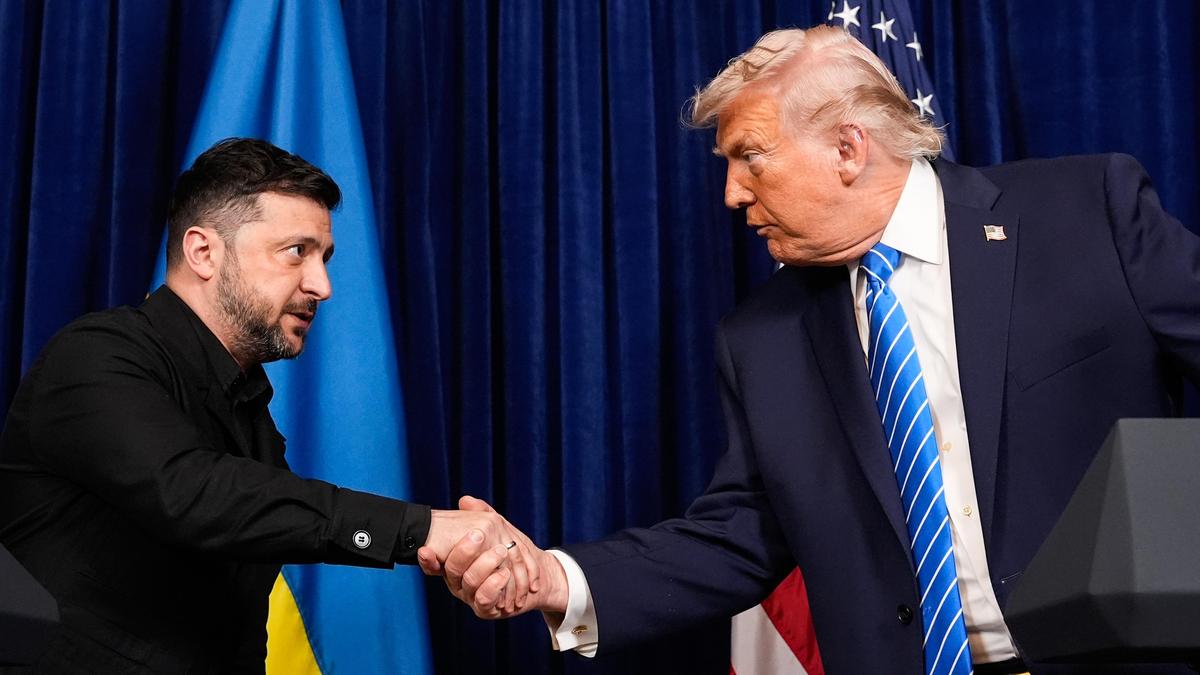
The upcoming dialogue in Geneva between President Donald Trump and President Volodymyr Zelenskyy represents a fundamental shift from ideological alignment to a transactional security framework. This interaction is not merely a diplomatic meeting; it is a high-stakes negotiation where the primary currency is no longer democratic solidarity, but strategic leverage and fiscal sustainability. The success of this summit depends on reconciling the American "America First" retrenchment with the Ukrainian requirement for existential security guarantees.
The Mechanics of the Trump-Zelenskyy Interface
To analyze the potential outcomes of the Geneva talks, we must first deconstruct the underlying incentives of both parties. These incentives are governed by internal political pressures and external military realities.
- The American Fiscal Constraint: The U.S. position is increasingly defined by a cost-benefit analysis of foreign intervention. The primary objective is the mitigation of open-ended financial commitments.
- The Ukrainian Survival Imperative: For Kyiv, the objective is the acquisition of a "Hard Peace"—a state where the cost of further Russian aggression is rendered prohibitive through advanced technological superiority and formal defense structures.
The Three Pillars of the Geneva Negotiation Framework
The discussions in Geneva will likely rotate around three core structural pillars. These pillars form the basis of any sustainable resolution to the conflict.
Pillar I: The Security-Economic Swap
The Trump administration’s approach prioritizes economic revitalization over traditional aid. The logic suggests a transition from grants to loan-based or resource-backed assistance. Ukraine possesses significant deposits of critical minerals—lithium, titanium, and rare earth elements—estimated at trillions of dollars in value. The strategic play involves securing Western investment in these sectors in exchange for the high-end military hardware required to protect them. This creates a self-sustaining security loop: Ukrainian resources fund the American defense industry, which in turn provides the shield for the extraction of those resources.
Pillar II: The Territorial vs. Sovereignty Trade-off
A critical friction point is the distinction between territorial integrity and sovereign independence. Traditional diplomacy emphasizes the restoration of 1991 borders. However, the current military attrition rates and demographic pressures suggest a "Korean Scenario" may be discussed—a cessation of active hostilities along a clarified Line of Control (LoC) without a formal legal recognition of lost territory. The negotiation bottleneck here is the nature of the "Guarantee." If the U.S. withholds NATO membership, it must provide a bilateral equivalent that includes "tripwire" forces or a qualitative military edge (QME) similar to the U.S.-Israel relationship.
Pillar III: The European Burden-Sharing Mandate
The U.S. delegation will likely use the Geneva summit to pivot the primary logistical and financial burden of Ukrainian reconstruction onto the European Union. By establishing a "Geneva Protocol," the U.S. aims to redefine its role as the lead arms provider while designating Europe as the lead financier. This forces a restructuring of European defense spending, effectively ending the era of the "security free-rider."
The Cost Function of Prolonged Conflict
Continuing the war in its current high-intensity state carries specific variables that the Geneva talks aim to solve.
- Human Capital Depletion: Ukraine’s demographic pyramid is inverted. Prolonged mobilization threatens the long-term viability of the Ukrainian state.
- Industrial Base Degradation: Every month of kinetic warfare reduces the capacity for a post-war economic "Marshall Plan" to succeed, as infrastructure damage compounds.
- Political Capital Volatility: In the U.S., the "Ukraine fatigue" metric is a quantifiable variable in legislative voting patterns. The Geneva summit is a preemptive strike against the total cessation of aid by a skeptical Congress.
Strategic Bottlenecks and Failure Points
Despite the structured intent of the summit, several variables could derail the negotiation.
The Kremlin’s Veto Power
Any agreement reached in Geneva is bilateral between the U.S. and Ukraine. Moscow’s refusal to acknowledge a ceasefire, or its demand for a total "demilitarization" of Ukraine, creates a zero-sum game. If the U.S. pushes for a freeze that Russia ignores, the U.S. risks either an escalatory commitment it wants to avoid or a humiliating withdrawal that damages global prestige.
The "Budapest Memory" Problem
Kyiv’s distrust of non-binding security assurances is rooted in the 1994 Budapest Memorandum. For Zelenskyy to accept any deal that involves territorial concessions or a delayed NATO path, the alternative must be legally codified and involve tangible assets—such as advanced air defense systems (Patriot batteries) and long-range strike capabilities (ATACMS) stationed permanently on Ukrainian soil.
Operationalizing the Peace: The Tactical Map
If the summit moves toward a framework agreement, the implementation will follow a specific sequence of "De-escalation Steps":
- Kinetic Freeze: A localized ceasefire to allow for the establishment of a demilitarized zone (DMZ).
- Monitoring Mechanism: The deployment of a non-NATO, perhaps UN or multi-national, peacekeeping force to verify compliance.
- The Reconstruction Fund: The unfreezing of Russian sovereign assets (approximately 300 billion USD) to be used as a primary source for Ukrainian rebuilding, potentially linked to Russian compliance with the freeze.
The Geneva summit is not about ending the war in a vacuum; it is about managing the transition from a kinetic conflict to a frozen one that serves American domestic interests while preserving a pro-Western Ukrainian state. The objective is "Strategic Stability"—a state where neither side can gain significantly more through violence than they can through negotiation.
The immediate tactical move for the Ukrainian delegation is to present a "Victory Plan" that is framed entirely in terms of American industrial gains and European security autonomy. For the U.S. delegation, the move is to secure a commitment from Zelenskyy that allows for a "win" to be declared domestically—specifically, a defined end-date for massive financial outlays. The resulting "Geneva Framework" will likely be a high-tech, fortified armistice rather than a comprehensive peace treaty. This creates a "Fortress Ukraine" that serves as a permanent buffer between the West and Russia, funded by European capital and armed by American industry.


