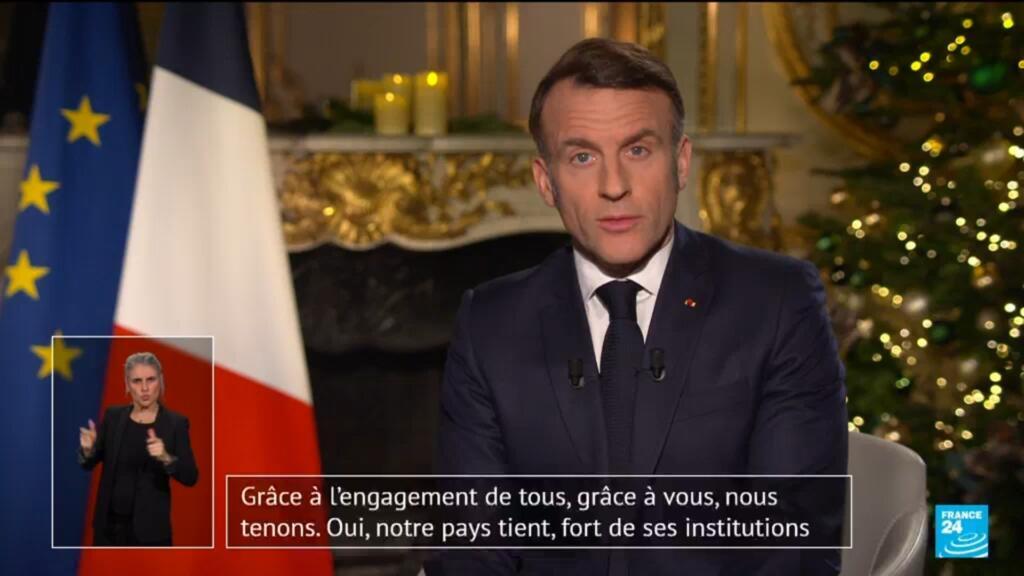
Emmanuel Macron’s 2026 New Year’s address functions as more than a ceremonial tradition; it is a strategic signaling mechanism designed to stabilize French sovereign risk and manage domestic volatility in the penultimate year of his presidency. By dissecting the rhetoric of "unity, strength, and hope," we find a calculated attempt to address three structural deficits: the legislative gridlock in the National Assembly, the erosion of French fiscal credibility within the Eurozone, and the shifting security architecture of Eastern Europe.
The efficacy of this address depends on Macron's ability to convert abstract optimism into a tangible execution roadmap for the remaining sixteen months of his term. This analysis deconstructs the speech through the lenses of political capital expenditure, macroeconomic constraints, and the "Lame Duck" risk profile.
The Tri-Pillar Framework of Presidential Authority
Macron’s appeal to unity is not a moral plea but a tactical necessity for a minority government. The French executive currently operates under a fragmented parliamentary reality where the cost of passing any significant reform is an increasingly expensive negotiation with the center-right and the moderate left.
- Social Cohesion as a Productivity Metric: Macron identifies social fragmentation as a direct threat to the French GDP. Strikes, civil unrest, and legislative obstructionism act as friction in the economic engine. In his view, "unity" is the prerequisite for the labor market flexibility and industrial reshoring projects (France 2030) that define his economic legacy.
- Strategic Autonomy as a Security Hedge: The "strength" referenced in the address pertains to the European Defense Initiative. With the volatility of Atlanticist commitments, Macron is positioning France as the de facto military and diplomatic anchor of the European Union. This involves increasing the defense budget to meet the 3% GDP target—a significant shift from the previous 2% baseline.
- Psychological Calibration: The "hope" pillar serves to counteract the déclinisme—a pervasive French cultural sentiment that the nation’s best days are in the past. By framing 2026 as "fruitful," the Élysée is attempting to stimulate consumer confidence and domestic investment through narrative signaling.
The Fiscal Constraint Function
The primary tension in Macron’s 2026 agenda is the collision between his ambitious social programs and the hard reality of the French debt-to-GDP ratio, which currently hovers near 110%. The European Commission’s stricter enforcement of the Stability and Growth Pact creates a narrow corridor for maneuver.
- The Interest Rate Trap: As the European Central Bank maintains a restrictive or neutral stance to combat persistent service-sector inflation, the cost of servicing French sovereign debt consumes a larger share of the national budget. Macron’s promises of "fruitful" outcomes must be weighed against the mandatory spending cuts required to bring the deficit back toward the 3% target.
- Energy Transition Costs: The 2026 roadmap includes accelerated investment in the EPR2 nuclear reactors and offshore wind. These are capital-intensive, long-horizon projects. The funding mechanism for these—likely a mix of green bonds and private-public partnerships—requires a stable political environment to attract international capital at competitive yields.
- Labor Market Optimization: Macron’s previous reforms (pension and unemployment insurance) were designed to increase the "active" population. In 2026, the focus shifts to the "employment rate of seniors" and vocational training. If these metrics do not improve, the fiscal pressure on the social security system will become unsustainable, regardless of the president's optimistic rhetoric.
Geopolitical Force Projection in a Multi-Polar 2026
The New Year's address signaled a pivot toward a more aggressive European integration strategy. Macron’s logic suggests that French "strength" is no longer possible in isolation. This creates a causal chain where French domestic stability is the currency used to buy European influence.
The "Weimar Triangle" (France, Germany, Poland) has emerged as the primary decision-making hub for continental security. Macron’s 2026 strategy involves:
- Standardizing European defense procurement to reduce reliance on non-EU hardware.
- Pushing for a "European Energy Sovereignty" pact that favors nuclear-heavy grids.
- Advocating for "Digital Protectionism" to allow European tech firms to scale without being acquired by Silicon Valley or Shenzhen-based conglomerates.
This geopolitical ambition is the "strength" Macron referenced. However, it faces a significant bottleneck: the internal political weakness of the German coalition and the rise of populist movements across the continent. Macron is effectively betting that French stability can bridge the gap until the next European election cycle.
The Cost of Political Friction
The address omitted the specific "price" of the proposed unity. In a polarized electorate, the pursuit of center-ground stability often results in the alienation of the fringes. The logic of the Élysée suggests that if the economy grows at a rate of 1.5% or higher in 2026, the populist threat will be neutralized by rising purchasing power.
However, this ignores the "Identity Cost Function." Part of the French electorate perceives Macron’s technocratic efficiency as a threat to local sovereignty and traditional social safety nets. The 2026 strategy must account for this by pivoting from "reform" (which implies pain) to "protection" (which implies security).
Technical Limitations of the Macronist Model
The strategy outlined in the New Year's speech has three primary failure points:
- The Inflationary Tail: If global energy prices spike due to Middle Eastern instability or shipping disruptions, the French state’s "shield" (the bouclier tarifaire) will become too expensive to maintain, leading to a direct hit on household disposable income.
- Parliamentary Paralysis: Without a majority, the government may be forced to use Article 49.3—a constitutional tool that allows the passage of laws without a vote but triggers a motion of no confidence. Excessive use of this tool in 2026 will erode the "unity" Macron is attempting to build.
- The Succession Vacuum: As the 2027 election nears, Macron’s own ministers may begin to prioritize their personal campaigns over the collective 2026 agenda. This "centrifugal force" within the cabinet can lead to policy incoherence.
Strategic Execution for 2026
To achieve the "fruitful" year described, the executive must transition from a strategy of grand gestures to one of surgical administrative wins. This involves:
- Prioritizing the "Green Industry Act": Focusing on tangible job creation in the "Battery Valley" of Northern France to provide a concrete example of the benefits of his industrial policy.
- Decentralization of Power: Offloading certain administrative burdens to regional governments to reduce the "Paris-centric" friction that fuels rural resentment.
- The Mediterranean Pivot: Using the 2026 diplomatic calendar to solidify trade and migration agreements with North African partners, reducing the salience of immigration as a domestic political weapon for the opposition.
The 2026 mandate is not about new ideas; it is about the liquidation of the current political inventory. The success of Macron's presidency will not be judged by the "hope" he inspires, but by the debt-to-GDP trajectory and the employment rate of the 55-64 demographic by December 31st.
Investors and analysts should monitor the spread between French and German 10-year bonds (the OAT-Bund spread) as the primary KPI for Macron’s "unity." A widening spread indicates that the market views the New Year's rhetoric as insufficient to mask the underlying structural risks. Conversely, a tightening spread suggests the "strength" pillar is gaining credibility.
The final strategic move for the Élysée is the conversion of executive orders into permanent institutional frameworks that can survive the 2027 transition. This requires Macron to stop acting as a "Jupiterian" leader and start acting as a "Grand Architect," embedding his reforms into the deep state apparatus so they become the new status quo, regardless of who wins the next election.



