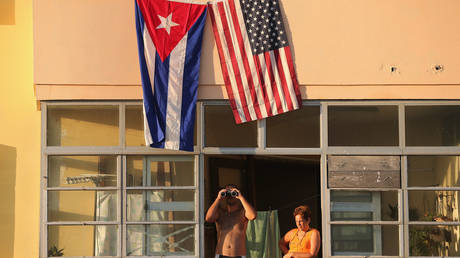
The era of "strategic patience" with Havana just hit a brick wall. On Friday, as he was leaving the White House for a trip to Texas, President Donald Trump dropped a phrase that has sent shockwaves from the Malecon to the halls of the United Nations. He didn't talk about another round of sanctions or a diplomatic cold shoulder. Instead, he suggested a friendly takeover of Cuba.
It’s a classic Trumpian reframe of a 60-year-old stalemate. For decades, we’ve been told that the only options for Cuba were a slow-motion embargo or a sudden, violent regime change. By calling it a "friendly takeover," the administration is signaling something entirely different. They aren't looking for a war. They're looking for a liquidation sale of a failing state.
The Island is Running on Empty
You can't understand this shift without looking at the absolute desperation on the ground in Havana right now. Cuba is broke. Not "struggling" or "in a recession," but fundamentally broken. The government has no money, no oil, and no food.
The catalyst for this collapse wasn't just the long-standing embargo. It was the recent U.S. operation in Venezuela that ousted Nicolás Maduro. For years, Venezuela was Cuba’s life support system, pumping in subsidized crude oil that kept the lights on. Once that tap was turned off in January, the clock started ticking for the Cuban Communist Party.
Without Venezuelan oil, and with the Trump administration threatening massive tariffs on any other country—including Mexico—that tries to fill the void, the island is literally sitting in the dark. Frequent blackouts have crippled what's left of the tourism industry. Airlines have started canceling flights because they can't even guarantee there will be jet fuel to get their planes back in the air.
Negotiating from a Position of Zero
"The Cuban government is talking with us," Trump told reporters. That’s the most significant part of this entire development. For the first time in a long time, the U.S. holds every single card.
The strategy here isn't a military invasion. It’s an economic squeeze designed to force the Cuban leadership to the table to negotiate their own exit or, at the very least, a total surrender of their economic model. Secretary of State Marco Rubio, whose family history makes this mission personal, has been leading these high-level talks.
Rubio isn't just looking for a few political prisoners to be released. He’s pushing for:
- A total expansion of the private sector.
- Access for U.S. companies to take over energy, ports, and telecoms.
- The removal of the military’s grip on the economy (specifically GAESA, the military-run conglomerate).
When Trump says "friendly takeover," think less "Bay of Pigs" and more "corporate acquisition." He’s treating a sovereign nation like a distressed asset.
What Happens to the People
There’s a massive human element to this that goes beyond the geopolitical chess match. Trump pointed out that there are millions of people in the U.S. who were "expelled or worse" from Cuba. These families have spent sixty years waiting for a chance to go back, not just to visit, but to rebuild.
The administration’s bet is that the Cuban diaspora will be the primary engine of this "friendly" transition. If the U.S. can facilitate a deal where American-Cubans can return and reinvest their wealth into a liberated economy, it bypasses the need for a messy, Iraq-style nation-building project.
However, we shouldn't pretend this is a simple path. There are 10 million people on that island currently facing a humanitarian crisis. The U.S. recently authorized some fuel shipments to the private sector specifically to avoid a total famine, but the pressure remains high. The risk is that if the squeeze is too tight, it won't be a "friendly" transition—it'll be a chaotic collapse that sends another massive wave of migrants toward Florida's shores.
The Geopolitical Stakes
This isn't happening in a vacuum. China has spent the last decade building deep ties with Havana. They aren't going to sit back and watch their most important outpost in the Western Hemisphere get "acquired" by Washington without a fight.
But China is far away, and the U.S. Navy is right there. By capturing Maduro and choking off the oil, the Trump administration has essentially blockaded the island without firing a single shot at a Cuban ship. It’s a masterclass in using economic leverage as a primary weapon of statecraft.
Whether this actually results in a peaceful transition remains to be seen. The Cuban leadership, headed by Miguel Díaz-Canel, is still officially vowing to defend their "sovereignty." But sovereignty doesn't mean much when you can't feed your people or keep the power on for more than four hours a day.
If you want to track how this progresses, keep your eyes on the private sector licenses coming out of the Treasury Department. That’s where the real "takeover" will happen—one business deal at a time. Watch for news on U.S. telecommunications firms or energy giants getting special "humanitarian" exemptions to operate on the island. That’s the blueprint for the new Cuba.


