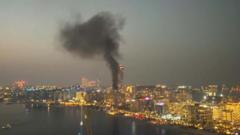
Dubai is currently grappling with a reality that its glossy brochures never anticipated. For years, the emirate has sold itself as a frictionless sanctuary of global capital, a place where the chaotic geopolitics of the Middle East simply stop at the border. That image shattered recently as the city found itself in the crosshairs of regional regional instability, marking a definitive end to the era of guaranteed Emirati isolation. This isn’t just a story about a few intercepted projectiles or a spike in security alerts. It is a fundamental reckoning for a business model built entirely on the assumption of absolute safety. When the "eerie" silence of a city on edge replaces the hum of commerce, the economic consequences are immediate and unforgiving.
The shift happened fast. One day, the focus was on record-breaking real estate transactions and the expansion of the world's busiest international airports. The next, residents were looking at the sky with a new kind of suspicion. While the government remains tight-lipped about specific defensive tallies, the psychological barrier has been breached. The vulnerability of critical infrastructure—desalination plants, power grids, and the logistical arteries of Jebel Ali—is no longer a theoretical exercise for risk analysts. It is a live variable that investors are now forced to price into every contract.
The High Cost of Neutrality
Dubai has long played a sophisticated game of geopolitical balancing. By staying open to everyone—from Western tech giants to sanctioned Russian oligarchs and Chinese state enterprises—it positioned itself as the Switzerland of the sand. However, neutrality is only an asset if you can defend it. As regional tensions boil over, the city's open-door policy has turned into a collection of high-value targets.
The military hardware protecting the Burj Khalifa and the surrounding skyline is among the most sophisticated on earth. Between the US-made Patriot batteries and the THAAD (Terminal High Altitude Area Defense) systems, the physical shield is formidable. But military experts know that no defense is absolute. A "saturation attack," where dozens of low-cost drones or missiles are launched simultaneously to overwhelm sensors, remains the nightmare scenario for any modern metropolis. In Dubai, where a single visible strike on a luxury hotel could trigger a mass exodus of the expatriate workforce, the margin for error is zero.
This isn't just about kinetic warfare. It is about the cost of insurance. In the weeks following the recent escalations, maritime insurance premiums for vessels entering the Gulf have seen significant adjustments. When the cost of moving goods rises, the "Dubai advantage" begins to erode. If the city loses its status as a low-risk hub, it becomes just another expensive desert city with a complicated neighborhood.
The Expat Panic and the Real Estate Bubble
Eighty percent of Dubai’s population is made up of foreign nationals. They are there for the tax-free salaries and the lifestyle, not out of a deep-seated sense of national duty. This makes the social fabric of the city incredibly responsive to perceived danger. If the "eerie" feeling persists, the "flight to safety" won't be into Dubai’s gold markets, but out of the DXB terminals.
We are already seeing a quiet shift in the real estate sector. While the official line remains bullish, secondary market listings have seen a subtle uptick in "motivated" sellers. These are often European or North American families who moved to the Gulf during the pandemic to escape lockdowns and are now questioning if a conflict zone is the best place to raise children.
The mechanism of a Dubai downturn is well-documented from the 2008 financial crisis. It starts with a cooling of sentiment, followed by a sudden drop in liquidity. Because so much of the economy is tied to property and tourism, any dent in the "brand" of Dubai as a safe haven has a compounding effect.
- Tourism: Luxury travel relies on the promise of relaxation. You cannot relax if you are checking news feeds for airspace closures.
- Aviation: Emirates and FlyDubai are the engines of the economy. Any perceived risk to the flight paths over the Gulf would be catastrophic for the bottom line.
- Foreign Investment: Capital is a coward. It flees at the first sign of genuine instability.
Shadow Wars and Digital Defenses
While the world watches the skies for missiles, a much quieter and perhaps more dangerous battle is being fought in the data centers of the DIFC (Dubai International Financial Centre). The city is under constant cyber assault. State-sponsored actors and non-state groups alike view Dubai’s digital infrastructure as a soft underbelly of global finance.
The "attack" isn't always a physical explosion. Sometimes, it is the systematic probing of the banking systems that hold the wealth of the region’s elite. The UAE has invested billions in its Cyber Security Council, but the threat surface is massive. Every "smart" building and automated port terminal is a potential entry point.
The real danger here is the erosion of trust. If a major bank or a government service is successfully breached during a period of kinetic tension, the narrative of "Dubai on edge" moves from a headline to a systemic collapse of confidence. The city-state is effectively a giant tech platform that people live inside of; if the platform feels compromised, the users will log off.
The Regional Leverage Trap
Dubai’s success has always been a source of quiet resentment among some of its neighbors. For years, it has outshone larger, more powerful states by being more nimble and more welcoming. Now, those same neighbors are looking at the current instability as an opportunity to reclaim lost ground.
Riyadh is already pushing hard with "Project HQ," a policy that requires international companies to move their regional headquarters to Saudi Arabia or risk losing government contracts. For a long time, the answer from CEOs was simple: "Dubai is safer and more fun." If the "safer" part of that equation disappears, the "fun" part won't be enough to keep the C-suite in the UAE.
The Emiratis are well aware of this. Their diplomatic efforts have moved into overdrive, attempting to de-escalate regional conflicts that they previously might have ignored or even encouraged. They realize that they are the most "exposed" player in the region. A conflict that might be a manageable nuisance for a large, oil-rich state like Iran or Saudi Arabia is an existential threat to a service-based economy like Dubai.
Hard Infrastructure vs. Soft Perception
There is a fundamental difference between a city that is under attack and a city that feels like it is under attack. Dubai is currently the latter. The actual physical damage from recent events has been minimal to non-existent, thanks to those billion-dollar defense systems. However, the "vibe shift" is undeniable.
Walk through the malls or the marinas, and the conversation has changed. It’s no longer just about the next crypto boom or the newest celebrity chef. It’s about exit strategies and the reliability of the "Golden Visa" if things take a turn for the worse.
The government’s response has been a mix of stoicism and a heavy-handed control of the narrative. In the UAE, spreading "rumors" or negative news can lead to severe legal penalties. While this helps maintain a facade of calm, it also creates an information vacuum. In that vacuum, anxiety grows. People start trusting WhatsApp groups more than official news agencies, which is a recipe for a localized panic.
The Resource Constraint
Dubai’s greatest vulnerability isn't actually its buildings; it’s its lack of natural resources. Every drop of water consumed in the city is desalinated. Every calorie of food is imported. The supply chains that keep the city alive are incredibly efficient but also incredibly fragile.
If a sustained conflict were to disrupt the shipping lanes or the power required to run the desalination plants, the city would become uninhabitable within days. This isn't hyperbole; it is the physical reality of building a mega-city in one of the harshest environments on the planet. The "edge" the city feels is the sudden realization of this dependency.
For the last twenty years, Dubai has lived in a historical anomaly—a period of relative peace and booming globalization. That era is over. The new era is defined by fragmented trade, regional power struggles, and the return of "hard" security concerns.
Pricing the Risk
What we are witnessing is the "normalization of risk" in the Gulf. For a long time, Dubai was treated by the markets as if it were Singapore or London. Now, it is being treated like what it is: a spectacular achievement of engineering and ambition located in the middle of a volatile geopolitical map.
The "eerie" quiet isn't just a mood; it's a warning. The city has spent forty years building a dream. Now, it has to prove that the dream can survive a wake-up call. The next few months will determine if Dubai remains the world’s playground or if it becomes a cautionary tale about the limits of building a global hub on a foundation of precarious peace.
Investors are no longer looking at the height of the next tower. They are looking at the range of the next battery of interceptors and the diplomatic agility of the ruling family. The game has changed from "how much can we build?" to "how much can we protect?"
If you are holding assets in the emirate, the time for blind optimism has passed. The security of your investment is no longer a given; it is a variable that requires constant monitoring. The shield is holding, for now, but the pressure on it is higher than it has ever been in the history of the United Arab Emirates.
Review your contingency plans and ensure your liquidity isn't tied up in "aspirational" projects that rely on a permanent peace.


