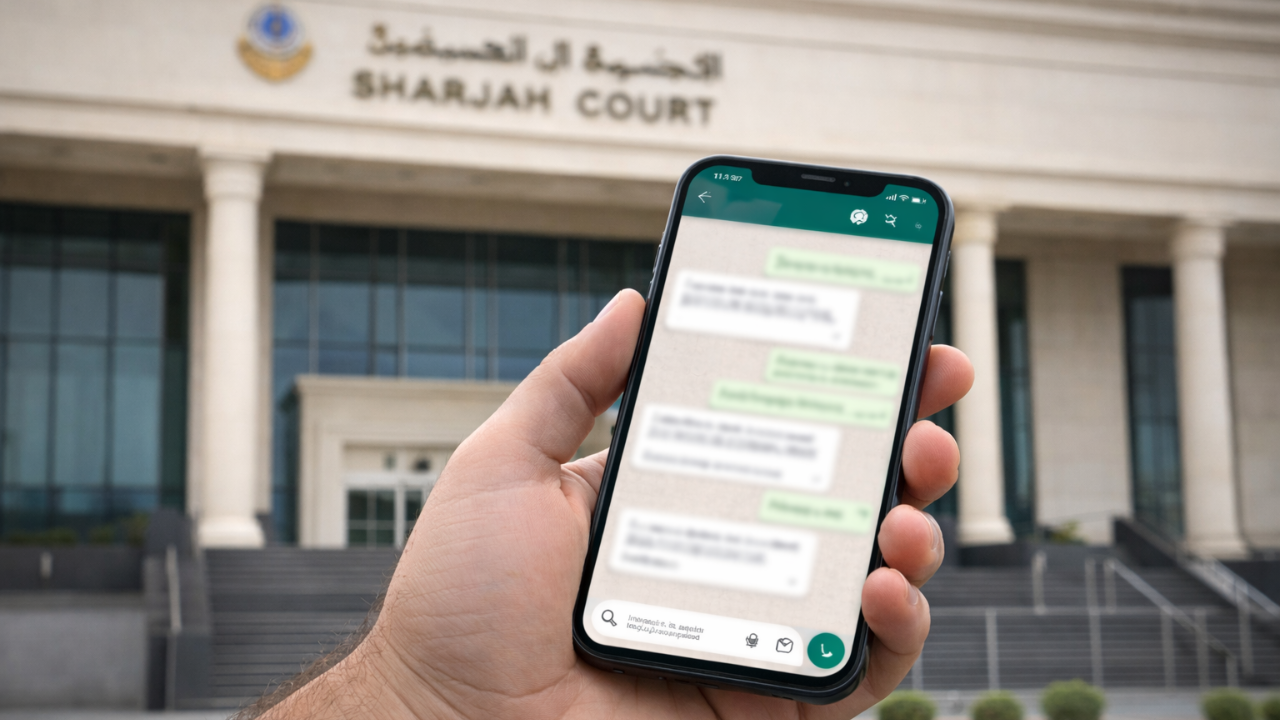
A single slip of the thumb on a glass screen has landed an Arab expatriate in a Sharjah courtroom, facing the grim reality of the United Arab Emirates’ uncompromising cybercrime laws. What the defendant claims was a simple spelling error in a WhatsApp message was interpreted by the recipient—and subsequently the state—as a calculated insult. This case is not an outlier. It is a stark demonstration of how high-definition surveillance and rigid digital speech laws have turned the smartphone into a potential legal liability for millions of residents in the Gulf.
The core of the dispute rests on a nuance of Arabic linguistics and the aggressive interpretation of Federal Decree-Law No. 34 of 2021 on Combatting Rumors and Cybercrimes. Under this framework, the intent behind a message is often secondary to the perception of the victim. If a word can be read as a slur, the burden of proof shifts heavily onto the sender to prove a technical glitch or a lack of malice. In a legal system where digital evidence is king, the "typo defense" is a fragile shield against a prosecution that views electronic communication as a permanent, unambiguous record of one’s character.
The Mechanics of a Digital Crime
In the Sharjah case, the defendant sent a message that contained a term deemed offensive to the recipient. The recipient did not see a mistake; they saw a provocation. They took the phone to the police. In many jurisdictions, this would be a matter for a moderator or a blocked contact list. In the UAE, it becomes a criminal file.
The law is broad by design. Article 43 of the Cybercrime Law specifies that any person who insults another or attributes to them an event that may make them subject to punishment or contempt by others, using an information network or an information technology mechanism, shall be punished by imprisonment and a fine between 250,000 and 500,000 dirhams. At current exchange rates, that is a financial penalty that can exceed $136,000. For the average expatriate worker, this is not just a fine. It is an end to their career and a fast track to deportation.
The legal machinery moves quickly once a complaint is filed. The Public Prosecution examines the digital transcript. They do not look for the "vibe" of the conversation. They look at the literal string of characters. If the string matches a prohibited term, the case moves to the misdemeanor court. The defendant's primary struggle is convincing a judge that their motor skills failed them at the exact moment they hit 'send'.
Why Autocorrect is a Legal Risk
Modern predictive text and autocorrect algorithms are built on probability, not accuracy. They guess what you want to say based on common usage patterns and proximity of keys on a QWERTY or Arabic keyboard. In the Arabic language, where a single "shadda" (diacritic) or a misplaced "nuqta" (dot) can transform a word from a term of endearment into a profound vulgarity, the margin for error is non-existent.
The Linguistic Landmines
Arabic is a root-based language. A three-letter root can branch into dozens of meanings. If a user is typing in a hurry, the proximity of the 'kh' and 'h' sounds or the placement of dots over letters like 'qaf' versus 'f' can result in a word that looks like a slur to a sensitive reader.
Furthermore, many users in the UAE rely on "Arabizi"—a shorthand that uses Latin characters and numbers to represent Arabic sounds. This creates a secondary layer of ambiguity. A "3" instead of an "e" or a "7" instead of an "h" can be misinterpreted by authorities who may not be fluent in the specific slang of a younger generation or a different regional dialect. The court, however, relies on official translators who may take a literal, formalist view of the text, stripped of the casual context of a WhatsApp chat.
The Zero Tolerance Culture
To understand why a typo leads to a courtroom, one must understand the social contract of the UAE. The nation prides itself on "tolerance" and "coexistence," but these concepts are enforced through a strict prohibition on public and private disharmony. Respect is a legally mandated requirement.
This creates a paradox. The more "connected" the society becomes, the more dangerous it becomes to communicate. Every WhatsApp group, every direct message, and every comment on a post is a potential piece of evidence in a future litigation. The UAE’s legal system has essentially outsourced social policing to the citizenry. If you feel offended, the law provides you a mechanism for total scorched-earth retaliation.
Critics of the system argue that this encourages "litigious opportunism." If a business deal goes sour or a personal relationship ends, one party can scour months of chat history looking for a single misplaced word or a heated phrase to use as leverage. In the Sharjah case, whether the recipient truly felt insulted or was simply using the law to settle a score is a question the court rarely entertains. The presence of the word in the digital record is usually sufficient to proceed.
The Cost of Defense
Defending against a cybercrime charge in the UAE is an expensive, grueling process.
- Legal Fees: Top-tier defense lawyers specializing in digital forensics and cyber law charge premium rates.
- Bail and Travel Bans: Once a case is registered, the defendant’s passport is typically confiscated. They cannot leave the country, often losing their jobs in the process as the case winds through the appeals system.
- Expert Testimony: Proving a typo often requires hiring a digital forensics expert to testify that the keyboard layout or the predictive text history of the device supports the claim of an accidental entry.
The psychological toll is equally heavy. The defendant in Sharjah faces the possibility of prison time for something that, in most parts of the world, would be solved with a "sorry, typo" follow-up message. But the UAE’s legal system does not believe in the "oops" factor. It believes in the sanctity of the digital word.
The Shadow of Mass Surveillance
This case also highlights the invisible infrastructure of the Gulf's digital landscape. While WhatsApp claims end-to-end encryption, that encryption is irrelevant the moment one party hands their unlocked phone to a police officer. The UAE has invested heavily in technologies that allow for the rapid extraction and analysis of mobile data.
The "Sigh" or "Al-Ameen" services in various emirates encourage residents to report suspicious or offensive digital behavior. What started as a way to catch terrorists and drug traffickers has bled into the policing of manners. This environment creates a chilling effect. People censor themselves, not just from political dissent, but from casual humor or even heated arguments with friends.
The Technical Reality of Proving Innocence
How does a veteran industry analyst look at this? The technology is failing the user. Developers at Meta (the parent company of WhatsApp) design for global scale, often ignoring the specific legal ramifications their UI/UX choices have in authoritarian or highly conservative legal jurisdictions.
If WhatsApp had a "delete for everyone" feature that truly scrubbed the record, or if it had a more robust "confirm send" option for certain keywords, perhaps these cases would dwindle. But the app is designed for speed. Speed is the enemy of the defendant in Sharjah.
To prove it was a typo, the defense must look at:
- Dwell time: How long did the user spend composing the message?
- Correction history: Does the user’s phone frequently autocorrect that specific word?
- Contextual proximity: Are the keys for the intended word and the offensive word adjacent on the virtual keyboard?
Even with this data, judges in the misdemeanor courts often lack the technical training to weigh digital forensics against a literal interpretation of the statute. They see a bad word; they see a law that forbids bad words; they issue a conviction.
The Reality for Expatriates
For the millions of foreign workers in Sharjah, Dubai, and Abu Dhabi, the lesson is clear. The privacy of your "private messages" is a myth. You are one screenshot away from a criminal record. The legal system is not designed to find the truth of your intent; it is designed to maintain a frictionless, offense-free social surface.
In this environment, a typo is not a mistake. It is a breach of the peace. The Arab man standing before the Sharjah court is a warning to every person who carries a smartphone in the region. If you cannot type with 100% accuracy, you shouldn't type at all.
Check your sent folder before the police do.