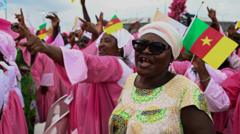
The red dust of Yaoundé has a way of coating everything it touches. On the morning of the open-air Mass, it clung to the Sunday best of hundreds of thousands who had trekked from the edges of the Littoral Province and the grassfields of the Northwest. They didn't come just to see a man in white. They came to witness a geopolitical statement. While the standard press coverage focuses on the sea of colorful umbrellas and the rhythmic swaying of the choir, the real story lies in the friction between an aging papacy and a continent that is no longer content to be the Church’s "spiritual lungs" without having a seat at the head of the table.
Africa is the only region where the Catholic Church is seeing explosive growth. By 2050, one-third of the world’s Catholics will live here. Yet, as the sun beat down on the capital’s central boulevard, the ceremony highlighted a deep-seated tension. The Vatican needs Africa to survive its demographic collapse in Europe, but Africa is increasingly demanding a brand of Catholicism that looks, sounds, and acts like its own culture—not a colonial relic imported from Rome.
The Logistics of Devotion
Organizing a gathering of this magnitude in a city with crumbling infrastructure is a feat of sheer will. The government cleared roads that hadn't seen a paving machine in years. Water stations were set up every fifty yards, though they ran dry before the first reading. Security was suffocating. Gendarmerie in combat gear lined the perimeter, a reminder that in Cameroon, faith and state power are inextricably linked.
The crowd began forming at 3:00 AM. Mothers carried infants wrapped in vibrant wax-print fabrics featuring the Pope’s face. These weren't just religious garments; they were political currency. In Cameroon, appearing pious is often a prerequisite for social mobility. President Paul Biya, one of the world's longest-serving leaders, knows this well. His presence in the front row, flanked by an entourage that cost more to outfit than the local hospital’s annual budget, was a calculated move to borrow the Pope’s moral authority.
The Economics of the Altar
Behind the spiritual fervor sits a massive economic engine. Street vendors did more business in six hours than they usually do in a month. They sold everything from plastic rosaries made in China to "blessed" bottled water and commemorative handkerchiefs.
- Vending Fees: Local authorities charged informal sellers for the "privilege" of setting up near the site.
- Transport Spikes: Bus fares from Douala tripled in the forty-eight hours leading up to the event.
- Hospitality: Every hotel room within a ten-mile radius was booked months in advance, often by government officials and their families.
This isn't just about faith. It’s a temporary stimulus package for a city that struggles with high unemployment. However, once the motorcade leaves and the red dust settles, the wealth generated by the event rarely trickles down to the parishes that need it most.
A Theological Tug of War
The sermon delivered under the scorching sun touched on peace and reconciliation, a necessity in a country fractured by the "Anglophone Crisis" in the western regions. But the crowd’s reaction to certain phrases revealed the deeper divide. When the talk turned to traditional family values, the roar of approval was deafening.
The African Church is arguably more conservative than the Vatican itself on social issues. While parts of the German and American clergy push for liberalization, the bishops in Cameroon and Nigeria are pulling in the opposite direction. They view Western secularism as a new form of ideological colonialism. They aren't interested in a "modernized" faith. They want a muscular, traditional Catholicism that can compete with the rapid rise of Pentecostalism and Islam in the region.
The Competition for Souls
The Catholic Church is losing market share. In every neighborhood in Yaoundé, storefront churches promise immediate miracles and financial prosperity. These "Prophetic" ministries offer a visceral, loud, and immediate spiritual experience that the traditional Latin-influenced Mass struggles to match.
The open-air Mass was an attempt to reclaim the narrative. It was high-production theater designed to show that the "Mother Church" still has the numbers. But numbers without engagement are hollow. The youth in the crowd—and over 60% of Cameroon is under the age of 25—are looking for more than just a glimpse of a passing Popemobile. They are looking for a Church that addresses the crushing lack of jobs and the systemic corruption that keeps their country in a state of arrested development.
The Specter of the Anglophone Crisis
You cannot talk about a mass gathering in Cameroon without talking about the war. For years, the English-speaking regions have been locked in a brutal conflict with the French-speaking central government. Thousands have died. Hundreds of villages have been burned.
The Pope’s visit was marketed as a mission of healing, yet the heavy military presence told a different story. Critics argue that by appearing alongside the administration, the Vatican risks being seen as an endorser of the status quo. The Church has historically been one of the few institutions capable of mediating the conflict, but that bridge is fraying.
During the Mass, there were prayers for peace, but they were carefully worded. In a country where the "anti-terror" laws are used to silence dissent, even the pulpit has its limits. The bishops are in a tight spot. If they speak too forcefully against government abuses, they lose their ability to operate. If they say nothing, they lose the trust of the suffering population in the Northwest and Southwest.
The Architecture of the Event
The physical layout of the Mass reflected the social hierarchy of Cameroon.
- The Inner Circle: Shaded seating for the elite, the diplomats, and the high-ranking clergy.
- The Middle Tier: Parish groups who raised money for months to secure a designated spot.
- The Perimeter: The masses, standing for hours in the sun, separated by steel barricades and armed guards.
This spatial arrangement mirrored the very inequalities the Church claims to oppose. It is a recurring theme in major papal visits to the Global South. The aesthetics of the event are designed for a global television audience, prioritizing a "unified" image over the messy, uncomfortable reality of the people on the edges.
Beyond the Photo Op
The international media will move on by tomorrow. They will publish galleries of smiling children and colorful robes, then forget about Yaoundé until the next disaster or election. But the impact of this day will be measured in the weeks to follow.
Will the Vatican follow up its calls for peace with actual diplomatic pressure on the Biya regime? Will the local archdiocese use the momentum to address the grievances of its English-speaking clergy? Or was this simply a high-priced exercise in branding?
The African Church is no longer a mission territory. It is the center of gravity. If Rome wants to maintain its relevance, it has to stop treating these visits like a royal tour of the colonies. It needs to listen to the anger and the aspiration that bubbles just beneath the surface of the hymns.
The people didn't stand in the heat for eight hours because they love the institution. They stood there because, in a country where the state has failed them and the economy has abandoned them, the Church is the only thing they have left to believe in. That is a heavy responsibility to carry, and a photo op doesn't fulfill it.
As the sun began to set, the crowd started the long walk home. The umbrellas were folded, and the "blessed" water bottles were discarded in the gutters. The red dust was still there, thicker than before. The euphoria of the Mass was already fading, replaced by the grim reality of Monday morning in a city that remains unchanged by the presence of a Pope. Faith might move mountains, but in Cameroon, it hasn't yet moved the needle on justice.
Stop looking at the pictures of the crowd and start looking at the faces of the people walking away.



