The recent infusion of capital into willow management programs at major wetlands reveals a grim reality about modern conservation. While headlines celebrate the "more cash" approach, the math suggests we are barely treading water. Invasive willow species, specifically the Grey Willow (Salix cinerea) and Crack Willow (Salix fragilis), are not just aesthetic nuisances. They are hydrological engines of destruction that can transpire thousands of liters of water daily, effectively choking the life out of the very swamps they inhabit. We are throwing money at a biological wildfire that grows faster than we can cut it down.
To understand why a few extra million dollars is a drop in the bucket, one must look at the mechanics of the invasion. These trees do not just sit in the mud. They transform it. By stabilizing banks and trapping sediment, willows turn open-water habitats into dry land. This process, known as terrestrialization, happens with terrifying speed. Once a wetland is "willowized," the native biodiversity—the rare orchids, the specialized amphibians, the migratory birds—vanishes. What remains is a monoculture that provides little value to the local ecosystem.
The Infrastructure of an Invasion
The problem begins with the sheer resilience of the species. A single willow branch, broken off during a storm or a poorly executed clearing operation, can float downstream, lodge in the mud, and sprout roots within days. It is a vegetative hydra. If you cut it and leave the stump untreated, it returns with five more stems.
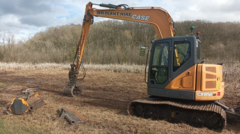
For decades, the standard response has been mechanical removal. Heavy machinery, often operating in sensitive, boggy terrain, attempts to rip the trees out by the roots. The cost of this is astronomical. Moving a twenty-ton excavator into a protected wetland requires specialized matting to prevent the machine from sinking or destroying the peat. You are often looking at thousands of dollars in mobilization costs before a single branch is even snapped.
Then there is the labor. Ground crews must often work in waist-deep water, dealing with dense thickets that are impenetrable to anything but hand tools. When you factor in the health and safety requirements, the environmental permits, and the seasonal windows mandated by bird nesting periods, the actual "work time" is remarkably slim. We are paying for a year of management to get six weeks of action.
The Chemical Compromise
There is a dirty secret in wetland conservation that most press releases gloss over. You cannot win this fight without herbicides. While "green" initiatives prefer to highlight community planting days and wooden boardwalks, the heavy lifting is done with glyphosate and other aquatic-approved chemicals.
The method is surgical but slow. "Drill and fill" or "basal bark" applications involve injecting poison directly into the tree's vascular system. It is effective, but it is a one-by-one battle in a forest of millions. If even a small percentage of the population is missed, the seed rain from those survivors will re-infest the cleared area within three to five seasons.
Environmental groups are caught in a pincer movement. They rely on public support, and the public generally dislikes the use of chemicals in pristine water sources. However, without these tools, the willow wins. The current funding boosts are often eaten up by the increased costs of "low impact" chemical applications and the monitoring required to ensure that runoff doesn't kill the very flora we are trying to save.
Why the Funding Always Falls Short
The cycle of funding is perhaps the greatest ally the willow has. Government grants are typically three-year cycles. This is a fundamental mismatch with biological reality. A wetland needs a thirty-year commitment, not a three-year burst of activity followed by a two-year lapse while the next grant is negotiated.
During those lapses, the willow regains its footing. The seedlings that sprouted the year after the clearing—tiny, innocuous sprigs—become three-meter-tall saplings by the time the next round of funding arrives. We are trapped in a loop of "maintenance" that never actually achieves "eradication."
True progress requires a shift from project-based funding to permanent land-management endowments. Without a dedicated, permanent workforce assigned to these wetlands, the money spent today is essentially a subsidy for a temporary reprieve. We are buying time, not solving the problem.
The Role of Drone Technology and Remote Sensing
If there is a silver lining, it lies in the shift toward high-tech surveillance. Historically, finding willow outbreaks meant sending a ranger out in a kayak or a pair of waders. It was imprecise and left vast tracts of the interior unmonitored.
Modern conservation is finally adopting multispectral drone imagery. By flying over thousands of hectares, managers can identify the specific spectral signature of invasive willows versus native vegetation. This allows for "precision strikes." Instead of clearing a massive area, crews can be sent to the exact coordinates of a new outbreak before it becomes a forest.
- Hypothetical Example: Imagine a 5,000-hectare marsh where a drone identifies three new willow clusters in the center. A crew can be helicoptered in for one day of work, costing $5,000. Without that drone, those clusters go unnoticed for five years, eventually requiring a $500,000 mechanical clearing operation.
Despite this potential, the adoption of technology is hampered by bureaucracy. Many conservation agencies are still operating with decades-old management plans that don't account for autonomous monitoring or targeted aerial spraying. The "more cash" mentioned in the news often goes toward old-school methods because the red tape for new tech is too thick to cut through.
The Water Security Connection
We must stop viewing willow removal as a niche environmental hobby. It is a matter of water security. In regions prone to drought, the water "stolen" by invasive willows can be the difference between a flowing river and a dry bed.
In some catchments, invasive trees can consume more water than the entire local agricultural sector. When you frame it as a resource theft, the urgency changes. The funding shouldn't just come from environmental departments; it should come from water utilities and disaster management agencies. A willow-choked wetland doesn't just dry out; it also fails as a flood mitigation tool. The dense trunks slow down water flow during storms, causing upstream flooding and increased siltation that ruins downstream infrastructure.
The Cost of Inaction
If we decide the cost of management is too high, the price of the alternative is even higher. We lose the "kidneys" of our landscape. Wetlands filter pollutants, sequester carbon at rates that put forests to shame, and provide a buffer against the extremes of a changing climate.
The current strategy of celebratory press releases for modest funding increases is a form of managed decline. It creates the illusion of progress while the physical landscape continues to degrade. We need to stop treating the willow as a weed to be pulled and start treating it as a structural failure of our land management system.
The "more cash" is a start, but without a fundamental change in how we deploy it—prioritizing long-term labor, cutting-edge surveillance, and a realistic acceptance of chemical necessity—the willows will simply wait us out. They have all the time in the world. Our budgets, however, do not.
The next time you see a photo of a politician holding a chainsaw in a swamp, look past the blade. Look at the thousands of seedlings behind them. That is the real debt we are failing to pay.
Shift the focus from the act of clearing to the strategy of prevention. Demand that funding be tied to long-term monitoring rather than one-off "restoration" events. If the goal is a healthy wetland, the measurement of success shouldn't be how many trees were cut, but how many never had the chance to grow.