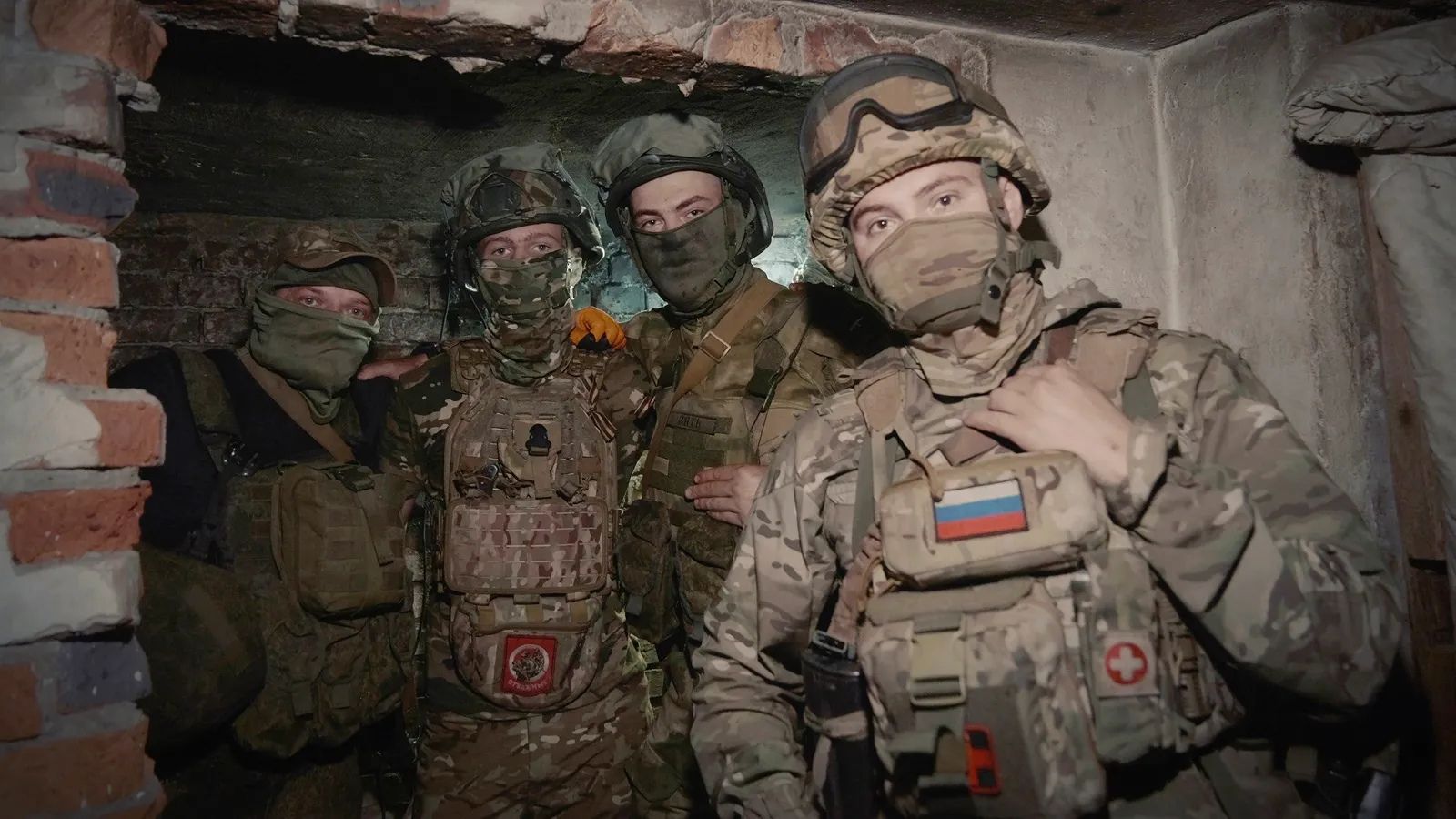
The headlines are predictable. They are comfortable. They feed a specific hunger for a narrative where the Russian military is a disorganized mob held together solely by the threat of a bullet to the back of the head. Reports of "barrier troops" and commanders ordering the execution of their own men make for high-engagement digital fodder, but they miss the cold, mechanical reality of how the Kremlin actually manages its human capital.
If you believe the Russian military machine is sustained primarily by spontaneous firing squads, you are fundamentally misunderstanding the nature of modern attrition warfare. You are looking at a symptom and calling it the cause.
The "lazy consensus" suggests that Vladimir Putin’s army is on the verge of collapse, held back only by the sheer terror of internal execution. This view is not just wrong; it’s dangerous. It leads Western observers to underestimate the systemic, bureaucratic resilience of a force that has transitioned from a professional army to a massive, industrial-scale meat grinder that functions with a terrifying, calculated indifference to life.
The Barrier Troop Trope
Let's address the ghost of Stalin’s Order No. 227. The Western media loves the "Not a Step Back" narrative because it’s cinematic. It evokes Enemy at the Gates. But in the mud of 2026, the Russian military doesn't need a line of machine gunners behind every platoon. They have something much more effective: Disciplinary Battalions (Shtrafbat 2.0) and the absolute weaponization of legal and financial desperation.
When a soldier refuses an order in the modern Russian context, he isn't usually shot on the spot. That’s a waste of a body. Instead, he is processed. He is sent to a "basement"—an illegal detention center—where the goal isn't execution, but "re-education" through physical abuse and psychological breaking. Why? Because a dead soldier provides zero utility. A broken, terrified soldier can still be pointed toward a Ukrainian trench to draw fire, revealing artillery positions.
This isn't "chaos." It’s a resource management strategy.
The Economics of the Meat Wave
The "meat wave" tactic is often described as a sign of incompetence. It’s actually a brutal optimization of low-quality assets. Russia has realized that it can trade three former convicts or "volunteers" with two weeks of training for one high-value Western-supplied munition or a single seasoned Ukrainian defender.
From a spreadsheet perspective, that is a winning trade.
- Cost of a Russian Storm-Z Recruit: Minimal. Sign-on bonuses are high, but payout on death is frequently dodged through bureaucratic "missing in action" labeling.
- Cost of a Javelin Missile: $175,000 to $200,000.
- The Result: Russia uses human beings as cheap kinetic sensors.
When reports surface of commanders "ordering executions," what we are often seeing are the extreme outliers of a system that has already dehumanized its front-line troops to the point where they are functionally indistinguishable from munitions. The execution isn't the policy; the expendability is the policy.
Why the "Collapse" Never Comes
We’ve been hearing about the imminent collapse of Russian morale since the second month of the invasion. Four years later, the line holds. Why? Because the Russian state has successfully decoupled the soldier's survival from the army's success.
For many recruits from the impoverished "inner colonies" of the Russian Federation—Buryatia, Tuva, Dagestan—the military is the only source of upward mobility or debt relief. The state has created an environment where the risk of the front is marginally more "profitable" than the certain misery of home.
You cannot break the morale of a man who never had any to begin with. You cannot induce a mutiny among people who view their own lives as a currency already spent by the state.
The Intelligence Gap
The fixation on "internal executions" serves as a psychological security blanket for the West. If the enemy is so "barbaric" that they shoot their own, then surely they must be weak. Surely they must be close to a 1917-style internal implosion.
This is a projection of Western values onto a system that doesn't share them. In the Russian military tradition, suffering is not a bug; it is a feature. The ability to endure higher levels of pain, loss, and internal cruelty than the opponent is viewed as a strategic advantage.
I’ve seen analysts track "desertion rates" as a proxy for failure. But look at the data: Russia has simply scaled its recruitment to outpace its attrition. It’s a simple equation of $R > A$. As long as the rate of replacement ($R$) exceeds the rate of loss ($A$), the "barbarism" of the commanders is irrelevant to the outcome on the map.
The Myth of the "Innocent" Russian Soldier
There is a recurring narrative that the average Russian soldier is a victim of his commanders. While the "execution" reports bolster this, they also obscure the agency involved. Many of these troops are not "forced" in the way we imagine. They are incentivized, then trapped.
By framing every Russian soldier as a victim waiting for a commander's bullet, we ignore the reality of the small-unit cohesion that does exist—often built on shared atrocities and the "bonding" of the "meat wave." This isn't an army of unwilling slaves; it's an army of the desperate and the radicalized, managed by a state that views human life as a replenishable raw material, like oil or iron ore.
The Tactical Utility of Fear
Fear isn't just about stopping retreats. It’s about ensuring that the next wave goes in. When a Storm-Z unit sees what happens to those who hesitate, they don't necessarily rebel. They focus on the only path forward. In their minds, the Ukrainian trench is a gamble, but the Russian commander is a certainty.
It is a perverse form of "focusing the mind."
When we analyze the reports of executions, we should stop looking for signs of a failing military. We should start looking at them as the maintenance of a high-pressure system. If you increase the pressure at the front, you must increase the pressure at the back to keep the flow moving. It’s fluid dynamics applied to human meat.
Stop Asking if They Are Executing Their Own
The question isn't whether Russian commanders are shooting their men. They are. The question is why we think that matters to the Russian state's ability to wage war.
The Western obsession with "human rights" within the Russian army is a category error. You are applying the rules of a luxury-brand military to a discount-bin slaughterhouse. Russia isn't trying to build a professional, motivated force that values individual initiative. They are building a tidal wave of "good enough."
If ten men are shot to ensure ten thousand keep moving forward, the Kremlin considers that a bargain.
We need to stop waiting for the Russian army to "wake up" or "realize" how badly they are being treated. They know. They simply don't have a seat at the table where that knowledge matters. The machine is designed to function with broken parts.
Stop looking for the collapse in the headlines. Look at the industrial output and the recruitment quotas. The cruelty isn't a sign of weakness; it's the lubricant for the entire engine.
If you want to defeat this, you don't do it by pointing out that they are "mean" to their soldiers. You do it by making the cost of the "meat wave" higher than the state's ability to recruit. Until the math changes, the executions—and the war—will continue.
Forget the moral outrage. Start counting the shells.