The financial press is currently patting Etsy on the back for its acquisition of Depop, citing a "pop" in stock price as if a momentary green candle on a chart equates to a coherent long-term strategy. They are looking at the wrong numbers. They see a strategic expansion into Gen Z demographics; I see a desperate, expensive attempt to buy the relevance Etsy accidentally traded away for mass-market margins.
Market analysts love a good acquisition story because it’s easier to model a merger than it is to admit a core product is rotting. The narrative is simple: Etsy’s revenue and Gross Merchandise Sales (GMS) missed the mark, so they bought a trendy competitor to fill the gap. But if you think this is about "synergy," you’ve been reading too many investor relations slide decks.
This isn't a victory lap. It’s a confession of failure.
The Handmade Lie
Etsy built its empire on the promise of "Keep Commerce Human." It was the anti-Amazon. It was the place for the artisan, the woodworker, and the vintage collector. Today, a five-minute scroll through the front page reveals a flood of mass-produced plastic junk, drop-shipped trinkets from Alibaba, and "handmade" items that are actually churned out in factories in Shenzhen.
When a platform loses its moat—which for Etsy was authenticity—it has two choices: fix the product or buy a new audience. Etsy chose the latter.
The acquisition of Depop for $1.62 billion isn't an expansion; it’s a hedge against their own identity crisis. They aren't integrating Depop to make Etsy better. They are buying Depop because they know the "Etsy" brand is increasingly synonymous with "Amazon-lite with longer shipping times."
Why the Depop Deal is a Toxic Band-Aid
The consensus is that Depop gives Etsy a foothold with Gen Z. That’s a lazy take. Gen Z doesn’t shop on Depop because it’s a marketplace; they shop there because it’s a social network that happens to have a checkout button.
Etsy’s management thinks they can apply their "scaling expertise" to Depop’s community-driven model. This is the same management that hiked seller fees by 30% in 2022, sparking a massive seller strike. They are quantitative optimizers. Depop is a qualitative ecosystem. When the optimizers move in, the cool kids move out.
Imagine a scenario where a major corporation buys a local underground dive bar. They "optimize" the menu, clean the bathrooms, and double the price of beer to meet quarterly targets. The revenue might go up for two quarters because of the brand name, but the regulars—the people who gave the bar its value—are already at the new spot down the street.
Etsy is the corporation. Depop is the dive bar. The regulars are already looking for the exit.
The Revenue Miss is the Only Real Data Point
Wall Street ignored the disappointing revenue and GMS because the Depop news was "exciting." This is a classic distraction technique.
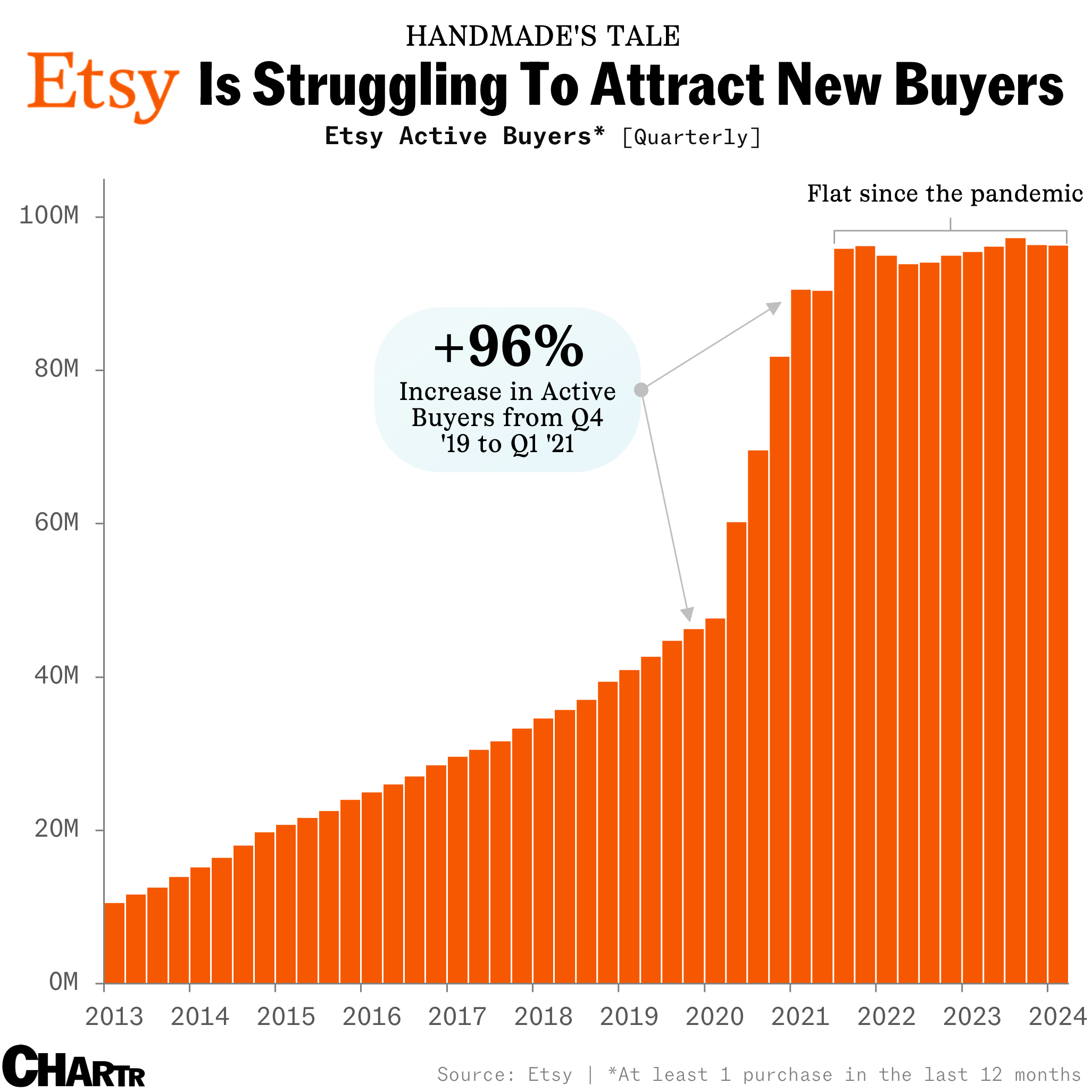
Let's look at the mechanics of why Etsy’s internal numbers are flagging. Marketplace growth is slowing because the value proposition to the seller has vanished.
- Ad-jacking: Etsy forces successful sellers into an "Offsite Ads" program. If Etsy’s algorithm decides to show your product on Google and someone buys it, Etsy takes an extra 12-15% cut. You can’t opt-out if you make over $10,000 a year.
- Search Sabotage: The search algorithm no longer prioritizes quality or relevance; it prioritizes "Star Sellers" and those who spend the most on internal ads.
- Fee Creep: Between transaction fees, payment processing fees, and mandatory advertising, many sellers are losing 20-30% of their gross to the platform before they even buy a shipping label.
When you squeeze your supply side this hard, the quality of goods inevitably drops. Skilled artisans leave because they can't maintain margins. They are replaced by drop-shippers who have 90% margins on garbage. This leads to a worse buyer experience, which leads to... disappointing revenue and merchandise sales.
Buying Depop doesn't fix this feedback loop. It just gives Etsy a fresh crop of sellers to squeeze until they, too, burn out.
The Gen Z Mirage
The "People Also Ask" sections of the web are filled with queries like "Is Depop safe?" and "Is Etsy still for handmade items?" The answer to both is increasingly "No."
The market assumes Gen Z loyalty is transferable. It isn’t. This demographic is the most brand-cynical in history. They use Depop for the aesthetic and the peer-to-peer connection. As soon as Etsy starts implementing "Standardized Shipping Policies" and "AI-driven search optimization" on Depop, the platform will lose the grit that made it valuable.
I’ve seen this play out a dozen times. A legacy player buys a disruptor, tries to "professionalize" the chaos, and ends up killing the very thing they paid a premium for. eBay did it with Skype. Yahoo did it with Tumblr. Etsy is doing it with Depop.
The Counter-Intuitive Truth
If Etsy actually wanted to save its stock price and its future, it shouldn't be spending billions on acquisitions. It should be spending millions on human moderation.
The most radical thing Etsy could do right now is delete 40% of its listings.
- Purge the Drop-shippers: If it’s on AliExpress, it shouldn't be on Etsy. Period.
- Cap Marketing Fees: Give sellers a predictable cost of business.
- Human Curation: Return to a front page that isn't determined by an ad-spend algorithm.
This would cause revenue to crater in the short term. The "disappointing revenue" the press mentioned would look like a dream compared to the hit they’d take. But it would rebuild the moat. It would make "Etsy" mean something again.
Instead, they are chasing growth through inorganic expansion. They are a shark that has to keep swimming or die, but they’ve forgotten how to hunt, so they’re just swallowing smaller fish. Eventually, there are no fish left.
The Math of Desperation
Let’s talk about the $1.62 billion price tag. That’s a massive multiple for a company that was not yet profitable at the time of the deal. Etsy paid for the feeling of growth because their own organic growth engine has stalled out.
When a company misses on its core KPIs (Key Performance Indicators) and immediately announces a flashy acquisition, that isn't "strategic pivot." It's "damage control." They are using the Depop deal to distract shareholders from the fact that the "Handmade" experiment is over. Etsy is now a logistics and advertising company that happens to sell crafts.
Stop Buying the Hype
Investors are cheering because they see a larger total addressable market (TAM). They see more users. They see "synergy."
I see a platform that has lost its way, trying to buy its youth back with a billion-dollar midlife crisis. You can't scale authenticity. You can't automate "cool." And you certainly can't fix a broken core business by bolting a trendier one onto the side of it.
The "pop" in stock price is the sound of a bubble getting thinner.
If you’re a seller, diversify your platforms now. If you’re an investor, look past the Depop glitter at the dull, declining numbers of the mother ship. The Etsy you knew is gone, and no amount of Gen Z resale clout is going to bring it back.
Get out before the "optimization" begins.