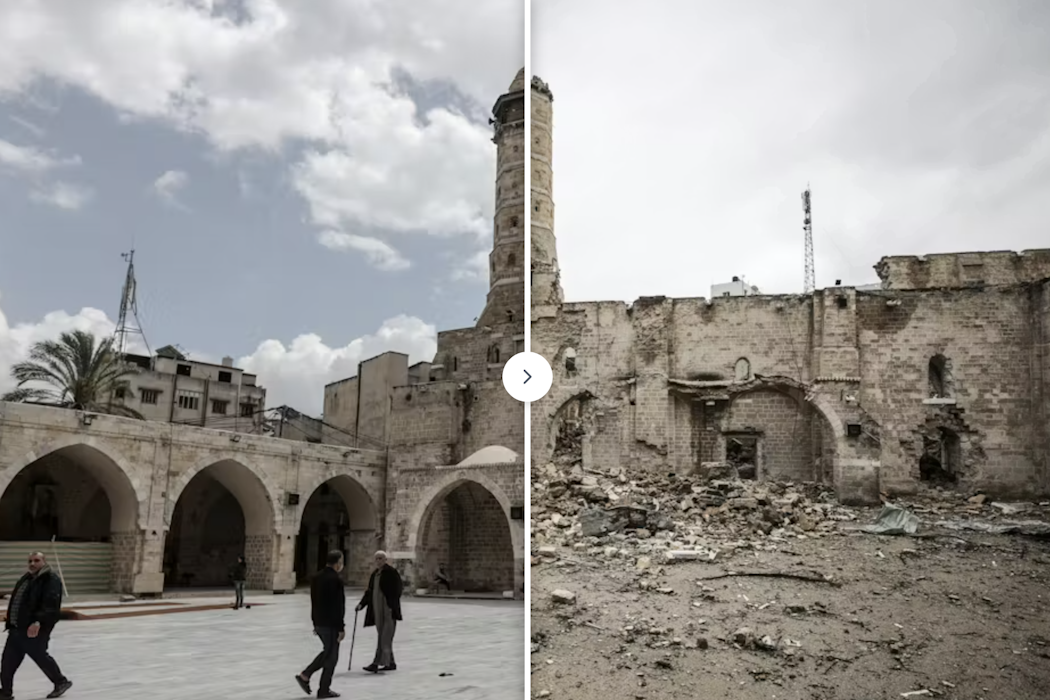
When a stone falls in Gaza City, it doesn't just displace dust. It displaces centuries.
Consider the Great Omari Mosque. For generations, it was more than a place of worship; it was a living architectural diary. It began its life as a Byzantine church, which itself was built atop the ruins of a Philistine temple. When the Islamic conquest arrived, it became a mosque. When the Crusaders marched through, they turned it back into a cathedral. Then, finally, it returned to its life as a mosque.
To walk through its courtyard was to touch the physical layers of human history. You could see the transition of empires in the way a column was carved or the specific geometry of a vaulted ceiling. It was a tangible proof of endurance.
Now, it is a graveyard of limestone.
We often talk about war in terms of the "human cost." We count the dead. We count the displaced. These numbers are visceral and staggering. But there is another kind of death occurring—a slower, quieter erasure that targets not the people, but the very idea of them. When you destroy a library, a museum, or a 1,400-year-old mosque, you aren't just breaking rocks. You are deleting the evidence that a culture ever existed.
The Architecture of Belonging
Imagine a young woman named Amal. She is a fictional composite of the students I’ve spoken with, but her grief is entirely real. Amal didn't visit the Al-Qarara Cultural Museum to study archaeology for a grade. She went there because her grandfather’s farming tools were housed in a display case alongside Roman glass and Iron Age pottery.
To Amal, the museum was a bridge. It told her that her family’s labor was part of a lineage that stretched back to the dawn of civilization. It gave her a sense of "somewhere-ness" in a world that often tries to render her people "nowhere-ness."
When that museum was leveled, Amal didn't just lose a building. She lost the physical receipt of her heritage.
This is the invisible stake of the conflict. When cultural sites are decimated, the survivors lose their anchor to the past. They become refugees not just in geography, but in time. If you cannot point to the bathhouse where your ancestors washed, or the library where your poets studied, your claim to the land becomes an abstraction. It becomes a matter of "he-said, she-said" rather than "here-it-is."
The Silence of the Guardians
In the wake of this destruction, eyes naturally turn toward UNESCO. This is the body created specifically to protect the "common heritage of humanity." Their mission statement is a beautiful, soaring promise: to build peace in the minds of men by protecting the treasures of the world.
But in Gaza, that promise has felt remarkably quiet.
While UNESCO has issued statements expressing "deep concern," the technical reality on the ground tells a different story. To date, the international response has been characterized by a bureaucratic lethargy that stands in sharp contrast to the urgency seen in other global conflicts. When sites in Ukraine were threatened, the international community mobilized with a speed that felt like a moral imperative. Satellites were pivoted. Funding was earmarked. Blue Shields—the cultural equivalent of the Red Cross—were prominently displayed.
In Gaza, the Blue Shields are buried under rubble.
The danger here isn't just the loss of the buildings themselves. It is the precedent being set. If the world’s primary cultural arbiter remains "muted," it sends a chilling message to every future combatant: Heritage is negotiable. It suggests that some history is worth more than others. If a 5th-century monastery in one part of the world is a "sacred trust," but a 5th-century monastery in Gaza is "collateral damage," the very concept of universal heritage collapses. We are left with a tiered system of value where the winners write the history and the losers lose the right to have a history at all.
The Logic of the Void
Why does it matter if a medieval bathhouse is turned into a parking lot?
In the cold logic of military strategy, buildings are often viewed as assets or obstacles. A minaret is a potential sniper perch. A museum is a convenient staging ground. But this logic ignores the psychological weight of these spaces.
Destroying a city's cultural heart is a form of "urbicide"—the ritual killing of a city. It is designed to make a place unlivable, not just because the electricity is off, but because the soul of the place has been gutted. Without the landmarks that define a community’s identity, the survivors are left in a vacuum.
Consider the Rashad Shawa Cultural Center. It wasn't an ancient ruin; it was a brutalist masterpiece of modern Palestinian life. It hosted theater, art exhibitions, and public debates. It was where the future was being negotiated. When it was destroyed, the message wasn't "we are fighting a war." The message was "you have no future here."
The False Choice of Priorities
There is a common argument used to dismiss these concerns: "How can you worry about old stones when children are dying?"
It is a powerful, emotional trap. But it is a false choice. We do not have to choose between the living and the legacies they inherit. In fact, the two are inextricably linked. A person’s dignity is tied to their culture. Their mental health is tied to their sense of continuity.
When we allow cultural decimation to happen without a fierce, coordinated international protest, we are essentially saying that the people of that region have no past worth saving. And if they have no past, it becomes much easier to justify a future where they have no home.
The statistics are harrowing. Over 200 sites of historical or cultural significance have been damaged or destroyed. This includes the Central Archives of Gaza City, which contained thousands of historical documents, land deeds, and municipal records. This wasn't just "art." It was the administrative memory of a society. Without those records, how does a family prove they own their home? How does a city reconstruct its tax base?
The destruction is a form of identity theft on a civilizational scale.
The Responsibility of the Witness
We are currently living through a period of profound institutional failure. The organizations meant to serve as the world’s conscience are paralyzed by the same geopolitical fault lines that fuel the wars they are supposed to mitigate.
But history is a stubborn thing. It doesn't just vanish because a wall falls. It lingers in the stories passed down, in the recipes kept in pockets, and in the collective memory of a people who refuse to be forgotten.
The tragedy of Gaza’s cultural sites is that once they are gone, they are truly gone. You can rebuild a high-rise. You can patch a road. But you cannot "rebuild" the authenticity of a 10th-century manuscript or the specific patina of a Mamluk-era archway. Those things require the one thing war destroys: time.
As the dust continues to settle over the ruins of the Omari Mosque and the Al-Qarara Museum, the silence from the international community grows louder. It is the sound of a precedent being set—a warning to the rest of the world that your history is only as safe as your political standing.
The next time we visit a museum in London, Paris, or New York, we should look at the artifacts behind the glass with a new perspective. We should ask ourselves: if these were under fire today, who would speak for them? And if the answer depends on which side of a border they sit on, then the "common heritage of mankind" is nothing more than a polite fiction.
Somewhere in the ruins of Gaza, a boy is picking up a piece of a shattered tile. It is blue and white, glazed with a pattern that has been used in his neighborhood for eight hundred years. He puts it in his pocket. He doesn't know the technical term for "cultural preservation," and he doesn't know the name of the UNESCO Director-General. He only knows that this piece of ceramic belongs to him, and he to it.
He is the last line of defense. He is the library. He is the museum. He is the memory that refuses to turn to dust.


