The Architecture of Absence
The first thing Maria does every morning isn’t checking her phone or brewing coffee. She touches a photograph. It is a small, grainy image of a young man with a lopsided grin, pinned to the wall next to a stack of legal documents that have begun to yellow at the edges. Her son has been "missing" for six years. In the official lexicon of the Mexican state, he is a statistic in a crisis of forced disappearances. To Maria, he is the cold spot on the sofa where he used to sit, the specific way the front door doesn’t creak at 6:00 PM, and the silence that has become a physical weight in her chest.
Mexico is currently haunted by over 115,000 such absences. These are not just people who wandered off or fell victim to random street crime. These are the disappeared.
To understand the scale of this, don't look at a map. Look at a stadium. Imagine a packed soccer arena where every single person—the vendors, the fans, the players—suddenly blinks out of existence. That is the volume of the void. Yet, the Mexican government currently finds itself locked in a bitter, bureaucratic dispute over whether this crisis constitutes a "crime against humanity." It is a debate over vocabulary while the soil is still giving up its secrets.
The Geography of Shadows
Forced disappearance is a unique brand of cruelty. If someone is murdered, there is a body, a ritual, a funeral, and eventually, the dulling ache of grief. But when someone is disappeared, the clock stops. The family is suspended in a permanent state of "not knowing." This is what psychologists call ambiguous loss. It is a psychological torture that never permits the wound to scab over.
The government’s stance is a masterclass in linguistic evasion. By contesting the label of "crimes against humanity," officials are doing more than just arguing over legal definitions. They are attempting to distance the state from the systemic nature of the violence. If these are just "isolated incidents" or "unfortunate byproducts of the drug war," then the responsibility is diffuse. If it is a crime against humanity, the implications are tectonic. It suggests a collapse of the rule of law so profound that it threatens the very fabric of our collective conscience.
Consider the hypothetical case of Javier, a law student who vanished after a routine traffic stop. In a functional society, a traffic stop ends with a ticket or a warning. In the geography of shadows, it ends with a white van and a phone that goes straight to voicemail. Forever. When thousands of Javiers vanish, it isn't a series of coincidences. It is a pattern. It is a system.
The War on Data
Numbers are supposed to be objective. They are the bedrock of truth. But in Mexico, the census of the missing has become a battlefield. Recently, the administration sought to "update" the registry of the disappeared. The goal, ostensibly, was to provide clarity. The result, however, felt to many like a disappearing act within a disappearing act.
By reclassifying thousands of cases—moving them into categories like "located," "insufficient information," or "uncertain status"—the official tally began to shrink. For the mothers digging in the dirt of Veracruz or Sonora with nothing but hand shovels and hope, this felt like a second abduction. This time, the state wasn't just taking their children; it was taking their names off the list.
The government argues that the registry was bloated and disorganized. This may be true. But when you are dealing with human souls, the margin for error should favor the victim, not the administration’s reputation. A name removed from a list without a body returned to a family is a lie told in the language of spreadsheets.
The Bone Seekers
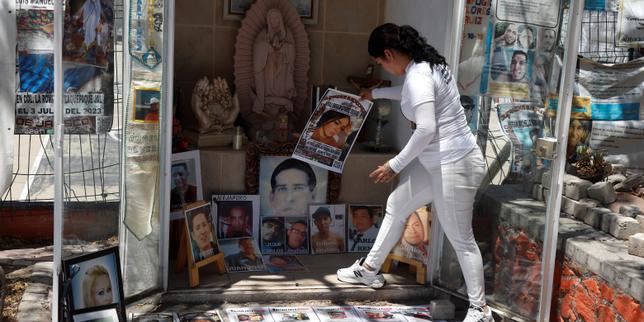
While the politicians argue in air-conditioned halls in Mexico City, the real work happens in the sun-scorched fields of the periphery. These are the buscadoras—the searchers. They are mostly women. Mothers, sisters, wives. They have become amateur forensic experts, learning the difference between the tooth of a dog and the femur of a human. They recognize the specific smell of a clandestine grave, a scent that is sweet and heavy and stays in your clothes for days.
These women are the living rebuke to the government’s denial. They do the work the police refuse to do. They follow tips from anonymous sources, they hike into territories controlled by cartels, and they push iron rods into the earth. When the rod comes up smelling of decay, they start to dig.
This is the invisible stake of the "crime against humanity" debate. If the government admits the depth of the crisis, it must also admit its own impotence—or worse, its complicity. In many cases, the line between organized crime and local authorities is not a line at all; it is a blurred smudge. A crime against humanity implies a failure of the state to protect its citizens. To admit that is to admit a loss of sovereignty.
The Language of Denial
"We are not the same as those who came before," is the frequent refrain of the current leadership. It is a powerful sentiment. It promises a break from a corrupt past. But history is not shed like a snake’s skin. It lingers in the institutions, the police forces, and the military.
The refusal to accept the international community's characterization of these disappearances is a defensive crouch. It is a way of saying, "We have this under control," even as the clandestine graves continue to multiply. But you cannot fix a wound you refuse to diagnose. By downplaying the systematic nature of the disappearances, the government effectively silences the victims twice.
Imagine standing in a room that is slowly filling with water. The government is standing on a chair, insisting that the floor is merely "damp." They point to a mop in the corner as proof of their commitment to the problem. Meanwhile, the water is at your chin.
The Ripple Effect
The disappearance of one person is not a single event. It is a stone thrown into a still pond. The ripples destroy families. They bankrupt parents who spend their life savings on private investigators or bribes for information that never comes. They traumatize siblings who grow up in a house where one room is kept as a shrine to a ghost.
This crisis is also a business problem, a technology problem, and a health crisis. It erodes trust in every institution. If you cannot trust the man in the uniform, who can you trust? If the law is a suggestion rather than a mandate, the entire social contract is shredded.
The stakes are not just about the 115,000 missing. They are about the 130 million people who remain. They are about the girl walking home from school and the journalist writing an exposé and the businessman driving to a meeting. If anyone can disappear, then everyone is, in a sense, already gone.
The Persistence of Memory
There is a specific kind of bravery required to keep an empty chair at the table. It is an act of defiance. It says: I refuse to accept the void you have created.
The debate over whether Mexico is witnessing a crime against humanity will likely drag on in international courts and domestic press conferences for years. Legal scholars will cite precedents from the Balkans or Rwanda. Politicians will produce new charts and more refined categories. They will use words like "methodology" and "reclassification" to soften the blow of the truth.
But the truth is not found in a briefing. The truth is found in the dirt of a desert hill where a mother is on her knees, her fingernails caked with mud, looking for a piece of cloth she recognizes. The truth is in the silent rooms of thousands of homes where the lights are left on, just in case.
We are often told that time heals all wounds. This is a comforting fiction. Time only heals the wounds that are allowed to close. For the families of the disappeared, time is not a healer; it is an interrogator. It asks the same question every morning and every night: Where are they?
As long as the government continues to prioritize its image over the agony of its people, that question will remain a scream in the dark. The tragedy isn't just that people are being taken. It’s that, in the eyes of the state, they are being erased before they are even found.
The sun sets over a small house in Jalisco. Maria turns off the lights, one by one. She leaves the porch light on. It casts a long, lonely yellow glow across the driveway. It is a small light, but it is a stubborn one. It is a light that refuses to believe in the permanence of the shadow, even when the shadow is all that remains.