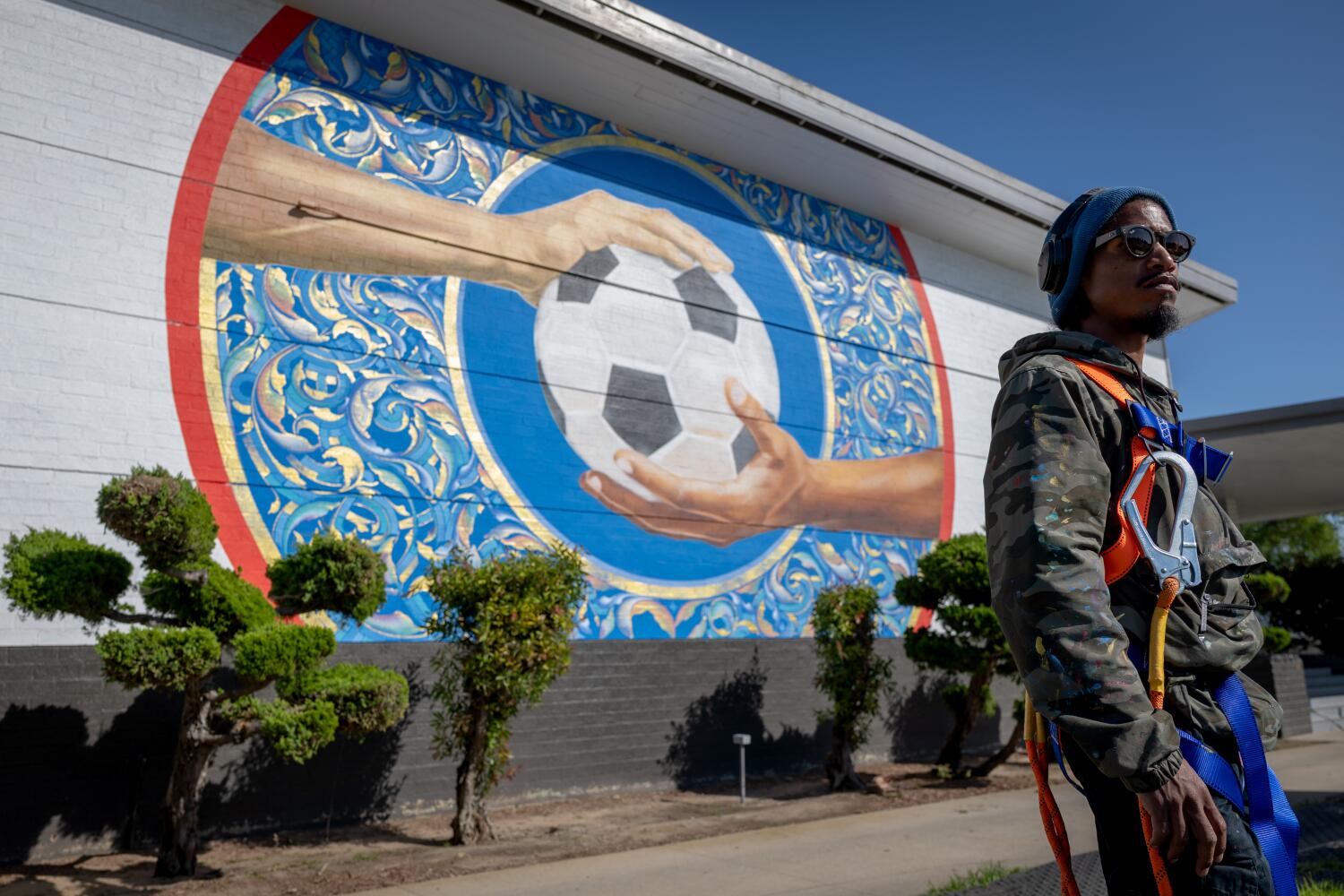
Large-scale sporting events like the 2026 FIFA World Cup frequently fail to deliver projected macroeconomic returns to host cities because municipal planning over-indexes on centralized infrastructure while neglecting localized economic integration. When international visitors arrive at centralized stadium hubs, capital flight occurs instantly if spending remains confined to multinational hotel chains and official tournament sponsors. For a municipality like Inglewood, California—housing major sports infrastructure including SoFi Stadium—capturing a sustainable fraction of this transient capital requires a deliberate strategy to divert foot traffic into the local micro-economy. The mobilization of local artists, community organizers, and small business networks through public murals and cultural programming functions not merely as civic beautification, but as a deliberate economic intervention designed to lower customer acquisition costs for local enterprises.
The Capital Capture Framework in Major Event Hosting
To evaluate how a host city transforms international tourism into local wealth retention, we must analyze the flow of capital through a specific spatial framework. The standard economic impact assessment of a mega-event typically relies on aggregate spending multipliers, which assume that every dollar spent within city limits circulates evenly. This assumption is flawed. In reality, event economics operate under a strict spatial hierarchy divided into three distinct zones. If you found value in this post, you should check out: this related article.
[Zone 1: The Event Core (Stadium/Sponsors)] -> High Capital Flight
                      │
                      ▼ (Friction: Security, Transportation, Lack of Navigation)
[Zone 2: The Transit Corridor]
                      │
                      ▼ (Intervention: Visual Anchors / Cultural Programming)
[Zone 3: The Municipal Micro-Economy (Local Retail)] -> High Wealth Retention
Zone 1: The Event Core
This consists of the stadium perimeter and official fan zones controlled by the organizing body and global corporate sponsors. Capital velocity here is high, but leakages are immediate. Revenue generated from ticket sales, official concessions, and licensed merchandise exits the host municipality instantly to satisfy international corporate balance sheets.
Zone 2: The Transit Corridor
The geographic pathways used by attendees to enter and exit the event core. These corridors represent dead space unless active interventions force a reduction in transit velocity. Without strategic friction, visitors move directly from transit hubs to stadium gates without engaging with the surrounding municipality. For another angle on this development, refer to the latest update from CBS Sports.
Zone 3: The Municipal Micro-Economy
The network of independently owned businesses, restaurants, and service providers operating outside the official tournament footprint. This zone has the highest wealth retention capacity; a dollar spent here circulates locally through wages, local supply chains, and municipal sales taxes.
The strategic challenge for a host city is to build a psychological and physical bridge from Zone 1 through Zone 2 into Zone 3. Public art installations and community-led cultural activations serve as the primary mechanisms to lower this spatial friction. By placing large-scale murals along key transit corridors, a city establishes visual anchors that signal safety, cultural density, and commercial viability to pedestrian traffic, effectively extending the dwell time of visitors outside the stadium gates.
Behavioral Mechanics of the Transit Corridor
Diverting a sports fan from a highly structured, secure stadium environment into an unfamiliar municipal neighborhood requires addressing specific behavioral economic barriers: asymmetric information, perceived security risks, and high cognitive load.
When international or out-of-state visitors exit a venue, they default to low-risk, high-convenience options, such as rideshare applications that transport them directly back to primary hotel clusters outside the host city. This behavior creates an economic bottleneck for local merchants.
[Visitor Exits Stadium]
         │
         ├─► Default Choice: Order Rideshare ──► Immediate Capital Flight
         │
         └─► Strategic Alternative: Pedestrian Exploration
                   │
                   ├─► Barrier 1: Asymmetric Information (Where to go?)
                   ├─► Barrier 2: Perceived Risk (Is it safe?)
                   └─► Barrier 3: Cognitive Load (Navigating unfamiliar terrain)
Public mural campaigns alter this choice architecture by functioning as a decentralized wayfinding system. Urban design literature demonstrates that large-scale, high-contrast visual interventions modify pedestrian distribution patterns through three distinct mechanisms:
- Cognitive Mapping: Unique visual landmarks reduce the mental energy required for navigation. A series of culturally relevant murals creates a legible pathway that guides foot traffic toward commercial corridors.
- The Prosocial Signaling Effect: Well-maintained public art signals active community stewardship and civic investment. This reduces the perceived risk associated with unfamiliar urban spaces, encouraging pedestrian exploration.
- Velocity Reduction: By converting a sterile transit corridor into an open-air cultural gallery, the walking experience is monetized through attention capture. This slower pedestrian velocity correlates directly with an increased probability of spontaneous retail transactions at adjacent businesses.
Quantifying the Return on Cultural Infrastructure
Municipalities frequently misclassify investments in public art as discretionary cultural spending rather than capital expenditures with measurable economic yields. To calculate the true efficiency of a community-led beautification initiative ahead of a major event, we must evaluate the cost-benefit structure through a localized lens.
The cost function of a regional mural campaign involves three primary inputs: artist compensation, material procurement, and municipal permitting/insurance.
$$C_{total} = C_{labor} + C_{materials} + C_{permits}$$
Conversely, the economic yield ($Y$) generated by this infrastructure over the duration of a multi-week tournament can be modeled based on visitor spend and velocity changes:
$$Y = \Delta V \cdot P_s \cdot A_v$$
Where:
- $\Delta V$ represents the net change in pedestrian traffic volume diverted into the commercial micro-economy.
- $P_s$ represents the probability that a diverted pedestrian makes a purchase at a local establishment.
- $A_v$ represents the average transaction value per local purchase.
The net municipal return is realized when $Y$ exceeds $C_{total}$, supplemented by the long-term appreciation of civic brand equity. Unlike temporary corporate pop-ups or sponsor pavilions that dismantle immediately after the final match, permanent public art remains in the asset portfolio of the community. This infrastructure continues to drive localized tourism, film location fees, and commercial desirability long after the tournament concludes, amortizing the initial capital outlay over a multi-year horizon.
Structural Bottlenecks and Execution Risks
While the deployment of community art as an economic catalyst is theoretically sound, structural vulnerabilities in execution can neutralize these benefits. Municipalities attempting to replicate this model face three specific operational risks.
Authenticity Dilution and Community Backlash
When public art initiatives are driven entirely by top-down bureaucratic mandates or corporate curation, they often result in generic, risk-averse designs that fail to resonate with the local population. If the resident community feels excluded from the creative process, the project risks inciting resistance or vandalism. This creates a negative feedback loop that deters investment and signals civic friction to visitors. True economic integration requires co-authoring the visual narrative with local stakeholders, ensuring the artwork accurately reflects the historical and cultural identity of the area.
Gentrification Mechanics and Displacement
A well-documented paradox of urban beautification is the potential to accelerate speculative real estate pressures. As a corridor becomes visually attractive and experiences increased foot traffic, commercial rents can escalate rapidly. If property ownership is concentrated in the hands of non-resident landlords, the long-term economic upside of the cultural investment is transferred away from the legacy business owners who anchored the neighborhood prior to the event. This displacement breaks the local wealth retention cycle.
The Spatial Mismatch of Infrastructure
If murals and cultural activations are placed too far outside the natural pedestrian flow of stadium egress, the friction remains too high to overcome. Conversely, if they are placed exclusively within the secure perimeter of the sports complex, they simply enhance the corporate zone without driving value to the municipal micro-economy. Precision in site selection—targeting the exact intersection where stadium property ends and the municipal commercial zone begins—is critical to success.
Strategic Action Framework for Host Municipalities
To optimize the economic yield of the 2026 World Cup and protect local micro-economies from corporate revenue extraction, municipal leaders must execute a data-driven integration strategy. The following sequence establishes an operational blueprint for balancing civic identity with aggressive capital capture.
[Phase 1: Identify Key Intersections]
                 │
                 ▼
[Phase 2: Establish Local Procurement Mandates]
                 │
                 ▼
[Phase 3: Deploy Micro-Grants for Physical Upgrades]
                 │
                 ▼
[Phase 4: Implement Temporal Zoning Regulations]
Map the Friction Points
Utilize cellular location data and historical event egress patterns to identify the exact geographic coordinates where pedestrian velocity drops and rideshare adoption spikes. These critical nodes represent the locations where visual interventions, street closures, and community activations will yield the highest rate of pedestrian diversion.
Implement Local Procurement Mandates
Ensure that 100% of the creative capital budget is directed to artists, vendors, and fabricators rooted within the immediate municipality. This converts the pre-event preparation phase into an immediate local stimulus program, ensuring that public funds circulate within the community before a single international match is played.
Pair Art with Commercial Micro-Grants
A mural alone cannot facilitate a transaction if the adjacent retail infrastructure is unequipped to handle international consumer demands. Municipalities should match public art installations with targeted grants for small businesses along the corridor to upgrade point-of-sale systems, extend operational hours, and optimize storefront configurations for high-volume pedestrian traffic.
Create Temporal Zoning Allowances
During the tournament window, modify local zoning laws along the designated cultural corridors to permit outdoor dining, sidewalk retail displays, and pop-up community performances. This maximizes the commercial density of the zone, transforming the space between the stadium and the transit hub into an active market that captures visitor dollars organically.
:max_bytes(150000):strip_icc():focal(749x0:751x2)/king-charles-coronation-portraits-050823-1-cee933616cd042eab8c220c3ab689cef.jpg)