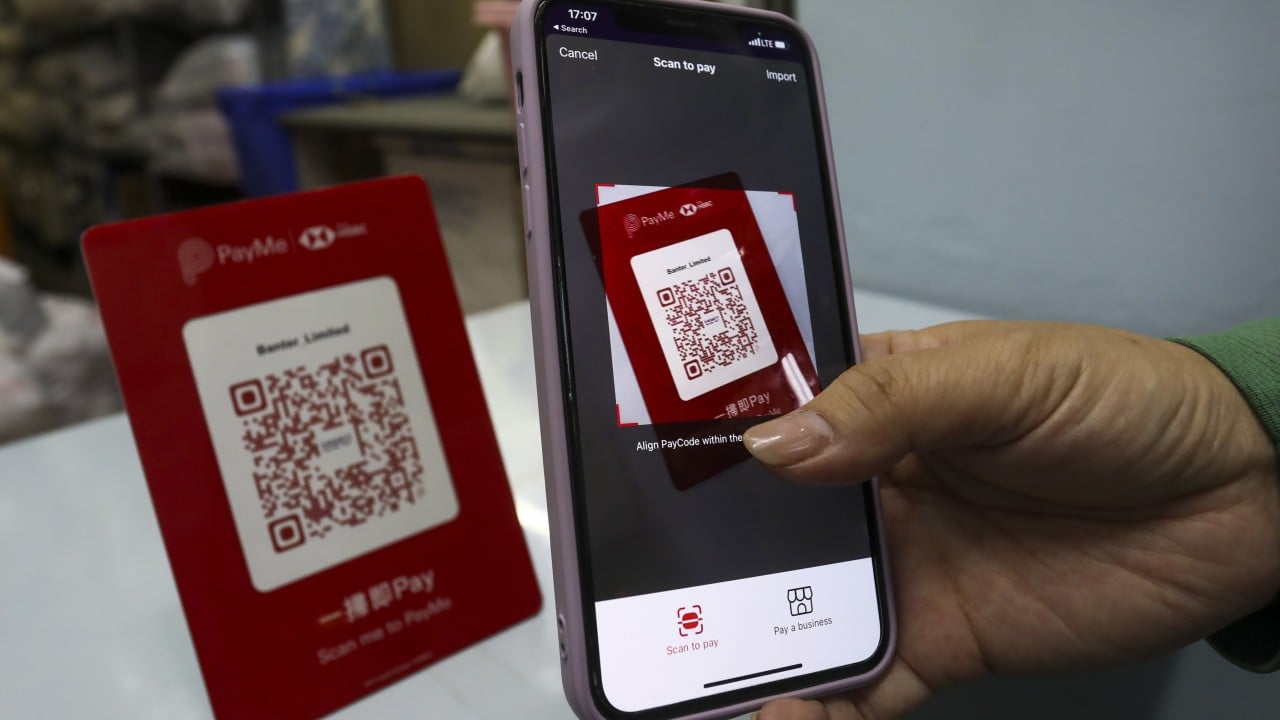
The humidity in Mong Kok doesn’t just sit on your skin; it presses into your lungs. On a Tuesday afternoon, Mrs. Wong stands behind a counter smaller than a telephone booth, surrounded by stacks of imported snacks and towers of bottled water. She is sixty-four. She remembers when every transaction in this city was a physical exchange of paper and sweat. Today, she watches a teenager wave a phone over a QR code. A soft ping emits from a device. The transaction is done. No change. No germs. No eye contact.
This is the miracle of PayMe, the social payment giant that has effectively digitized the wallet of nearly half of Hong Kong’s population. With 3.3 million users, it isn't just an app; it is the lubricant of the city's social engine. It’s how friends split the bill for dim sum and how parents send "red packet" money to children across the harbor. But beneath the convenience of the blue interface, a transformation is brewing. The money in Mrs. Wong’s digital till is about to change its DNA.
The Hong Kong Monetary Authority (HKMA) has been quietly laying the tracks for something more permanent than a balance on a screen. They are looking at stablecoins—digital assets pegged to a fiat currency like the Hong Kong Dollar. To the average user, this sounds like technical jargon designed to obscure rather than reveal. To the city's financial architects, it is the bridge between the world of old banks and the world of programmable money.
The Problem with Digital Mirrors
Current digital payments are often just mirrors of the traditional banking system. When you send money on a platform, you aren't moving "value" instantly; you are moving a promise. The banks settle the actual debt later, through a series of clearinghouses and ledgers that would make a Victorian accountant dizzy. It works, but it is slow and expensive for the people at the bottom of the chain.
Consider a small design firm in Kwun Tong trying to pay a freelance illustrator in Singapore. They use a credit card or a bank transfer. By the time the fees are carved out and the exchange rate is "adjusted" by the middleman, the illustrator loses 5%. In a world of fiber-optic speeds, our money is still traveling by steamship.
Stablecoins change the physics of the transaction. Because they live on a blockchain, the "coin" is the value itself. Moving a stablecoin isn't sending a message to a bank to move money; it is handing over the digital equivalent of a gold coin. It is instantaneous. It is final.
Why PayMe is the Catalyst
Why does it matter if 3.3 million PayMe users get access to this? Because scale creates its own reality. If PayMe integrates stablecoins, a third of the city suddenly has a portal to the "Web3" economy without having to understand a single line of code.
Imagine a hypothetical user named Leo. Leo runs a small craft brewery. Currently, he uses PayMe to collect payments from local bars. But his hops come from Yakima Valley in the US, and his bottles come from a factory in mainland China. To pay those suppliers, Leo has to step out of his easy digital ecosystem and into the clunky world of international wire transfers. He fills out forms. He waits three days. He pays $250 HKD in wire fees for a $2,000 HKD shipment of yeast.
If Leo’s PayMe wallet held stablecoins, he could send that payment directly to the factory's digital wallet. The factory receives it in seconds. The cost is pennies.
This isn't about speculation. This isn't about the wild volatility of Bitcoin or the latest "meme" coin that crashes by dinner time. This is about utility. A stablecoin pegged to the Hong Kong Dollar stays at one dollar. It is boring. And in the world of finance, boring is beautiful. Boring is what allows a business to plan for next month’s rent.
The Regulatory Shield
The skepticism is valid. We have all seen the headlines of digital exchanges vanishing into the ether and "stable" coins that proved to be anything but. This is where the Hong Kong government’s "sandbox" approach comes in. They aren't letting the Wild West run the show.
The HKMA is demanding that any stablecoin issuer must have 1-to-1 reserves. If there is a billion dollars worth of digital tokens in circulation, there must be a billion physical dollars sitting in a regulated vault. No "algorithmic" magic tricks. No lending out the reserves to risky hedge funds.
For the user, this means the trust moves from a specific bank to a regulated protocol. It’s a shift from "I trust this institution" to "I trust this math and this law." For many, especially the younger generation who watched the 2008 financial crisis from their living room floors, that is a meaningful distinction.
The Invisible Stakes
What happens to the giants? Companies like HSBC, which owns PayMe, are in a delicate dance. They are the incumbents, the kings of the old mountain. By embracing stablecoins, they are essentially disrupting their own business model. They are choosing to lead the change rather than be buried by it.
But the real stakes aren't for the banks. They are for the efficiency of the city. Hong Kong has always survived on its wits and its speed. It is a middleman city. But as the world moves toward direct, peer-to-peer commerce, the "middleman" has to become the "platform."
If Hong Kong fails to adopt these tools, the capital will simply flow elsewhere—to Singapore, to London, to New York. Money, like water, always finds the path of least resistance.
Beyond the QR Code
Back at the snack stall, Mrs. Wong doesn’t care about "distributed ledgers" or "atomic settlement." She cares about whether she can pay her suppliers on time and whether the money she earns today will buy the same amount of rice tomorrow.
The transition to stablecoins in the PayMe ecosystem would be invisible to her. She would still see a QR code. She would still hear a ping. But the money behind that sound would be more powerful. It would be money that can be "programmed."
Programmable money sounds like science fiction, but it is deeply practical. It means a contract can be written so that the payment is only released to a supplier the moment a shipping container is scanned at the port. No escrow. No lawyers. No delays. It is a self-executing economy.
The friction of the world is being sanded down. We are moving toward a future where the distance between "I want" and "I have" is reduced to a millisecond, regardless of borders.
Mrs. Wong takes a sip of her lukewarm tea. The teenager has moved on, disappearing into the neon-lit crowd of Mong Kok. The transaction was effortless, a ghost of an exchange that left no paper trail but moved real value across the city's invisible digital veins. We are living in the transition. The coins are becoming lines of code, and the vaults are becoming clouds, but the weight of a dollar earned remains the same.
The city is waiting for the next ping. It won't just be the sound of a payment. It will be the sound of the old world finally catching up to the new one.