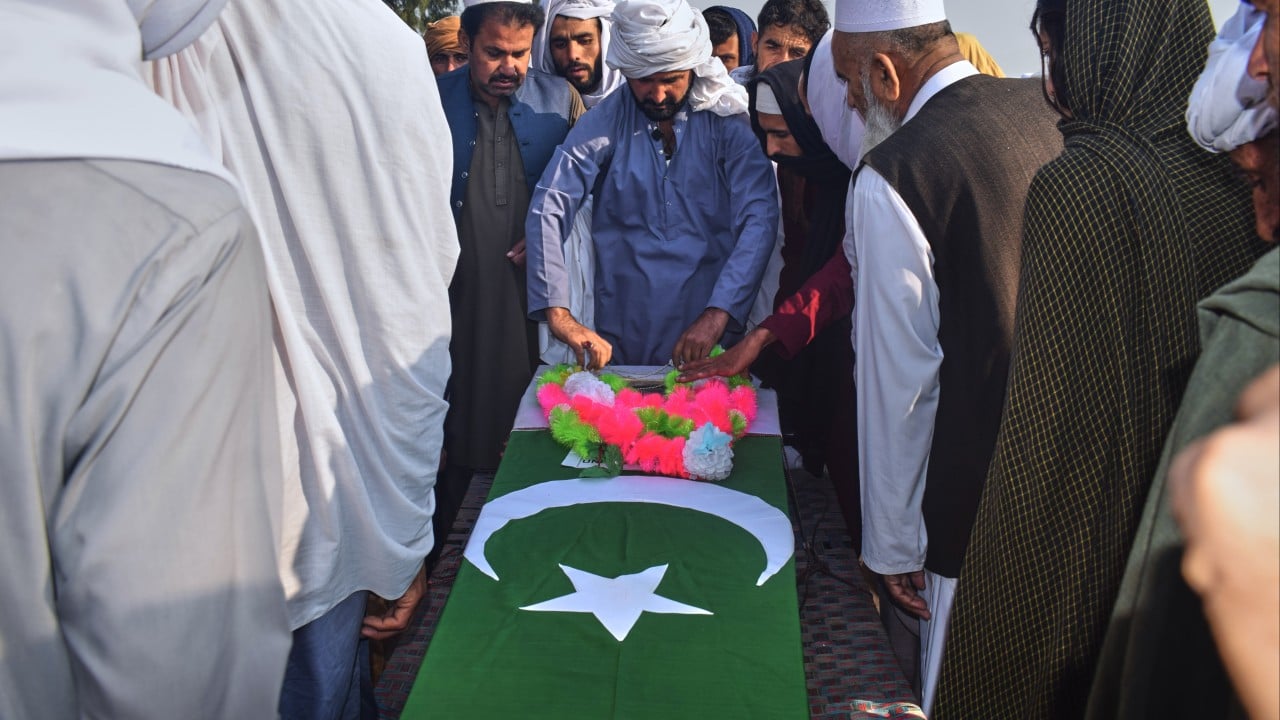
The tea in the cracked porcelain cup has gone cold, forming a thin, oily film on the surface. Outside the window in Rawalpindi, the air is thick with the smell of diesel exhaust and the muffled, rhythmic thumping of a generator that refuses to die. This is the sound of a nation holding its breath. It is a sound that hasn't changed in forty years.
We often talk about war as a series of explosions, a map marked with red pins, or a budget line item in a crumbling ledger. But in Pakistan, the "forever war" isn't a single event. It is a state of being. It is the exhaustion that settles in your marrow when you realize your children are inheriting the same ghosts you fought when you were a student in the nineties.
Consider a man we will call Abbas. He is a hypothetical composite of the thousands of fathers I have interviewed over two decades of reporting from the Indus to the Hindu Kush. Abbas owns a small textile shop. He is not a politician. He is not a general. He is a man who knows the exact price of electricity per unit and the exact risk of sending his daughter to a school that sits too close to a police station.
For Abbas, the "politics of exhaustion" isn't an academic phrase. It is the way he looks at the news. He sees a headline about a suicide bombing in Peshawar, followed by a press conference where a man in a crisp uniform promises "decisive action," followed by a debate about IMF loans. He turns the television off. He has heard the script. He knows the lines. He is simply too tired to believe the ending will change this time.
The tragedy of Pakistan’s current predicament is that the exhaustion has become the primary tool of governance. When the people are too tired to demand transparency, when they are too busy hunting for affordable flour to worry about the erosion of the judiciary, the status quo wins by default.
To understand how we got here, we have to look at the geometry of the border. For decades, the western frontier was treated as a "strategic depth" playground. It was a place where theories were tested and proxies were groomed. But borders are not one-way mirrors. What you project outward eventually bleeds back in. The militants who were once seen as strategic assets have long since become the primary liabilities.
The numbers tell a story of a hemorrhaging heart. Since 2001, Pakistan has lost over 70,000 lives to terrorism. The economic cost is estimated to exceed $150 billion. These are not just figures; they are the schools that were never built, the hospitals that lack medicine, and the generation of young men who grew up in the shadow of the drone and the IED.
But the real cost is the psychological toll.
There is a specific kind of fatigue that comes from living in a permanent state of emergency. It creates a society that stops planning for the next decade and starts merely surviving the next hour. This is the "politics of exhaustion" at its most lethal. It turns the citizenry into spectators of their own demise.
Imagine a bridge. Not a metaphorical one, but the concrete structures that span the Jhelum or the Chenab. In a healthy state, that bridge is a promise of movement. In a state of forever war, that bridge is a choke point. It is where the containers are placed to block protesters. It is where the checkpoints turn a twenty-minute commute into a three-hour interrogation. The infrastructure of the country has been repurposed from facilitating life to controlling it.
We see this most clearly in the relationship between the garrison and the street. The military has spent seventy years convincing the public that they are the only thing standing between Pakistan and total collapse. It is a seductive narrative. It offers certainty in a world of chaos. But that certainty comes at the price of the very institutions that are supposed to provide a safety net.
When the army enters the realm of real estate, logistics, and cereal manufacturing, it isn't just about money. It’s about the displacement of the civilian imagination. If the "khakis" do everything, why should the "babut" (the bureaucrats) bother to learn? The result is a hollowed-out state that can win a tactical skirmish but cannot provide clean water to its largest city.
The exhaustion is now systemic.
The political parties, rather than offering a way out, have become part of the cycle. They are dynastic entities that treat the treasury like a family inheritance. They wait for their "turn," usually brokered by the same generals they decried while in opposition. It is a dance of shadows where the music never stops, but the floor is collapsing.
Wait. Listen.
That silence you hear after a political rally ends isn't peace. It’s the sound of a vacuum.
In the last two years, the pressure has reached a boiling point. The economic crisis isn't just about inflation; it's about the loss of a future. When a middle-class family can no longer afford both meat and school fees, the social contract isn't just strained—it’s incinerated. We are seeing a mass exodus of the brightest minds. Doctors, engineers, and tech workers are leaving for Dubai, London, or Toronto. They aren't just looking for better salaries; they are running away from the fatigue.
They are tired of the uncertainty. Tired of the electricity going out during a surgery. Tired of the feeling that no matter how hard they work, the "invisible forces" can tilt the board at any moment.
There is a myth that Pakistan is "too big to fail." This is the ultimate comfort of the exhausted. It assumes that the international community will always provide a bailout because the alternative—a nuclear-armed state in freefall—is too terrifying to contemplate.
But failure isn't always a sudden bang.
Sometimes, failure is a slow, agonizing whimper. It is the gradual degradation of the rule of law until it is unrecognizable. It is the normalization of "enforced disappearances." It is the way a young boy in Quetta looks at a soldier with fear instead of pride.
The forever war has turned inward. It is no longer just about the TTP or the insurgents in Balochistan. It is a war against the idea of a functional, democratic Pakistan. Every time a journalist is silenced, the exhaustion grows. Every time a vote is manipulated, the stakes disappear.
Consider the paradox of the 2024 elections. Despite the suppression, despite the blackouts and the legal gymnastics, people turned out. They waited in the sun. They used their bodies as a protest against the very fatigue that was supposed to keep them home.
That was a moment of hope, but it was also a moment of immense danger. When you give people a sliver of light and then pull the curtain shut again, the resulting darkness is twice as heavy. The "mandate" was stolen, or at least heavily rearranged, and the message to the public was clear: Your participation is a formality, not a choice.
So, where does the road lead when the map has been torn up?
We are currently witnessing a desperate attempt to reboot the system using the same old parts. A hybrid government, backed by the military, trying to implement "reforms" that the public has no stake in. It is like trying to fix a jet engine with duct tape while the plane is in a nose-dive.
The IMF demands austerity, which means the poor get poorer, while the elite continue to live in air-conditioned bubbles, shielded from the reality of the streets. This isn't just bad economics; it's a recipe for a social explosion.
The "politics of exhaustion" has a limit. Eventually, the fatigue turns into a different kind of energy. It becomes a nihilistic rage. We saw flashes of this on May 9th, when symbols of the state's power were attacked by the very people who once cheered them. It was a chaotic, ugly expression of a fundamental truth: you cannot keep a population in a state of permanent tension without something eventually snapping.
To fix this, we have to stop talking about "stability" and start talking about "legitimacy."
Stability is what you have in a graveyard. It is quiet. It is predictable. But it is dead.
Legitimacy is messy. It requires listening to the provinces that feel ignored. It requires letting the judiciary act as a check on power, even when it’s inconvenient. It requires the military to step back into the barracks, not just in word, but in deed and in pocketbook.
Most importantly, it requires an end to the forever war mindset. As long as the state views its own citizens as potential threats or chess pieces in a regional game, the exhaustion will remain.
The man in the shop, Abbas, doesn't want a revolution. He wants a predictable life. He wants to know that if he pays his taxes, the lights will stay on. He wants to know that if his son speaks his mind, he will come home for dinner.
These are not radical demands. They are the basic requirements of a civilization.
As I sit here, the sun is setting over the Margalla Hills. The sky is a bruised purple, beautiful and ominous all at once. The generator outside has finally run out of fuel, and the silence that follows is deafening.
In that silence, you realize that Pakistan isn't just a country on a map. It is a collection of millions of souls who have been told for seventy years that their struggle is a sacrifice for some greater, abstract good. They have given their youth, their taxes, and their lives to this "forever war."
They have nothing left to give.
The mirrors are broken. The tea is cold. The actors are reciting their lines to an empty theater. The only thing left is the exhaustion, heavy as a wet wool blanket, draped over the shoulders of a nation that just wants to sleep without wondering if the roof will still be there in the morning.
The tragedy isn't that the war hasn't ended. The tragedy is that we have forgotten what peace looks like.