The phone rings at 3:00 AM in a quiet suburb of Ohio. It isn't the frantic, rhythmic trill of a telemarketer or the buzzing notification of a social media tag. It is a heavy, tectonic sound. For a mother whose son is stationed six thousand miles away, that sound doesn’t just wake her up; it alters the molecular structure of the room. She knows, before she even touches the screen, that the world she went to sleep in has been replaced by something much sharper and more unforgiving.
This is the invisible front line of a war that hasn't officially begun, but is already collecting its toll.
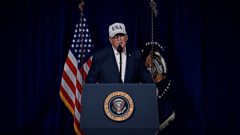
When Donald Trump stood before the cameras to warn that more Americans would die if a full-scale conflict with Iran erupted, the words were analyzed by pundits for political strategy and geopolitical leverage. They looked at the maps. They counted the missiles. They debated the doctrine of "maximum pressure." But the strategy isn't the story. The story is the 3:00 AM phone call. The story is the weight of a Kevlar vest on a twenty-year-old’s shoulders in a desert where the wind smells like sun-baked dust and impending metal.
The Geography of a Grudge
To understand why the air feels so heavy right now, you have to look past the headlines and into the history of a thousand paper cuts. This isn't a new argument. It is a multi-generational inheritance of trauma and pride.
Imagine two neighbors who have been shouting across a fence for forty years. At first, they argued over the property line. Then they argued over the noise. Eventually, they stopped remembering exactly what started it, but they began keeping rocks in their pockets, just in case. One neighbor has a massive, high-tech security system and a megaphone. The other has a collection of hidden tripwires and a very long memory.
The United States and Iran aren't just two governments clashing; they are two different concepts of time. Washington often operates in four-year cycles, looking for quick wins and immediate exits. Tehran plays a game of centuries. When an American drone takes out a high-level commander, the U.S. sees a tactical necessity. Iran sees a martyr whose blood will water the seeds of resistance for the next fifty years.
The warnings of "more deaths" aren't just rhetoric. They are a cold recognition of how Iran fights. They don't meet an aircraft carrier group in the open ocean where they would be vaporized in minutes. They fight in the shadows. They use proxies—groups in Lebanon, Yemen, and Iraq—to strike where the armor is thinnest. It’s the "death by a thousand cuts" strategy.
The Calculus of the Unthinkable
Consider the Strait of Hormuz. It is a narrow, shimmering stretch of water that looks peaceful enough from a satellite. Yet, twenty percent of the world’s oil flows through that throat. If it closes, the global economy doesn't just stumble; it gasps for air.
For the average person, this might mean an extra two dollars at the pump. For a farmer in the Midwest, it means the cost of fertilizer and fuel for his tractor suddenly exceeds the value of his crop. For a family living on the edge of the poverty line, it means choosing between heating the house or buying groceries. This is how a conflict in the Middle East reaches into a kitchen in Des Moines and turns out the lights.
We often talk about war in terms of "surgical strikes." It’s a clean, clinical word. It suggests a scalpel, a steady hand, and the removal of a tumor with minimal damage to the patient. But war is never surgical. It is a blunt force trauma.
When a missile hits a target, the "collateral damage" isn't just a statistic. It is a shopkeeper who was just trying to open his shutters. It is a schoolgirl who happened to be walking on the wrong side of the street. It is also the American soldier who survives the blast but spends the next thirty years jumping at the sound of a car backfiring.
The Ghost in the Briefing Room
Donald Trump’s warning carries a specific kind of weight because it acknowledges the one thing leaders usually try to hide: the inevitability of loss. In the traditional political playbook, you promise victory. You promise that the enemy will be "shocked and awed." You don't usually stand at a podium and tell the public that their sons and daughters are going to come home in flag-draped boxes.
There is a psychological shift happening here. By framing the conflict as a choice between a "bad deal" and "American lives," the narrative moves from the abstract realm of international law to the visceral realm of the dinner table. It forces a question that most people would rather avoid: What is the exact value of a geopolitical objective?
Is a change in a foreign government worth a thousand lives? Ten thousand? Is the prevention of a nuclear program worth the stability of the entire region for a decade?
There is no "correct" answer in a spreadsheet. There is only the mounting cost.
The Invisible Stakes
We have become desensitized to the language of escalation. "Tensions are rising." "Red lines are being crossed." These phrases have been repeated so often they’ve lost their teeth. They feel like the background noise of a world that is always on the brink.
But the reality of a war with Iran would be unlike anything the modern generation has seen. This wouldn't be the lopsided invasion of 2003. Iran is a mountainous, fortified nation with a population that has been raised on the rhetoric of "Sacred Defense." It is a country that knows how to suffer.
When you fight an enemy that views suffering as a form of worship, the traditional metrics of victory disappear. You can’t out-muscle a ghost. You can’t intimidate someone who believes that dying in a struggle against you is the ultimate promotion.
This brings us back to the human element. Behind every policy decision, there is a person who has to live with the consequences. There is the diplomat who hasn't slept in three days, trying to find a linguistic bridge that allows both sides to save face. There is the sailor on a destroyer in the Persian Gulf, staring at a radar screen, knowing that a single mistake could trigger a chain reaction that burns down the world.
The Echoes of the Past
History is a heavy ghost. It sits in the corner of every meeting in the Situation Room. It whispers about Vietnam. It screams about Iraq. It reminds us that every time we thought a war would be "quick and easy," we were wrong.
The warnings of more deaths are an admission that we are playing with fire in a room full of gasoline. The rhetoric of "strength" is often used to mask a profound fear of looking weak. But there is a different kind of strength—the strength required to step back from the edge.
It is easy to start a fire. Any child with a match can do it. It takes an incredible, coordinated effort to put one out once the wind catches it.
The current standoff is a test of nerves, yes, but it is also a test of imagination. Can we imagine a path that doesn't end in a cemetery? Can we see the "enemy" not as a monolithic evil, but as a collection of people who also have 3:00 AM phone calls to fear?
The stakes aren't just about who sits in the White House or who controls the oil fields. The stakes are the empty chairs at the Thanksgiving table five years from now. They are the shadows that linger in the eyes of veterans. They are the dreams of children in Tehran and Tulsa that will never happen because a "surgical strike" wasn't as clean as the briefing promised.
Silence.
That is what follows the warning. A heavy, expectant silence as the world waits to see who blinks first. We watch the news, we check our feeds, and we wait for the next ping, the next headline, the next alert.
But for some, the silence is already broken. It was broken long ago by the sound of boots on a driveway or the notification that a "non-combat incident" has claimed another name.
The war doesn't start when the first bomb drops. It starts when we decide that the lives on the other side of the map are worth less than the points on a political scoreboard.
Somewhere, right now, a young man is cleaning his rifle. He is thinking about his home, his dog, and the girl he wants to marry. He is the one who will pay the price for the warnings and the rhetoric. He is the "more deaths." He is a person, not a statistic, and he is waiting for us to decide if his life is worth more than a headline.
The sun will rise tomorrow, but for many, it will rise on a world that feels just a little bit more fragile, a little bit more temporary, as the shadows of the long night continue to grow.