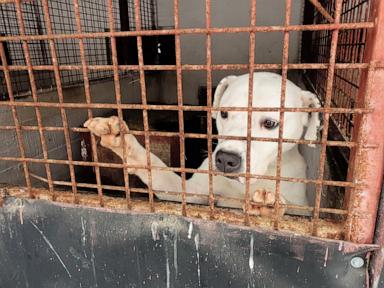
The wind in the foothills of the Carpathian Mountains doesn't just howl; it carries a specific, metallic scent. It’s the smell of wet gravel, rusted iron, and something else—the sharp, unmistakable tang of ammonia that burns the back of your throat before you even see the gates.
In the public dog shelters of Romania, silence is the most terrifying sound. You expect a cacophony. You expect the frantic, rhythmic barking of hundreds of souls demanding to be noticed. But as you walk past the rusted chain-link fences of a municipal facility in a small town outside Bucharest, the noise is thin. Brittle. The dogs here have learned a hard, evolutionary lesson: energy spent barking is energy stolen from the body's desperate attempt to stay warm on a slab of damp concrete.
This isn't a story about a few bad actors. It is about a system that has turned neglect into a line item on a government budget.
The Architecture of Indifference
To understand the crisis, you have to look at the numbers, though the numbers are designed to be slippery. Animal welfare investigators recently pulled back the curtain on a network of public shelters where "systemic neglect" isn't just a buzzword—it’s the operating manual. In many of these facilities, the mortality rate isn't a tragedy; it’s a metric of efficiency.
Consider a hypothetical dog. Let’s call him Mihai. Mihai is a crossbreed, a "community dog" with the sturdy legs of a shepherd and eyes the color of weak tea. He was scooped up by a city-contracted van during a routine sweep. Under Romanian law, specifically the controversial Emergency Ordinance 155/2001, stray dogs are rounded up and held for 14 days. If no one claims them, they can be euthanized.
But "euthanasia" implies a merciful end. What investigators found in reality was far more jagged.
In the shadows of these state-funded warehouses, the 14-day rule is often ignored in favor of a slower, cheaper disappearance. Why pay for a lethal injection when you can simply stop providing adequate food? Why heat a kennel when the cold will eventually do the work for you? Reports from NGOs like PETA and local Romanian rescue groups have documented dogs living in their own waste, with water bowls frozen solid for days at a time.
The Economics of a Stray
Money flows through these shelters like water through a cracked pipe. The Romanian government allocates significant funds to municipal councils for the management of stray populations. On paper, this money covers high-quality kibble, veterinary care, mandatory microchipping, and sterilization.
In practice, the paper trail often ends at a padlocked gate.
Corruption in the stray dog management sector has become an open secret. Contracts are frequently awarded to private companies with ties to local officials—firms that view every dog not as a living creature, but as a vessel for a subsidy. If a company receives 50 Euros per dog for "maintenance," every cent they don't spend on food or medicine is pure profit.
The result is a landscape of skeletal figures. When investigators entered one facility in the eastern part of the country, they found animals so emaciated their skin seemed draped over their bones like wet tissue paper. Cannibalism is not uncommon. It is the logical, horrific conclusion of a system that starves its inhabitants until the instinct to survive overrides everything else.
The Human Ghost in the Machine
It would be easy to point the finger solely at the "dog catchers" or the shelter managers. But the human element is more complex. Many of the workers in these facilities are underpaid and undertrained, trapped in a cycle of secondary trauma. They spend eight hours a day in a place of rot and despair. Eventually, the heart builds a callus.
I remember speaking to a volunteer who had managed to slip inside a "closed" facility under the guise of looking for a lost pet. She described the eyes of the workers. They weren't monsters, she said. They were just... empty. They moved through the pens with the mechanical indifference of warehouse staff moving pallets of spoiled fruit.
"If they care," she told me, "they can't do the job. So they stop caring. And then the dogs stop being dogs. They just become noise."
This psychological distancing allows the systemic neglect to continue. It's how a supervisor can walk past a dog with an open, untreated wound and not see a medical emergency, but rather a nuisance that will likely resolve itself by morning through death.
A Legacy of Concrete and History
The stray dog problem in Romania didn't appear out of thin air. It is a scar left by the country's history. During the reign of Nicolae Ceaușescu, the rapid urbanization and the demolition of traditional houses in favor of massive apartment blocks forced families to abandon their pets. Dogs were left to the streets, where they bred, survived, and became part of the urban fabric.
For decades, the response has been a pendulum swing between mass culling and periods of legislative paralysis. The 2013 tragedy, where a young boy was fatally attacked by strays in Bucharest, sparked a wave of public anger that led to the hardening of the laws. But the anger didn't build better shelters. It built more cages.
The tragedy of the current system is that it ignores the only proven solution: mass sterilization and public education. Instead, the country remains locked in a cycle of "catch and kill"—except the "kill" is often a slow, agonizing slide into starvation behind closed doors.
The Invisible Stakes
Why should someone sitting in a cafe in London or a home in New York care about a muddy shelter in the Romanian countryside?
Because these shelters are a litmus test for the rule of law. When a government can systematically ignore its own welfare standards and funnel public funds into the pockets of "ghost contractors," the rot is never limited to the animal pens. It speaks to a broader failure of transparency and accountability.
Moreover, the stray dog crisis has turned Romania into a hub for the "International Rescue" trade. Thousands of dogs are exported every year to adopters in Western Europe. While many of these stories end in a warm bed and a full bowl, the sheer volume of "exported trauma" has created its own set of problems. Shelters in Germany and the UK are increasingly seeing Romanian dogs with severe behavioral issues—animals that have been so broken by the public shelter system that they struggle to integrate into human homes.
The trauma doesn't stay behind the fence. It travels.
The Thin Line of Hope
There are, however, cracks in the concrete.
Across Romania, a grassroots movement of private rescuers is fighting an asymmetrical war against the state-funded system. These are individuals who spend their own salaries on vet bills, who run "private" shelters that are actually just their own backyards, and who risk legal harassment to document the conditions inside municipal facilities.
They are the ones who found "Lara."
Lara was a shepherd mix found in a public shelter in the south. She had been there for three months. When she was finally pulled out by a private NGO, she weighed half of what she should have. She had forgotten how to walk on grass; her muscles had atrophied from the cramped cage. For the first week in her foster home, she wouldn't sleep. She stayed standing, her head pressed against the corner of the room, waiting for a blow that never came.
Lara’s recovery wasn't a miracle. It was a testament to what happens when the human element is one of compassion rather than calculation. It took three months of steady meals, soft voices, and the simple dignity of a dry blanket.
The Cost of Looking Away
The competitor's report on "systemic neglect" captures the facts, but it misses the soul of the failure. The failure isn't just a lack of food or a lack of medicine. It is a lack of witness.
Public shelters in Romania are often located in remote areas, far from the eyes of the city-dwelling public. They are protected by high walls and aggressive "No Photography" signs. This is by design. It is easy to ignore the suffering of thousands when it is tucked away in the industrial outskirts of a town you’ll never visit.
But the gravel is still wet. The ammonia still stings. And the dogs are still waiting in the silence.
The real problem isn't the dogs on the street. It’s the money in the shadows and the walls we build to keep the consequences of our history out of sight. Until the "dog management" industry is stripped of its profitability and replaced with a transparent, humanity-first approach, the ghost shelters will continue to haunt the Romanian countryside.
The crates are full. The bowls are empty. The gate is locked. And somewhere inside, a dog like Mihai is leaning his head against a cold iron bar, listening to the wind from the mountains, waiting for a human voice that doesn't sound like a threat.
Romania’s shelters aren't just a crisis of animal welfare. They are a mirror held up to how a society treats its most vulnerable when it thinks no one is watching. The image reflected back is one of cold stone and wasted lives, a narrative that can only change when the silence is finally, loudly broken.