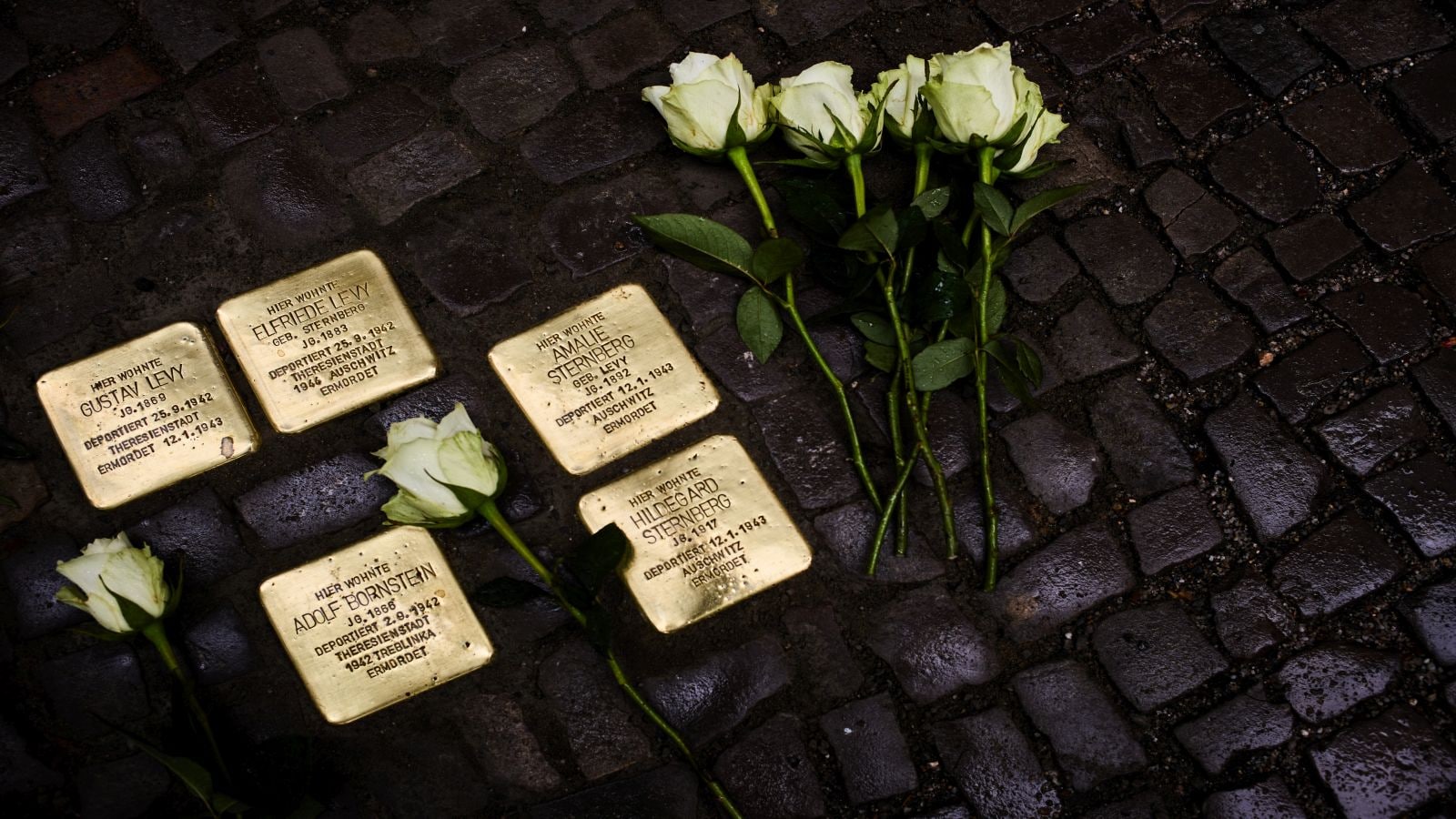
Walk through Berlin with your head held high and you will miss the most important story in the city. To see it, you have to look down. There, embedded in the sidewalk outside ordinary apartment buildings, are the Stolpersteine—"stumbling stones." These 10-centimeter brass cubes are not just memorials; they are a decentralized, guerrilla-style historical intervention. Each stone records a name, a birth date, and a fate, marking the exact spot where a human being was last seen before being swallowed by the Nazi machinery.
Gunter Demnig, the artist behind the project, started this work in the early 1990s as a provocation. He wanted to bring the scale of the Holocaust back to the individual doorstep. Today, there are over 100,000 stones across Europe, making it the world’s largest decentralized memorial. But to view the Stolpersteine as mere public art is to misunderstand their function. They are an active, ongoing battle against the human tendency to forget and the political desire to sanitize.
The Logistics of Remembering
The brilliance of the Stolpersteine lies in their physical imposition on the modern city. Unlike a massive, centralized monument like the Memorial to the Murdered Jews of Europe near the Brandenburg Gate, which you must choose to visit, the stumbling stones find you. They interrupt your commute. They appear while you are walking your dog or looking for a café.
Each stone is handmade. This is a deliberate choice by Demnig to counter the industrialized, mass-production nature of the genocide itself. The process begins with a request, often from a descendant or a local resident who has researched the history of their building. Once the data is verified—a process that involves deep dives into the Arolsen Archives and local registry offices—the stone is cast in concrete and topped with a hand-stamped brass plate.
The installation is a quiet, rhythmic act of reclamation. A square is carved out of the pavement, the stone is set with mortar, and the brass is polished. In that moment, a name that was meant to be erased from history is literally hammered back into the map of the city.
The Friction of Public Space
Despite their widespread acceptance now, the Stolpersteine have faced fierce opposition, proving that even thirty years later, the project still hits a raw nerve. The most notable resistance came from within the Jewish community itself. Charlotte Knobloch, former president of the Central Council of Jews in Germany, famously argued that the stones are an indignity. Her logic is visceral: the victims were kicked and trampled upon in life, and the stones allow them to be stepped on once again in death.
This creates a paradox. In Munich, Knobloch’s influence led to a city-wide ban on Stolpersteine on public property that lasted for years. Proponents of the stones argue the opposite—that to read the inscription, one must physically bow before the victim. This physical movement creates a momentary, involuntary act of respect.
The debate reveals a fundamental tension in how we handle trauma in the built environment. Should a memorial be a sanctuary, or should it be a tripwire? Demnig’s work chooses the latter. It forces the current residents of a "gentrified" neighborhood to acknowledge that their living room was once someone else’s sanctuary, taken by force.
Beyond the Brass Surface
The stones do more than just name the dead; they map the logistics of the Holocaust. When you see a cluster of stones outside a single doorway, you are looking at the destruction of a family. When you see stones for political dissidents, Sinti, Roma, Jehovah’s Witnesses, and LGBTQ+ victims alongside Jewish names, you begin to grasp the totality of the purge.
However, the stones also highlight the gaps in our records. For every stone laid, thousands of people remain nameless because their entire lineages were extinguished, leaving no one to request a memorial. The project is inherently incomplete. This incompleteness serves as its own kind of testimony. It reminds us that what we see on the sidewalk is only a fraction of the void.
The research required to place a stone often turns ordinary citizens into amateur historians. This "bottom-up" approach to history is what gives the project its staying power. It isn't a government mandate; it is a neighbor-to-neighbor transfer of memory. In many Berlin districts, local Stolperstein-Initiativen meet regularly to clean the brass, which oxidizes and turns dark over time. This maintenance is a ritual. Without the rubbing of a cloth or the friction of soles, the names would eventually turn black and disappear into the grey of the asphalt.
The Economics of Memory
There is a pragmatic side to this movement that rarely makes the headlines. Each stone costs roughly 130 Euros to produce and install. This fee is almost always covered by private donors or "sponsors." This funding model makes the project immune to the shifting winds of government budgets or political administrations that might want to distance themselves from "guilt culture."
But as the project grows, so do the challenges. The sheer volume of stones has created a backlog that can span years. This delay has led to some criticism regarding the centralized control Demnig maintains over the production. Some argue that for the project to survive his lifetime, it must be further decentralized, perhaps allowing local artisans to take up the hammer. Yet, the uniformity of the stones is part of their power. They are a consistent visual language that crosses borders, from the streets of Berlin to the sidewalks of Rome and Thessaloniki.
The Risk of Normalization
The greatest threat to the Stolpersteine isn't a city ban or a vandal’s spray paint. It is the "wallpaper effect." When something becomes a permanent fixture of the urban landscape, we eventually stop seeing it.
I have watched tourists in the Mitte district walk directly over these names while checking their phones for the nearest Currywurst stand. I have seen delivery bikes parked directly on top of the brass plaques, obscuring the "Born 1892" and "Murdered in Auschwitz" text. This is the danger of the decentralized memorial: it risks becoming just another piece of street furniture.
But perhaps that is the point. The victims lived ordinary lives in these ordinary buildings. By placing their names in the path of our daily indifference, the stones mirror the reality of the 1930s. The Holocaust didn't happen in a vacuum; it happened while people were walking to work, buying bread, and ignoring their neighbors' disappearance. The fact that we can step over a stone without looking is a chilling reminder of how easily the "banality of evil" operates.
A Blueprint for the Future
Berlin’s relationship with its pavement offers a lesson for other cities grappling with dark histories. In the United States, there have been tentative discussions about using similar markers for the sites of slave auctions or lynchings. The Stolpersteine prove that you don't need a massive budget or a grand architectural plan to change the narrative of a city. You only need a name, a date, and the courage to place it where people can't help but encounter it.
The stones are not "healing" the past. They are keeping the wound open just enough to prevent it from scabbing over with apathy. Every time a new stone is laid, the city admits that it can never be fully repaired. It acknowledges that the geography of Berlin is forever haunted by the absence of those who were dragged from its hallways.
If you find yourself in Berlin, do not look for the stones on a map. Put your phone away. Walk the side streets of Charlottenburg or Prenzlauer Berg. Wait for a glint of gold to catch the light near your feet. When it does, stop. Read the name out loud. In the Jewish tradition, a person is only truly dead when their name is forgotten. By speaking that name, you are performing a small, vital act of resurrection on a busy street corner.
The brass will continue to tarnish. The city will continue to change. But as long as these stones remain, the ghosts of Berlin have a permanent address. They are no longer "missing." They are exactly where they belong—under the feet of the living, demanding to be seen.
Search for a stone in your own neighborhood or check the local archives for the history of your own street. The ground beneath you is never as silent as it seems.


