Scotland’s ambitious target to decarbonize a million homes by 2030 is currently a mathematical impossibility. While the Scottish Government continues to broadcast grand visions of a net-zero future, the reality on the ground is a stagnant mess of high costs, insufficient labor, and a crumbling incentive structure. The Climate Change Committee (CCC) has signaled the alarm, but even their warnings undersell the structural rot within the transition. To reach the 2030 goal, the current installation rate needs to increase tenfold, starting yesterday. It isn't happening.
The failure is not one of public will, but of economic gravity. For the average homeowner in a damp tenement or a drafty granite terrace, the math simply does not work. We are asking families to swap a reliable, well-understood gas boiler for a technology that costs three times as much to install and, in many cases, more to run. Without a radical overhaul of how we price electricity versus gas, the heat pump will remain a luxury item for the eco-conscious wealthy, rather than a functional tool for the masses. Recently making waves recently: Finland Is Not Keeping Calm And The West Is Misreading The Silence.
The Cost Gap That No Grant Can Bridge
The Scottish Government offers grants of up to £7,500—and £9,000 for those in rural areas—to help with the switch. On paper, this looks generous. In practice, it barely scratches the surface of the total capital expenditure required for an older building.
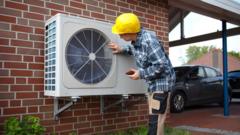
A heat pump operates at lower temperatures than a traditional boiler. This is basic thermodynamics. To keep a room warm with cooler water flowing through the system, you need more surface area. This means pulling out every radiator in a house and replacing them with "oversized" units. It often means ripping up floorboards to install larger-diameter piping. In a modern, airtight apartment, a heat pump is a marvel. In a Victorian villa in Aberdeen, it is a renovation nightmare that can easily see the total bill climb toward £20,000. More information regarding the matter are covered by NPR.
The "spark gap" is the invisible wall stopping this transition. In the UK, electricity is roughly four times more expensive than gas per unit of energy. This is largely due to historical policy choices that loaded "green levies" onto electricity bills while leaving gas relatively untouched. Even with a high-efficiency heat pump, the running costs often end up being a wash, or worse, an increase. Until the government rebalances these costs, the "heat pump ready" revolution is effectively asking people to pay a premium for the privilege of a higher monthly bill.
A Workforce That Does Not Exist
If every homeowner in Scotland decided to install a heat pump tomorrow, the system would collapse by noon. We simply do not have the boots on the ground.
For decades, the heating industry has been built on the back of gas safe engineers. These are skilled tradespeople who can swap a combi boiler in half a day. Transitioning to heat pumps isn't just a matter of a weekend training course. It requires a deep understanding of heat loss calculations, hydraulic balancing, and electrical integration.
Currently, the number of certified installers is a fraction of what is required to meet the 2030 targets. Many veteran engineers are looking at the paperwork and the thin margins of government-subsidized schemes and deciding they would rather stick to what they know until retirement. We are facing a demographic cliff in the trades just as we are demanding a technological leap.
The Rural Penalty
The Scottish Highlands and Islands face an even steeper climb. These are the areas often touted as "prime" for heat pumps because they are frequently off the gas grid and rely on expensive oil or electric storage heaters. However, these are also the areas where the electrical grid is at its most fragile.
A massive rollout of air-source heat pumps adds significant "peak load" to a grid that wasn't designed for it. If a remote village all switches to electric heating, the local substation requires an upgrade that can cost hundreds of thousands of pounds. Who pays for that? Currently, the burden often falls on the developer or the homeowner, creating a "first mover disadvantage" that paralyzes local progress.
The Fabric First Fallacy
Policy advisers love the phrase "fabric first." It means you should insulate a house to the hilt before you even think about the heating system. It is logically sound. It is also practically exhausting for a nation where a huge percentage of the housing stock consists of pre-1919 stone buildings.
Insulating a solid stone wall isn't as simple as blowing foam into a cavity. It requires internal or external wall insulation, both of which are invasive, expensive, and—in the case of listed buildings or conservation areas—often illegal under current planning laws. When the government mandates heat pump targets without simultaneously fixing the planning system and the insulation supply chain, they are putting the cart before a horse that hasn't even been born yet.
The Missing Hybrid Solution
In the rush to be a global leader in green energy, the Scottish Government has largely ignored the "middle way." Hybrid systems—where a small heat pump works alongside a hydrogen-ready gas boiler—could provide a pragmatic bridge. These systems use the heat pump for 80% of the year but allow the gas boiler to kick in during the brutal "Beast from the East" cold snaps when air-source pumps are at their least efficient.
By insisting on an all-or-nothing approach to electrification, policymakers have alienated a significant portion of the heating industry and the public. A hybrid approach would require less drastic changes to the internal piping of a home and would put less immediate strain on the National Grid. Yet, the current subsidy framework is designed to push users toward 100% electric solutions that many homes simply aren't ready to handle.
The Ghost of the Green Homes Grant
Skepticism among the public is high, and for good reason. Previous iterations of green energy schemes, both at the UK and Scottish levels, have been characterized by "stop-start" funding. Installers are wary of scaling up their businesses only for a grant scheme to be pulled six months later due to budget constraints or administrative failure.
To fix this, the industry needs a ten-year horizon of certainty. We need a massive, state-backed apprenticeship program that treats heat pump installation as a specialized, high-status trade. We need a simplification of the MCS (Microgeneration Certification Scheme) which currently buries small installers in so much red tape that many don't bother applying.
The 2030 target is currently a fantasy written in a press release. To make it a reality, the Scottish Government needs to stop talking about "visions" and start talking about copper pipes, grid capacity, and the price of a kilowatt-hour.
The solution starts with a brutal honest assessment of the grid. We need to map every substation in the country and identify where the bottlenecks are before we send out the next round of marketing brochures. We need to move the green levies off electricity and onto general taxation or gas imports to make the running costs of a heat pump undeniable. Most importantly, we need to stop treating the Scottish housing stock as if it’s a uniform block of new-builds.
Direct your attention to the planning departments. If they aren't empowered to approve external wall insulation and heat pump units on historic streets with speed and consistency, the decarbonization of our cities will remain a pipe dream.