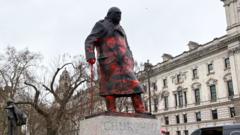
The red paint dripping from the plinth of Winston Churchill’s statue in Parliament Square is more than a mess for a cleaning crew. It is the latest escalation in a calculated campaign of symbolic warfare. When Palestine Action targeted the bronze likeness of Britain’s wartime leader, the immediate arrest of a 25-year-old activist was the expected outcome, but for the group, the legal consequences are secondary to the optical victory. This was not a random outburst of frustration. It was a targeted strike on a national icon designed to force a collision between Britain’s colonial past and its current foreign policy.
The incident occurred during a period of heightened tension over UK arms exports to Israel. By defacing Churchill, the activists are attempting to bridge the gap between historical grievances and modern-day conflict. They argue that the same imperial logic that defined Churchill’s era continues to dictate the UK's involvement in the Middle East. While the public remains deeply divided on the ethics of such protests, the tactical shift is clear. Protesters are moving away from traditional marches and toward the high-stakes defacement of heritage sites to ensure their message cannot be ignored by the evening news cycle.
The Mechanics of Radical Dissent
Palestine Action has built its reputation on direct action, primarily targeting the physical infrastructure of the arms trade. Until recently, their focus was almost exclusively on factories and corporate offices, specifically those belonging to Elbit Systems. The shift toward historical monuments represents a pivot in strategy. They are no longer just trying to disrupt the supply chain; they are trying to disrupt the national narrative.
Targeting a statue of Churchill is a move designed to provoke maximum emotional response. For a large segment of the British population, Churchill is the untouchable architect of the victory over fascism. For the activists, he represents the architect of a colonial system they hold responsible for the original displacement of Palestinians. This clash of interpretations is exactly what the group seeks to exploit. They want to turn a quiet square into a courtroom where history is put on trial.
The police response was swift. Officers on the scene moved in within minutes of the paint hitting the bronze. Yet, the footage was already circulating. In the age of instant digital transmission, the physical duration of a protest matters less than the speed of the upload. The arrest is viewed by the movement not as a failure, but as a necessary sacrifice for the "propaganda of the deed."
Beyond the Paint
To understand why this is happening now, one must look at the legal pressure mounting against direct-action groups. The UK government has steadily increased the powers available to police to curb disruptive protests through the Public Order Act. With longer potential prison sentences and broader definitions of "serious disruption," the stakes for activists have never been higher.
Paradoxically, these tighter restrictions often lead to more radical behavior. When low-level disruption is criminalized at a high level, the "cost" of more extreme acts becomes relatively lower in the eyes of the committed activist. If you risk a prison sentence for standing in the road, you may as well risk one for a high-profile act of vandalism that guarantees international headlines.
The Churchill statue has become a recurring lightning rod in this struggle. It was encased in a protective box during the 2020 protests, a visual metaphor for a state on the defensive regarding its own history. The current defacement by Palestine Action taps into that same vein of cultural anxiety. They are betting that the public outcry over the "desecration" of a hero will inadvertently shine a light on the specific grievances they are raising regarding the Gaza strip.
The Arms Link
While the statue is the visible target, the underlying motive remains the UK's defense relationship with Israel. Palestine Action claims that the British government is complicit in war crimes through the licensing of components for F-35 fighter jets and other military hardware. The government maintains that its export licensing criteria are among the most "robust" in the world—a term that activists now use as a punchline.
The disconnect between official policy and the demands of the street is widening. While the Foreign Office provides nuanced legal justifications for continued trade, the protesters provide the visceral image of red paint. It is a battle of complexity versus clarity.
The Cost of Heritage Security
The constant need to guard and repair national monuments is creating a massive logistical and financial burden.
- Cleaning Costs: Removing specialized paints from porous stone and aged bronze requires expert conservators, often costing thousands of pounds per incident.
- Police Deployment: Static guards for monuments drain resources from neighborhood policing, creating a point of political friction for the Metropolitan Police.
- Infrastructure: The potential for permanent enclosures or "security zones" around Parliament Square is being discussed, which would fundamentally alter the accessible nature of British democracy.
The Failure of Traditional Advocacy
This escalation suggests a total breakdown in faith in traditional political channels. For months, hundreds of thousands of people marched through London calling for a ceasefire and an arms embargo. When those marches failed to produce a shift in government policy, the vacuum was filled by smaller, more aggressive cells.
These groups do not seek a seat at the table. They seek to break the table. By targeting Churchill, they are signaling that they no longer respect the foundational myths of the British state. It is an attempt to de-legitimize the institutions that they believe are ignoring the humanitarian crisis in Gaza.
Critics argue that these tactics are self-defeating. They point to polling data suggesting that the vast majority of the public finds the defacement of war memorials and historical statues abhorrent. Instead of winning hearts and minds, the activists may be isolating themselves and providing the government with the popular mandate needed to crack down even harder.
However, the members of Palestine Action often state that they are not interested in popularity. Their metric for success is the disruption of the "business as usual" atmosphere. They believe that if they make the status quo uncomfortable enough, the cost of maintaining current foreign policy will eventually outweigh the political benefits.
A Growing Trend of Iconoclasm
This isn't an isolated British phenomenon. Across Europe and North America, activists are increasingly using cultural heritage as a canvas for political grievance. From throwing soup at the Mona Lisa to spray-painting the Lincoln Memorial, the trend is toward attacking things the public loves to force a conversation about things the public ignores.
The Churchill incident is a warning shot. As long as the conflict in the Middle East continues and the UK maintains its current defense stance, the symbols of the British state will remain in the crosshairs. The red paint is a symptom of a much deeper, more volatile rupture in the social contract.
The government now faces a choice between increasing the "fortress" mentality around London's monuments or addressing the specific policy grievances that are fueling this radicalization. One path leads to a city of barricaded statues; the other leads to a contentious debate over Britain’s role on the world stage. Neither path is easy, and neither will be solved by a pressure washer.
Investigate the specific export licenses currently held by UK-based subsidiaries of Elbit Systems to see where the physical protest meets the paperwork of the arms trade.