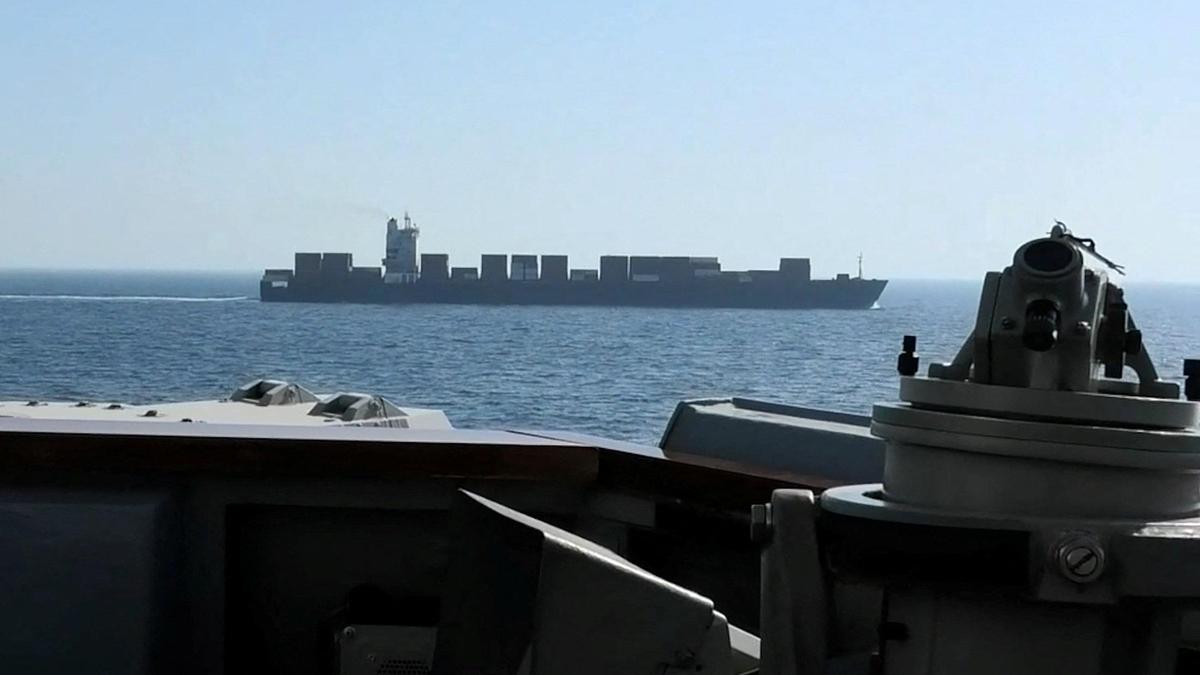
The steel under your feet doesn’t just vibrate; it hums with a low-frequency anxiety that crawls up your spine. Imagine standing on the bridge of a vessel cutting through the Strait of Hormuz. To your left, the jagged, sun-bleached cliffs of Oman. To your right, the Iranian coastline. Between them lies a narrow ribbon of water—the carotid artery of the global economy.
When the U.S. Navy moves in to seize a ship here, it isn’t just a tactical maneuver. It is a cardiac event for the world’s energy supply.
Late last night, the rhythmic sloshing of the Arabian Sea was punctured by the roar of MH-60 Seahawk engines and the authoritative crackle of radio frequencies. The target: an Iranian-flagged tanker. The reason: a complex web of sanctions, alleged smuggling, and the invisible lines of international law that most people only think about when the price of a gallon of gas spikes at the local pump.
The Weight of the Invisible
To understand why a single ship matters, you have to look past the hull. You have to see the ghost of the cargo.
Think of a hypothetical merchant sailor named Elias. He’s three months into a six-month contract. His world is grease, salt air, and the steady beat of a massive diesel engine. For Elias, the Strait of Hormuz isn't a geopolitical flashpoint on a news crawl; it’s a twenty-one-mile-wide gauntlet where the air feels heavy with the gaze of a dozen different shore batteries.
When the Navy’s boarding teams—men and women wrapped in Kevlar and high-tech optics—descended onto that deck, they weren't just seizing oil. They were enforcing a world order that feels increasingly fragile.
The U.S. Navy maintains that the seizure was a necessary response to illegal activity. Tehran, meanwhile, views it as an act of high-seas piracy. This isn't a simple disagreement. It’s a collision of two entirely different realities. One sees a rules-based international order; the other sees a colonial vestige strangling its sovereignty.
The Anatomy of a Confrontation
Modern naval warfare has largely moved away from the broadside volleys of the nineteenth century. Today, it is a game of electronic shadows and sudden, overwhelming presence.
The seizure happened fast. Precision. Speed. Silence.
The Iranian-flagged vessel was intercepted in international waters, according to official reports. But "international waters" is a fluid concept in a place where the coastlines are so close you can almost smell the dust from the shore. The technicalities matter—the exact GPS coordinates, the speed of the intercept, the specific maritime laws cited—but the emotional resonance matters more.
Tehran’s response was immediate and predictably sharp. They vowed a "swift response." That phrase isn't just rhetoric. It’s a promise of friction. It’s the sound of a spring being wound too tight.
Consider what happens next: a game of maritime tit-for-tat. History shows us the pattern. A ship is seized. A week later, a different ship—perhaps a British tanker or an American-linked freighter—finds itself surrounded by fast-attack boats from the Islamic Revolutionary Guard Corps.
Why Your Morning Coffee Costs More
It’s easy to dismiss this as "over there" news. A faraway desert, a distant sea, a conflict between governments that feel like abstractions.
But the world is wired together by copper, fiber optics, and heavy crude.
The Strait of Hormuz handles roughly 20 percent of the world's total oil consumption. When a ship is seized, insurance premiums for every other vessel in the region climb. Shipping companies rethink their routes. Traders in London and New York stare at flickering screens and place bets on chaos.
A ripple in the Persian Gulf becomes a wave in the Atlantic.
We live in an age where the "seamless" flow of goods we’ve come to expect is actually a miracle of constant, high-stakes management. We expect the shelves to be full and the lights to stay on. We rarely think about the gray-hulled ships patrolling the heat haze to make that possible, or the sailors on the other side who feel they are defending their own front yard.
The Human Toll of Policy
Behind every "Tehran vows response" headline are people.
There are the young sailors on the U.S. destroyers, barely out of high school, standing watch in 110-degree heat, wondering if today is the day a routine patrol turns into something historical.
There are the families in Iran, living under the weight of an economy squeezed by the very sanctions these ship seizures are meant to enforce.
There are the captains of neutral merchant ships, men and women from the Philippines, India, and Ukraine, who find themselves caught in the middle of a superpower staring contest. They aren't combatants. They are workers. And yet, they are the ones who have to navigate these waters with a knot in their stomachs.
The tension here is an old story with new technology. We’ve replaced wooden frigates with Aegis combat systems, but the fundamental struggle remains the same: who controls the crossroads?
The Echo in the Water
The sea doesn't keep records of the borders we draw on maps. It only knows the weight of the ships and the salt in the wounds of the people who sail them.
As the seized Iranian ship is escorted to an undisclosed location, the immediate crisis might seem to fade. But the water doesn't settle. The "swift response" promised by Tehran is already in motion, perhaps not in the form of a missile, but in the slow, grinding escalation of presence. More drones. More patrols. More moments where a single misunderstood radio call could ignite the horizon.
We want to believe that the world is governed by logic and law. We want to believe that every action has a clear, justifiable reaction. But out there, where the desert meets the deep blue, the logic is often thinner than the paint on a hull.
It’s about pride. It’s about posture. It’s about the terrifying realization that our entire global civilization rests on a few miles of water that two bitter rivals are fighting over.
The next time you see a headline about a ship seizure, don't look at the tonnage. Don't look at the flag. Look at the faces of the people on the deck. Look at the narrowness of the water.
The Strait is a place where the world holds its breath, waiting to see if the next vibration underfoot is the engine—or the explosion.