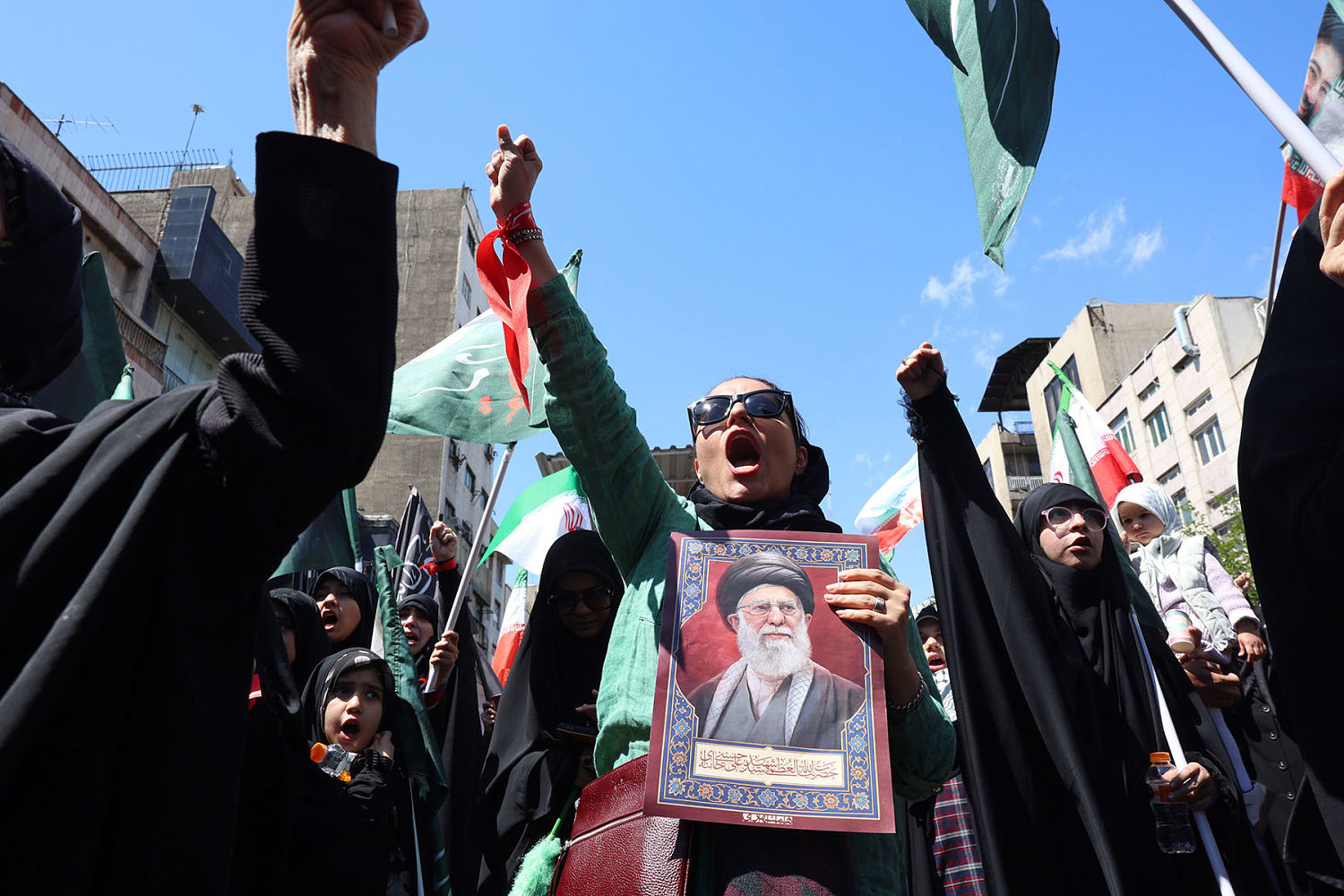
In a small tea house in a winding alley of north Tehran, the steam from a samovar carries more than just the scent of cardamom. It carries the weight of a collective breath being held. Old men stir cubes of beet sugar into dark liquid, their eyes darting toward the television mounted on the wall. They aren't looking for sports or soap operas. They are looking for a sign that the walls aren't closing in any tighter.
Iran is stepping toward a mahogany table in a foreign capital, preparing to talk. But this isn't a gesture of sudden friendship. It is the calculated move of a boxer who has taken a dozen body blows, found his vision blurring, yet still believes he has one knockout punch left in his gloves. The air is thick with a paradox: the regime feels stronger than it has in years on the map of the Middle East, yet its knees are shaking at home. Meanwhile, you can read similar stories here: The Visa Fraud Indictment Myth and the Broken Talent Pipeline.
Consider the merchant, we’ll call him Farhad, who watches the rial tumble against the dollar like a stone dropped from a cliff. To Farhad, "geopolitics" isn't a white paper written by a think tank in D.C. It is the price of imported circuit boards. It is the empty storefront next to his. It is the quiet, simmering rage of his daughter, who remembers the protests of last year and sees the morality police returning to the street corners. Farhad represents the "wounded" side of the headline.
The wounds are deep. Decades of sanctions have turned the Iranian economy into a puzzle where half the pieces are missing. Inflation isn't a statistic; it is a predator. It eats the retirement of the elderly and the dreams of the young. When the government sits down to negotiate, they aren't just talking about centrifuges or heavy water. They are bartering for the survival of their own social contract. They need the pressure to lift before the internal boiler explodes. To understand the bigger picture, we recommend the excellent report by Reuters.
Yet, as they walk into the room, they carry a swagger that seems to defy their bank accounts.
How can a nation so financially strangled feel "emboldened"? Look at the horizon. From the Mediterranean to the Gulf of Aden, the influence of Tehran is no longer a shadow; it is a physical presence. They have built a "ring of fire" that keeps their rivals awake at night. Their drones are buzzing over European battlefields. Their allies are dictating the flow of global shipping in the Red Sea. They feel they have proven they can survive the "Maximum Pressure" campaign of the past. They didn't collapse. They adapted. They became a cornered animal with very sharp teeth.
This brings us to the specter in the room. The name that hangs over the table like a storm cloud that refuses to dissipate. Donald Trump.
For the Iranian leadership, Trump is not just a former president; he is the man who tore up the map and set the table on fire. The memory of 2018—when the hard-won nuclear deal was shredded with a single Sharpie stroke—is a scar that hasn't faded. It dictates every syllable they utter today. They are wary. No, they are more than wary. They are haunted by the unpredictability of a man who values the "art of the deal" over the sanctity of the treaty.
They find themselves in a desperate race against the American election calendar. They want a deal, but they want it to be "Trump-proof." It is a fool’s errand, of course. In the theater of international relations, there is no such thing as a permanent lock. There are only temporary pauses.
The strategy now is a high-stakes game of chicken. Iran is pushing its nuclear enrichment levels closer to the "breakout" point, not necessarily because they want the bomb today, but because they want the leverage tomorrow. They are building a pile of chips so high that the next American administration, regardless of who leads it, cannot simply walk away from the table.
But leverage is a double-edged sword. If you sharpen it too much, you cut yourself.
Imagine the negotiators sitting across from European and American diplomats. On the surface, it’s all protocol and translated pleasantries. But underneath, there is a frantic calculation. The Iranians know that if they push too hard, they trigger the "snapback" sanctions—a total economic blackout that would make current conditions look like a golden age. If they don't push hard enough, they look weak to their own hardliners and their regional proxies.
It is a performance.
The "wounded" part of the equation is the most dangerous. History shows us that empires and regimes are most volatile when they feel their grip slipping at home while their banners are flying high abroad. The Iranian leadership is projecting strength to mask a fundamental fragility. They are selling the idea of a "Resistance Economy" to a population that just wants to buy eggs without a loan.
There is a specific kind of tension that exists in the silence between two rivals who know they have to talk but don't want to listen. It’s the tension of a spring wound too tight.
The invisible stakes are the lives of eighty-five million people who are not in the room. The stakes are the young tech workers in Tehran who are using VPNs to see a world they are forbidden from joining. The stakes are the sailors in the Strait of Hormuz who are one miscommunication away from a global energy crisis.
The negotiators talk about "Uranium hexafluoride" and "Advanced IR-6 centrifuges." These are cold, sterile terms. But the reality is the heat of a regional war that no one—not Washington, not Tel Aviv, and certainly not Tehran—actually wants, yet everyone seems to be preparing for.
Iran's entry into these talks is an admission that the status quo is unsustainable. You cannot run a country on ideology and proxies alone when the currency is worthless. They are seeking a lifeline. But they are seeking it while holding a dagger behind their back, convinced that the person offering the lifeline is also holding a noose.
Trust is a dead language in this room. It hasn't been spoken here in decades. Instead, they speak the language of "verifiable steps" and "proportionality." It is a clinical, soul-less dialect designed to bridge a gap that is essentially a canyon of blood and broken promises.
As the sun sets over the Alborz mountains, painting the smog of Tehran in shades of bruised purple and orange, Farhad closes his shop. He doesn't know what was said in the closed-door meetings in Geneva or Vienna. He only knows that tomorrow, the price of bread might be higher. He only knows that the "emboldened" stance of his leaders doesn't put meat on his table.
The chessboard is set. The pieces are moving. But the board itself is made of thin, cracked glass. One heavy-handed move, one tweet from across the Atlantic, one over-eager commander in the field, and the whole thing shatters.
The tragedy of the moment is that both sides know the cost of failure, yet both are too terrified of looking weak to ensure success. They are trapped in a cycle of "strategic patience" that has long since run out of strategy and is rapidly losing its patience.
They will talk. They will posture. They will sign papers that may or may not be honored. But the fundamental reality remains: Iran is a nation trying to buy time with a currency that is running out, facing an opponent who is waiting for the clock to strike midnight.
The tea in the samovar has gone cold. The television screen flickers with images of men in suits shaking hands, their smiles not reaching their eyes. Outside, the wind kicks up the dust of the desert, blurring the lines between the city and the void, leaving only the sound of a gate rattling on its hinges in the dark.


