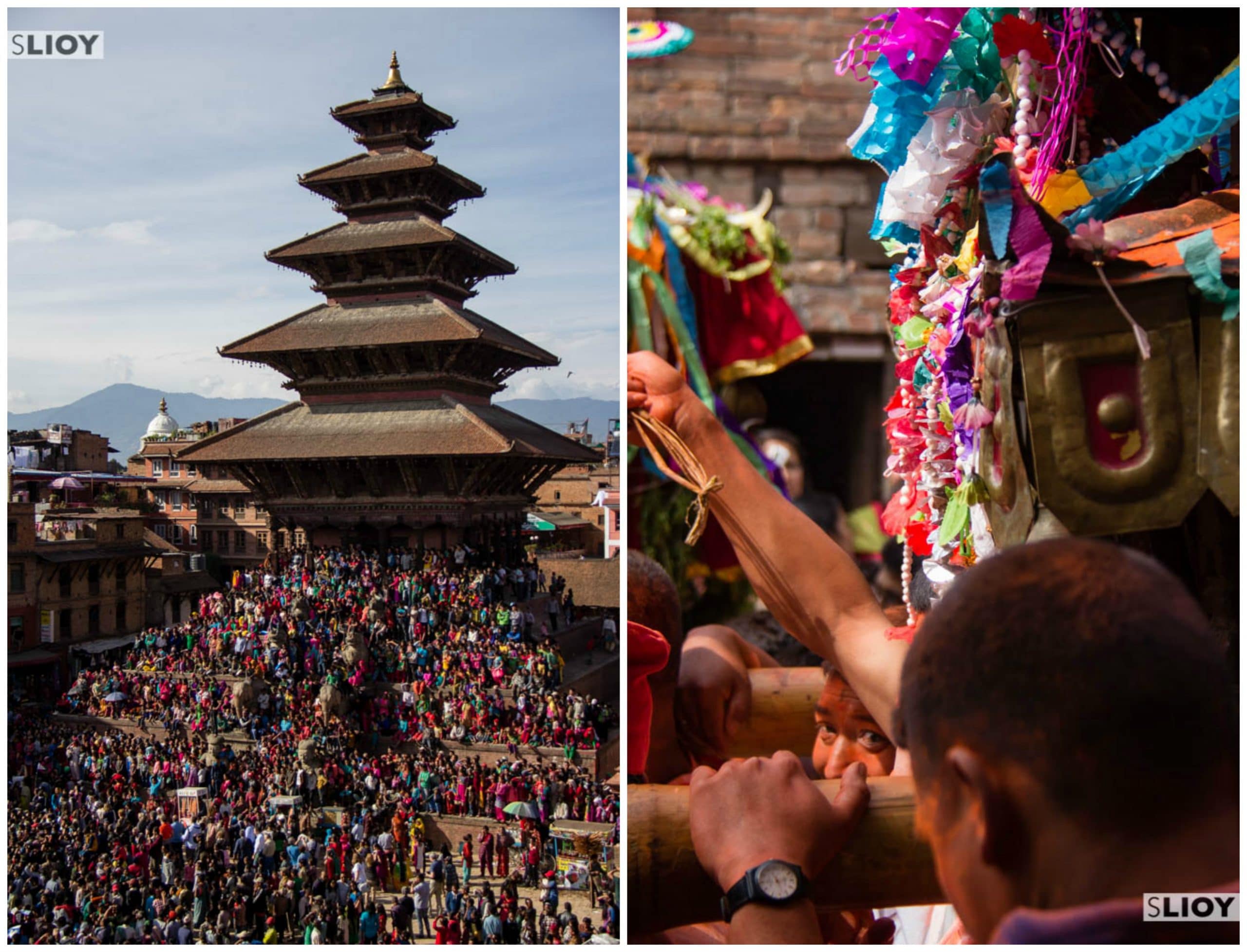
The air in Bhaktapur doesn't just smell of incense and drying grain. In the days leading up to the solar new year, it smells of fresh timber, old sweat, and an electric, underlying anxiety that vibrates through the bricks of the Taumadhi Square. This isn't the quiet, reflective transition of a Gregorian midnight. This is Biska Jatra. It is a collision.
To understand the Biska Jatra is to understand that in Nepal, time is not a digital ticker. It is a massive, three-story wooden machine with wheels the size of grown men, dragged through narrow alleys by hundreds of straining bodies. While the rest of the world might settle for a countdown and a glass of champagne, the people of this ancient Newar city choose a more visceral ritual. They celebrate the death of serpents and the birth of a year by engaging in a literal tug-of-war with destiny.
The Bone and the Beam
Imagine a man named Rajesh. He is a third-generation woodworker, and for the last month, his world has narrowed down to the grain of the Sal tree. He is one of the many hands responsible for assembling the chariot of Bhairava, the terrifying manifestation of Shiva. There are no blueprints in a PDF. The engineering is held in the muscle memory of the elders.
The chariot is a towering, precarious pagoda on wheels. It looks top-heavy, impossible, a structural nightmare that shouldn't survive a ten-foot roll, let alone a journey through a city built of medieval brick. But it does. The secret lies in the joints. No nails are used. The wood is lashed with thick ropes and fitted with wooden pegs, allowing the entire structure to flex and groan like a living thing as it navigates the uneven stones.
Rajesh runs a hand over the massive axle. He knows that if this wood snaps, the year starts in blood. This isn't a metaphor. The "invisible stakes" here are deeply felt by every resident: the movement of the chariot dictates the fortune of the city. If it tilts too far, if it gets stuck for too long, if the rope snaps—these are omens that carry the weight of a thousand years of superstition.
The Tug of War
The festival officially ignites with the pulling of the chariots. This is where the standard news reports fail to capture the sensory overload. They describe it as a "procession." It is actually a riot with a purpose.
On one side, the residents of the upper part of the city. On the other, the residents of the lower part. Between them lies the chariot of Bhairav. They grab the massive ropes, thick as a human thigh, and they pull. They pull until their faces turn purple, until the dust from the square rises in a choking cloud, until the very ground seems to moan.
Why? Because the winner gets to pull the chariot toward their quarter of the town. It is a fierce, competitive display of communal strength. The chariot lurches. It screams as wood grinds against wood. The crowd roars, a primal sound that drowns out the temple bells.
In this moment, the New Year isn't something that happens to you. It is something you seize. You drag the new year into your neighborhood through sheer physical will. It is a reminder that survival in the Kathmandu Valley has always required this kind of collective, grueling effort.
The Pole That Pierces the Sky
While the chariot battle rages, another drama unfolds at the edge of the city in a place called Yale. Here, a different kind of engineering feat takes center stage: the Lyo Sin Dyo.
This is a wooden pole, often over fifty feet tall, stripped of its branches and raised toward the heavens. It represents the victory over two malevolent serpents that, according to legend, killed anyone who tried to marry the princess of the ancient kingdom. A brave prince, guided by a goddess, eventually slew them.
The raising of the pole is a delicate, dangerous dance. Hundreds of men use ropes to hoist the massive timber upright. It sways, threatening to crush the crowd below. When it finally clicks into its stone base, a collective sigh of relief ripples through Bhaktapur.
But the real magic happens the next day—the actual New Year's Day of the Bikram Sambat calendar. The pole is pulled down. As it crashes toward the earth, the old year is officially broken. The serpents are dead. The cycle is reset.
The Geometry of the Sacred
For the casual observer, Biska Jatra looks like chaos. It looks like a safety inspector’s worst nightmare. But look closer at the geometry.
The festival is a map of the Newar universe. The chariot of Bhairav is joined by the smaller chariot of the goddess Bhadrakali. Their eventual "collision" or meeting is a symbolic union of masculine and feminine energies, a cosmic necessity to ensure the fertility of the land.
- The Chariot: A moving temple that brings the divine out of the sanctum and into the muddy reality of the streets.
- The Pole: A vertical axis connecting the underworld, the human realm, and the heavens.
- The Blood: Historically, animal sacrifices were central. Today, while the practice is evolving, the "redness" remains—in the vermillion powder that coats every face, every stone, and every piece of sacred wood.
Consider the risk. Every year, people are injured. Sometimes, people die. A wheel jumps a curb, a rope snaps, a wall collapses under the weight of spectators. Yet, the festival never stops. To stop Biska Jatra would be to stop time itself. The Newar people accept the physical danger because the spiritual danger of a stagnant year is far worse.
The Quiet After the Crash
When the pole hits the ground and the chariots are finally parked, a strange silence descends over Bhaktapur. The adrenaline leaves the system, replaced by a deep, communal exhaustion.
The city is covered in a thick layer of red powder and discarded marigolds. Rajesh, the woodworker, sits on a stone plinth near the Nyatapola Temple. His hands are blistered. His clothes are ruined. But he watches the children playing near the now-stationary wheels of Bhairav’s chariot.
He knows that for the next week, the city will feast. Families will gather to eat samay baji—a traditional platter of beaten rice, roasted meat, ginger, and soy beans. They will drink aila, the potent local spirit that burns going down and warms the belly against the mountain chill. They will tell the same stories they told last year, and the year before that, stretching back into a past that feels more real than the present.
The "standard" news will tell you that Biska Jatra is a tourist attraction or a cultural curiosity. It will give you the dates and the location. But it won't tell you about the vibration in your chest when the chariot starts to move. It won't tell you about the smell of the dust that tastes like history.
In Bhaktapur, the new year isn't a digital flip of a calendar. It is a physical reclamation of the earth. It is a reminder that we are all tied to the rope, pulling against the weight of the past, hoping that this time, the wood holds, the axle turns, and the gods decide to stay for one more cycle.
The last of the sun dips behind the Himalayan peaks, casting long, distorted shadows of the empty chariots across the square. The wood is silent now. The ropes are slack. Somewhere in the distance, a single drum continues to beat, a rhythmic pulse that sounds remarkably like a heart.