The valuation of a closely held business is traditionally a function of its discounted future cash flows, but the net liquidity an owner realizes at exit is increasingly dictated by tax geometry rather than operational performance. Recent shifts in federal tax policy—specifically those targeting "Main Street" pass-through entities—have fundamentally altered the friction points of a sale. For owners of S-Corps, Partnerships, and Sole Proprietorships, the delta between a successful exit and a mediocre one now resides in the optimization of the Section 199A deduction and the strategic reclassification of assets during the due diligence phase.
The current tax environment creates a specific window of opportunity where the federal government effectively subsidizes the transition of small business ownership. To capture this value, an owner must move beyond the "sale price" obsession and instead solve for the after-tax proceeds through three distinct analytical pillars: asset allocation logic, the permanence of the Qualified Business Income (QBI) deduction, and the timing of the constructive receipt.
The Asset Allocation Friction Point
Most sellers overlook the inherent conflict between buyer and seller during the purchase price allocation, often referred to as the IRS Form 8594 negotiation. This is where the deal's true value is won or lost.
A buyer seeks to allocate as much of the purchase price as possible to "Class II" or "Class V" assets—tangible property like equipment or furniture—because they can depreciate these assets rapidly to offset future income. Conversely, a seller prefers the majority of the price to fall under "Class VII" assets: Goodwill.
The mathematical tension is clear:
- Ordinary Income Recapture: If you sell equipment for more than its depreciated book value, the gain is taxed at ordinary income rates (up to 37%).
- Capital Gains Treatment: Goodwill is taxed at the long-term capital gains rate (typically 20% plus the 3.8% Net Investment Income Tax).
A failure to model this friction before signing a Letter of Intent (LOI) results in an "effective tax rate" that can climb 10-15 points higher than the advertised capital gains rate. The strategic consultant’s role is to quantify this "recapture penalty" and use it as a lever to negotiate a higher gross sale price if the buyer insists on an asset-heavy allocation.
The QBI Deduction as an Exit Multiplier
The Section 199A deduction, often called the QBI deduction, allows many small business owners to deduct up to 20% of their qualified business income from their taxes. While widely understood as an operational benefit, its application during an exit is a specialized maneuver.
The deduction applies to "qualified business income," but specifically excludes capital gains. This creates a structural paradox. If a business is sold as an asset sale (the preference for 90% of buyers), the gain from the sale of inventory or accounts receivable may qualify as ordinary business income, potentially eligible for the 20% deduction. However, the gain from goodwill does not.
To optimize this, owners must analyze the "Internal Rate of Return" (IRR) of shifting value toward inventory or pre-paid expenses versus goodwill.
- The Optimization Formula: If the 20% deduction is applied to ordinary income, the effective tax rate on that portion of the sale drops from 37% to 29.6%.
- The Risk: This is still higher than the 23.8% capital gains rate.
The logic dictates that a seller should only push value toward QBI-eligible assets if they have significant Net Operating Losses (NOLs) to offset the higher base rate or if the buyer is willing to pay a premium for the stepped-up basis that exceeds the 5.8% tax gap.
Structural Velocity: The Stock vs. Asset Sale Dichotomy
The "Main Street" tax advantages frequently cited in current policy discussions rely heavily on the assumption that the business is an "eligible" entity. For many, this means the sale must be structured as an asset sale to allow the buyer to reset the depreciation clock.
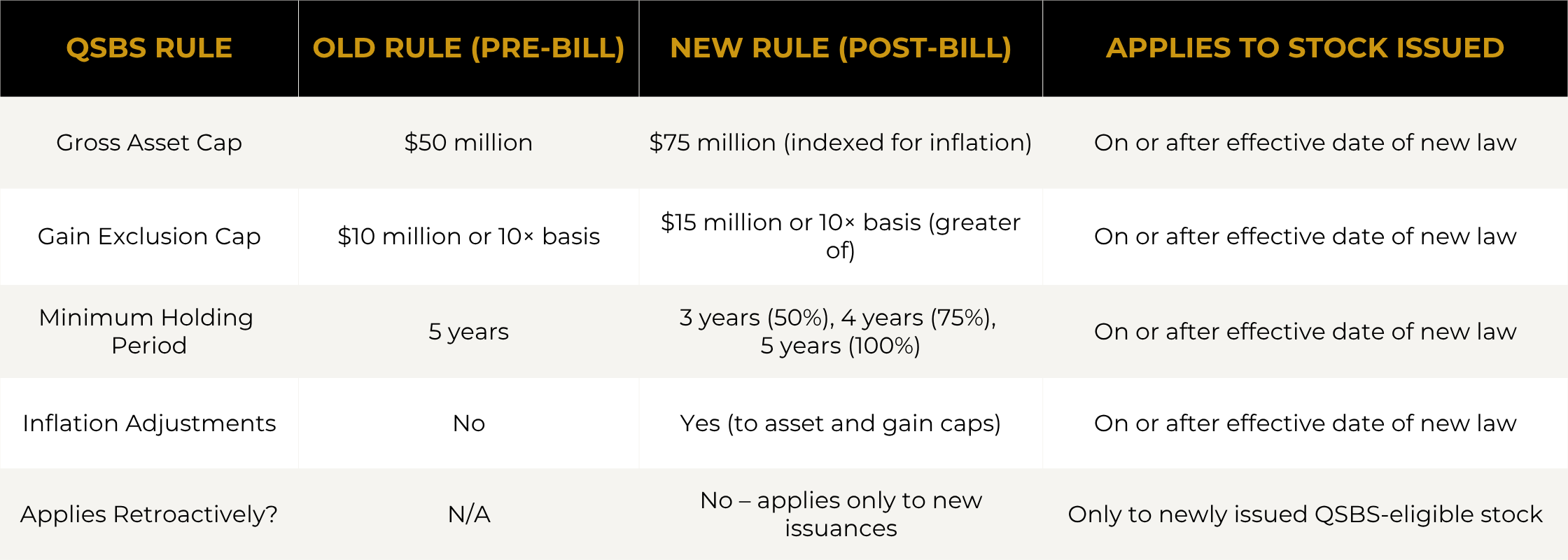
However, the "C-Corp Conversion" strategy is gaining traction for businesses with high-growth trajectories and a 5-year exit horizon. Under Section 1202, shareholders of a Qualified Small Business (QSB) can potentially exclude up to 100% of their gain from federal taxes, up to $10 million or 10 times their basis.
The transition from a pass-through (S-Corp) to a C-Corp to trigger Section 1202 benefits requires a 5-year holding period. This introduces a "Time Value of Tax Savings" calculation. If an owner anticipates a sale in 24 months, the 199A pass-through benefits of an S-Corp are superior. If the horizon is 60 months+, the C-Corp conversion becomes the dominant strategy.
The Cost Function of Deferred Liquidity
Modern tax law has made the "Installment Sale" (Section 453) a primary tool for mitigating tax bracket creep. By spreading the receipt of the purchase price over multiple years, an owner avoids being pushed into the highest possible tax bracket in a single calendar year.
There are, however, hidden cost functions to this strategy:
- The Interest Component: The IRS requires "imputed interest" on installment notes. This interest is taxed at ordinary income rates, not capital gains.
- Credit Risk: The seller becomes a lender to the buyer. If the business fails under the new ownership, the remaining "tax-advantaged" payments may never arrive.
- Legislative Risk: Taking an installment sale assumes that tax rates will remain stable or decrease. If capital gains rates are hiked in a future legislative session, the deferred payments will be taxed at the new, higher rate, destroying the original NPV calculation of the deal.
Precise Valuations and the "Reasonable Compensation" Trap
The IRS is increasingly scrutinizing S-Corp owners who suppress their "Reasonable Compensation" (W-2 salary) to maximize the amount of income flowing through as distributions (which are not subject to self-employment tax).
During a sale, this becomes a liability. A buyer’s "Quality of Earnings" (QofE) report will "normalize" the owner’s salary to a market rate. If the owner was taking a $50,000 salary for a role that costs $150,000 to replace, the buyer will subtract $100,000 from the annual EBITDA. At a 5x multiple, the owner has just "saved" $15,000 in payroll taxes while losing $500,000 in sale price.
The strategy here is proactive normalization. Two years before a sale, owners should increase their W-2 compensation to market levels. This hardens the EBITDA, simplifies the QofE audit, and signals to the buyer that the business is an institutional-grade asset rather than a lifestyle hobby.
Identifying the Break-Even Point for State Nexus
For owners in high-tax states (California, New York, New Jersey), the federal tax law is only half the battle. The "Salt Cap" remains a significant drag on exit liquidity.
The emergence of Pass-Through Entity (PTE) taxes at the state level allows the business to pay state income tax at the entity level, effectively bypassing the $10,000 federal limit on state and local tax deductions. Before an exit, the entity must be registered and compliant with these state-level workarounds. A failure to execute this "PTE Election" in the year of the sale can result in a 5% to 13% loss of net proceeds, depending on the jurisdiction.
The Definitive Exit Playbook
The optimal path to cashing out under the current tax regime requires a 24-month lead time and a refusal to accept the buyer's first structural offer. The sequence of operations is as follows:
- Conduct a Shadow QofE: Hire a third party to normalize your EBITDA and identify "add-backs" that the buyer will likely dispute.
- Model the Asset Allocation: Determine the specific dollar amount of "Ordinary Income Recapture" you will face. Use this number as your floor for price negotiations.
- PTE Election: Ensure your entity has opted into the State Pass-Through Entity tax to maximize federal deductibility of state taxes on the sale.
- Charitable Lead/Remainder Trusts: If the gain exceeds $5 million, evaluate the contribution of a portion of the business interests to a trust before an LOI is signed to avoid "assignment of income" doctrine issues.
- Negotiate the Section 338(h)(10) Election: If the buyer wants the tax benefits of an asset sale but you want the legal simplicity of a stock sale, use the 338(h)(10) election as a bargaining chip to demand a "gross-up" in the purchase price to cover your increased tax liability.
The final strategic move is the transition from "operator" to "investor" long before the closing date. This involves shifting the business's reliance away from the owner's personal "Goodwill" toward "Institutional Goodwill." If the value of the company is tied to your personal name or relationships, the IRS and the buyer will both classify the sale proceeds in ways that maximize their gain at your expense. Transfer those relationships to a management team today to ensure the exit is a capital event, not a deferred compensation nightmare.