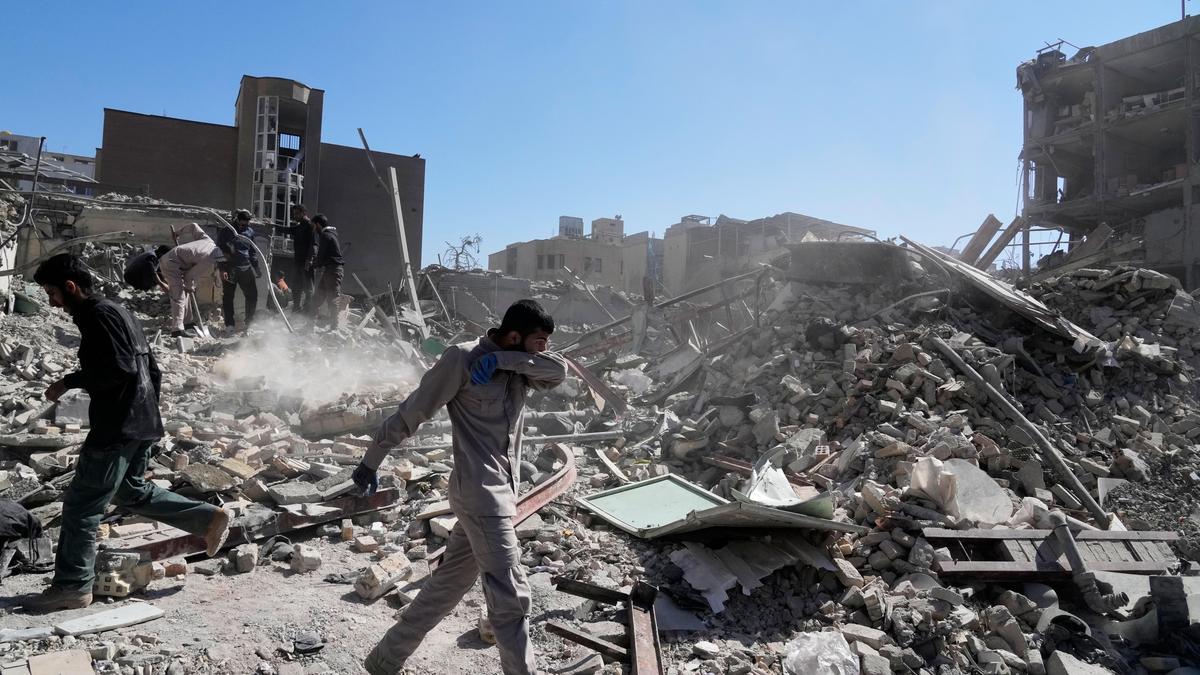
The Israeli military establishment is signaling a shift in the physics of Middle Eastern warfare. By publicly ruling out a ground invasion of Iran while preparing for a sustained aerial campaign, Jerusalem is not just managing expectations; it is acknowledging the brutal geographic and logistical realities that have rendered traditional 20th-century conquest obsolete in this theater. This is not a sign of restraint. It is a refinement of violence.
Direct conflict between these two powers has moved past the era of proxy skirmishes. We are now seeing the blueprint for a high-intensity, "stand-off" war where the objective is not to hold territory, but to systematically dismantle the industrial and military nervous system of a nation-state from 1,000 miles away.
The Logistics of the Impossible
A ground invasion of Iran by Israel remains a physical impossibility for a simple reason: geography does not lie. To put boots on the ground in Tehran, Israeli armored divisions would need to traverse the sovereign territory of either Jordan and Iraq or Saudi Arabia. None of these nations, despite their various grievances with the Islamic Republic, are prepared to host a massive foreign invasion force that would turn their own soil into a permanent battlefield.
Even if diplomatic miracles cleared a path, the sheer scale of the Iranian landmass—roughly the size of Western Europe—would swallow the Israel Defense Forces (IDF) whole. The IDF is built for rapid, overwhelming strikes in compact territories like Lebanon or Gaza. It is an army designed to return its reservists to their desks and cafes within weeks. Managing an occupation or a deep-penetration ground war against a population of 88 million is a fantasy that no serious strategist in the Kirya—Israel’s Pentagon—is actually entertaining.
Instead, the "weeks-long campaign" mentioned by military spokespeople points to a different kind of war. It is a war of attrition through precision.
The Aerial Siege Strategy
If you cannot march on the capital, you must make the capital untenable. The Israeli strategy now focuses on a tiered degradation of Iranian capabilities. This isn’t a single "surgical strike" on a nuclear facility. It is a structural dismantling.
The first tier involves the total suppression of enemy air defenses (SEAD). Before any meaningful damage can be done to the nuclear program or the Islamic Revolutionary Guard Corps (IRGC) infrastructure, Israel must blind the S-300 systems and indigenous Iranian radar arrays. This requires a sustained presence of F-35 "Adir" stealth fighters, likely supported by a massive fleet of unmanned aerial vehicles (UAVs) to saturate and confuse the target environment.
The second tier is the "industrial decapitation." This moves beyond military targets into the dual-use infrastructure that keeps the IRGC funded. We are talking about port facilities, oil refineries, and power grids. By signaling a "weeks-long" duration, the Israeli government is telling the world—and Washington—that they intend to stay in Iranian airspace until the cost of the war for Tehran exceeds the value of its nuclear ambitions.
The Missile Gap and the Home Front
The most significant risk to this strategy is not what happens over Tehran, but what happens over Tel Aviv. Iran’s primary defense against an aerial siege is its massive ballistic missile arsenal. This creates a terrifying math problem for Israeli planners.
Israel’s multi-layered defense system—Iron Dome, David’s Sling, and Arrow—is the best in the world. But it is not infinite. In a sustained, weeks-long exchange, the "interceptor-to-missile" ratio becomes the most critical metric of the war. If Iran can launch enough low-cost projectiles to bleed Israel’s supply of high-cost interceptors, the shield eventually cracks.
This is why the Israeli Air Force is prioritizing the destruction of mobile launch sites. They are in a race to destroy the arrows before they are fired, knowing they cannot catch every single one in flight forever. The psychological endurance of the Israeli public will be tested as the economy grinds to a halt under the constant threat of long-range fire.
The Role of Cyber and Kinetic Synergy
We have moved into an era where a physical bomb is often the second or third step in an attack. Investigative looks into recent disruptions within Iran suggest that "kinetic" strikes—explosions and fires—are being preceded by sophisticated cyber-operations that disable emergency response systems or compromise the internal networks of the target facility.
By integrating cyber-warfare into the "weeks-long" campaign, Israel aims to create a state of internal paralysis. If a power plant goes offline due to a code injection while a nearby missile silo is hit by a physical bunker-buster, the ability of the Iranian state to coordinate a response is halved. This synergy is designed to make the Iranian leadership feel that their entire environment has become hostile, from their computer screens to the sky above them.
The Ghost of 2006
The shadow of the Second Lebanon War hangs over these preparations. In 2006, Israel relied heavily on airpower against Hezbollah, only to find that bombs alone could not stop the short-range rocket fire that paralyzed northern Israel. The "spokesperson’s" insistence on a weeks-long campaign suggests that lessons have been learned. They are no longer promising a quick fix.
They are preparing for a grueling, high-tech siege.
This approach acknowledges that the IRGC has spent decades "hardening" its assets. Facilities like Fordow are buried deep within mountains, protected by meters of reinforced concrete and rock. A single strike does nothing to these locations. It takes a relentless, repetitive application of force—hitting the entrances, the ventilation shafts, and the transport links—to effectively "mission kill" a site that cannot be physically destroyed.
The American Veto and the Regional Fuse
No Israeli campaign against Iran happens in a vacuum. The logistical tail for a weeks-long operation requires American cooperation, specifically regarding munitions resupply and satellite intelligence. While the U.S. remains hesitant to see a full-scale regional war, the Israeli messaging is a form of coercive diplomacy directed at the White House.
By taking a ground invasion off the table, Jerusalem is presenting a "cleaner," more professional version of war to its allies. They are arguing that this is a manageable, surgical necessity rather than a chaotic, messy occupation.
However, this ignores the "Hezbollah Factor." The moment the first Israeli bombs fall on Iranian soil, the 150,000 rockets stationed in Southern Lebanon become the most dangerous variables in the world. Israel is betting that it can deter Hezbollah or degrade them simultaneously, but history suggests that once the dogs of war are unleashed, they rarely follow the script written by the press office.
The Economic Warfare Component
Beyond the explosions, a sustained campaign serves as a final, crushing blow to the Iranian economy. Every day that the Iranian Air Force is forced to scramble and every day that workers are cleared out of oil terminals is a day that the Iranian state loses millions in evaporated GDP.
Israel is counting on the internal pressures within Iran. They are gambling that a population already fatigued by inflation and social restriction will not rally around the flag, but will instead see the IRGC’s regional provocations as the direct cause of their national misery. It is a high-stakes play on social psychology, backed by the weight of a thousand-pound JDAM.
The reality of modern warfare is that "winning" no longer looks like a flag raised over a parliament building. Winning is the total removal of the enemy's ability to project power. If Israel can achieve that through the air, without the meat-grinder of a ground war, they will have rewritten the manual on 21st-century conflict. But if they fail to silence the missile batteries within the first seventy-two hours, the "weeks-long campaign" may turn into a decade-long disaster.
Watch the skies over the Persian Gulf. The silence of the tanks is not peace; it is the sound of a different, more precise kind of storm gathering.
If you are tracking the specific munitions being moved into forward airbases, you should be looking at the inventory of GBU-57 Deep Penetrators and the sudden uptick in long-range tanker sorties. That is where the true story of the coming months is being written.

.png?format=1500w)