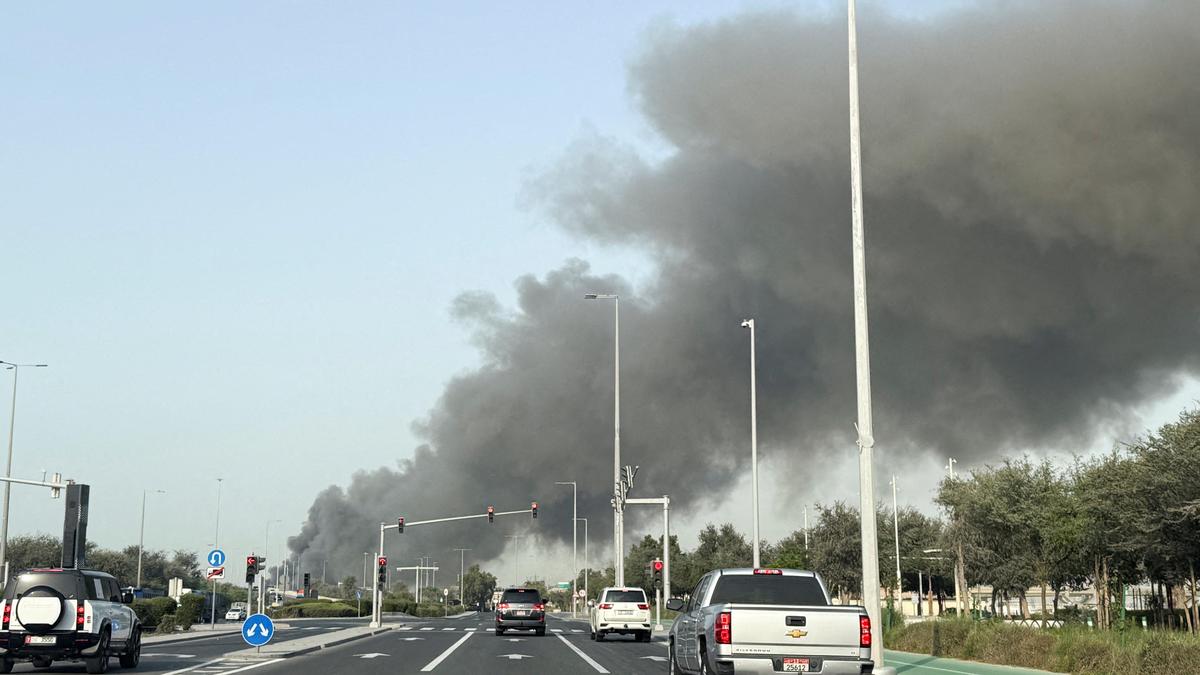
The United Arab Emirates did not just pause its financial tickers because of falling numbers. When the Abu Dhabi Securities Exchange (ADX) and the Dubai Financial Market (DFM) shuttered their doors for forty-eight hours following Iranian strikes, the official narrative pointed toward "precautionary volatility management." The reality is far more clinical and concerning. This was a calculated seizure of the gears to prevent a systemic margin call that could have liquidated the wealth of the Emirati middle class and shaken the foundational stability of the nation’s sovereign wealth funds.
By halting trading for two days, the UAE regulators did more than stop a price slide. They broke the feedback loop between geopolitical panic and automated high-frequency trading. When regional missiles fly, algorithms sell first and ask questions never. Left unchecked, those sales trigger margin calls for local retail investors, forcing them to sell even more to cover their debts, which in turn drives the price lower. It is a death spiral that the UAE authorities decided they would simply not allow to happen.
The Invisible Architecture of the Gulf Halt
Most investors view a stock exchange as a continuous, unstoppable flow of capital. It isn't. It is a fragile agreement between buyers and sellers, mediated by a clearinghouse. When Iran launched strikes, that agreement vanished. The spread between what buyers were willing to pay and what sellers wanted became a chasm. In the dark hours following the kinetic military action, liquidity in the Gulf markets evaporated.
The two-day suspension was a tactical retreat designed to let the "fog of war" lift. Had the markets remained open, the bid-ask spreads would have widened to a point where a single $50,000 trade could have wiped 5% off the valuation of a multi-billion-dollar entity like Etisalat or First Abu Dhabi Bank. This isn't just about protecting a stock price. It’s about protecting the collateral that backs the entire UAE banking system.
Why Price Discovery Failed
Price discovery is the primary job of a stock market. However, in the immediate aftermath of a regional military escalation, there is no price discovery. There is only panic. The UAE markets are heavily weighted toward real estate, banking, and logistics—three sectors that are hyper-sensitive to the physical security of the Strait of Hormuz and the broader Persian Gulf.
When the strikes occurred, the "fair value" of a Dubai real estate giant became impossible to calculate. Does a luxury tower in Downtown Dubai lose value because a missile was fired hundreds of miles away? Logically, perhaps not. Psychologically, it loses 20% in five minutes. The regulators stepped in to act as a circuit breaker for human fear.
The Geopolitical Risk Premium Returns
For years, the UAE has worked tirelessly to decouple its economic reputation from the volatility of its neighbors. It has branded itself as a safe haven, a "Switzerland of the Middle East." These two days of silence on the trading floor prove that the decoupling is not yet complete. Despite the glitz of the Museum of the Future and the skyscraper-laden skyline, the Emirates remains tethered to the regional security environment.
Institutional investors from London and New York look at a market halt and see a red flag. To them, it signals that the market is not "mature" enough to handle bad news. They prefer a market that crashes 10% and stays open over one that closes for two days to hide the damage. This is the trade-off the UAE leadership has made. They would rather face the temporary ire of Western fund managers than deal with the domestic political fallout of a localized financial depression.
The Sovereign Wealth Fund Factor
One must look at the influence of entities like ADIA (Abu Dhabi Investment Authority) and Mubadala. These are the giants that loom over the local exchanges. While these funds are global in scope, their domestic holdings are the bedrock of the UAE economy. A sustained crash in local equity markets devalues the state’s own balance sheet.
If the market had stayed open, these sovereign funds would have been forced into a difficult choice: let the market burn or use taxpayer money to buy up every falling share. By closing the market, they chose a third option. They bought time. They allowed the global diplomatic machine to work, hoping that by the time the opening bell rang again, the threat of an all-out regional war would have subsided.
The Retail Investor Trap
The UAE stock market is not just a playground for the ultra-wealthy. It is a vital vehicle for the savings of Emirati citizens and expatriates. Unlike the US market, which is dominated by institutional index funds, the UAE markets have a high percentage of "active" retail participants. Many of these individuals trade on margin—borrowing money from brokers to amplify their bets.
A two-day halt is a lifeline for these people. In a standard crash, a margin call happens instantly. The broker sells your shares at whatever price they can get to get their money back. By the time you wake up, your life savings are gone. The freeze allowed these investors forty-eight hours to find cash, move assets, or wait for the initial shock to wear off. It was a social safety net disguised as a regulatory procedure.
The Precedent of 2008 and 2020
This is not the first time a major exchange has hit the "off" switch. We saw similar moves during the 2008 financial crisis in various emerging markets, and again globally during the early days of the 2020 pandemic when circuit breakers were triggered repeatedly. The difference here is the duration. A fifteen-minute circuit breaker is a speed bump. A two-day closure is a barricade.
The decision reflects a shift in how modern states view financial markets. In the old neoliberal model, the market was a god that must be allowed to speak, no matter how much it screamed. In the new model, the market is a tool of the state. If the tool is broken or being used against the national interest, the state simply unplugs it.
Comparison of Regional Responses
| Country | Response Strategy | Outcome |
|---|---|---|
| UAE | Total Market Suspension | Volatility suppressed; liquidity frozen. |
| Saudi Arabia | Open Market / State Support | Massive buy-backs by state-linked entities. |
| Qatar | Selective Trading Halts | High volatility in energy-linked stocks. |
| Kuwait | Standard Circuit Breakers | Sharp initial drop followed by slow recovery. |
The UAE’s approach was the most aggressive. It was also the most effective at preventing a localized "Black Swan" event, but it comes at the cost of transparency.
The Strategic Silence of the Brokers
Behind the scenes, the brokerage houses in Dubai and Abu Dhabi were likely the ones screaming for the halt. Their back-office systems are not designed to handle a 20% drop in a single morning. If the markets had stayed open, the sheer volume of forced liquidations would have overwhelmed the clearing systems.
When a clearinghouse fails, the whole system fails. We aren't just talking about stock prices anymore; we are talking about the ability of banks to lend money to each other. The UAE central bank cannot afford a liquidity crunch in the middle of a regional security crisis. The stock market halt was a sacrificial lamb to protect the broader banking sector.
Looking Beyond the Ticker
The real story isn't the two days the market was closed. The real story is what happens on day three. When the markets reopen, the pressure doesn't just go away. It is compressed. All the selling pressure that would have been distributed over forty-eight hours hits the tape in the first ten minutes of the next session.
To manage this, the UAE authorities likely spent those two days in back-room negotiations with major institutional holders. "Don't sell on Monday, and we will ensure the central bank provides liquidity on Tuesday." This is how the game is played in the Gulf. It is a managed economy, and the stock market freeze is the ultimate management tool.
The Problem with Managed Markets
The danger of this strategy is that it creates a false sense of security. If investors believe the government will always stop the market when things get bad, they take on more risk. They borrow more money. They buy more speculative real estate stocks. This creates a moral hazard that could lead to an even bigger bubble down the road.
Furthermore, it complicates the UAE’s goal of being included in major global emerging market indices. Index providers like MSCI and FTSE Russell want to know that their clients can get their money out whenever they want. If a market can be turned off at the whim of a regulator because of a geopolitical event, it is viewed as "uninvestable" by many large-scale pension funds.
The Tech Reality of Modern Warfare
In the age of cyberwarfare and drone strikes, the distance between a physical explosion and a financial collapse has narrowed to milliseconds. The UAE’s move proves that traditional financial regulations are ill-equipped for this new reality. A "standard" market crash is driven by earnings, interest rates, or economic data. This crash was driven by a video of a missile launch on social media.
The regulators are fighting a war against information speed. By shutting down the exchanges, they forced people to stop looking at their screens and start looking at the reality of the situation. It was a forced "cool down" period in an era where cooling down is almost impossible.
Assessing the Damage
While the halt prevented a total meltdown, it did not save everyone. Small-scale traders who needed to liquidate their positions to cover other debts were left stranded. Businesses that use their stock holdings as collateral for short-term operating loans found themselves in a temporary credit freeze.
The economic cost of a two-day halt is measured in billions of dollars of lost volume and a significant dent in investor confidence. However, compared to the alternative—a 30% wipeout of the national exchange in a single afternoon—the price was one the UAE was more than willing to pay.
The Security-Economy Nexus
This event marks a permanent change in how we must view the Gulf markets. They are no longer just "emerging markets" in the traditional sense. They are "frontline markets." Every investment in the region now carries a "geopolitical pause" risk.
Financial analysts must now build a new variable into their models: the probability of a state-mandated market shutdown. This isn't a glitch in the system; it is a feature. The UAE has signaled that it values social and systemic stability over market purity.
The Next Move for Global Investors
If you are holding assets in the UAE, the two-day freeze is a wake-up call to diversify your liquidity. You cannot rely on being able to exit a position during a crisis. The gates will be locked.
The strategy for the future involves moving away from high-margin positions in local stocks and toward assets that trade on international exchanges, even if they represent local companies. Dual-listed firms become the gold standard in this environment. If the DFM is closed, you can still trade the ADR in London or New York.
The markets will eventually return to their usual rhythm, and the skyscrapers will continue to rise. But the memory of those forty-eight hours of silence will remain. It serves as a stark reminder that in the shadow of conflict, the invisible hand of the market is easily overruled by the very visible hand of the state.
Ensure your portfolio has enough cash reserves to survive a forty-eight-hour total freeze, because the next time regional tensions flare, the "off" switch will be the first thing the authorities reach for.