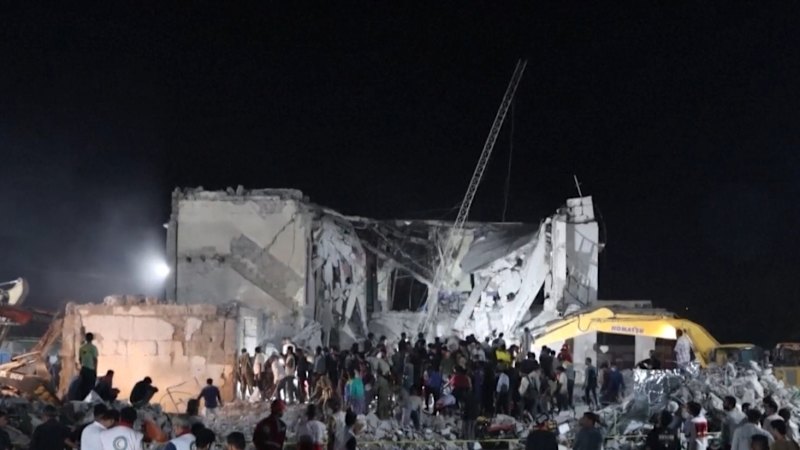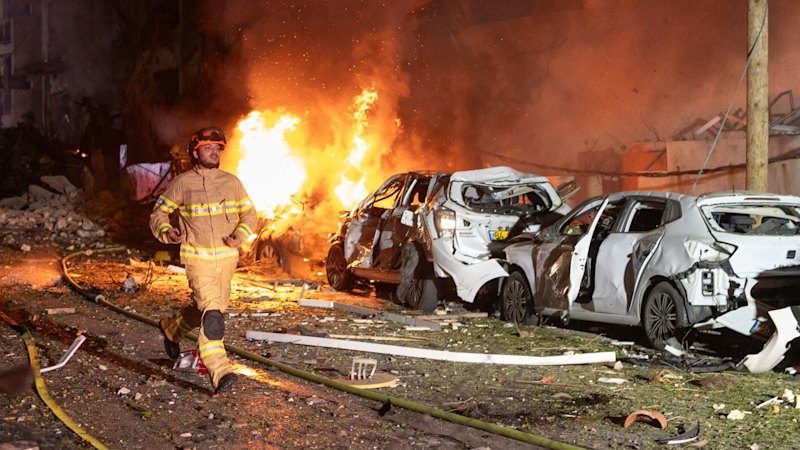
When the sirens scream across Tel Aviv or the skies above Tehran glow with the unnatural light of interceptor fire, the people on the ground face a terrifying reality. They are not just caught in a crossfire of missiles; they are trapped in a crossfire of information. While military commanders calculate trajectories and political leaders weigh the optics of escalation, the civilians under the flight paths are being fed a diet of conflicting, high-stakes instructions that often serve the state better than the citizen.
This isn't just a byproduct of war. It is a calculated component of modern psychological operations.
In the current friction between Israel, Iran, and the United States, "civil defense" has been weaponized. We are seeing a dangerous divergence where the directives issued to the public are designed to project strength or maintain order rather than provide a genuine safety net. When the Iranian government tells its citizens to stay in the streets to show defiance, while Israeli Home Front Command orders people into reinforced rooms, and U.S. State Department bulletins advise immediate evacuation, the resulting vacuum of certainty creates a unique kind of carnage.
The Strategic Use of Civilian Panic
Warfare in 2026 is as much about the narrative as it is about the payload. For the Iranian leadership, civilian presence in public spaces acts as a human shield against the "surgical" strikes promised by Western powers. By issuing directives that downplay the severity of incoming threats or encourage public gatherings, Tehran seeks to complicate the targeting logic of the Israeli Air Force. It is a grim math. If a strike kills a dozen technicians, it’s a military success; if it kills a hundred civilians who were told the area was safe, it’s a diplomatic nightmare for the attacker.
On the other side, Israel’s approach is rooted in hyper-compliance. The Home Front Command app is arguably the most sophisticated piece of civilian control software on the planet. Yet, even here, the directives are often filtered through the lens of national morale. During high-tension windows, the Israeli government must balance the need for safety with the need to keep the economy from grinding to a halt. Telling a million people to stay in shelters for 48 hours is a massive self-inflicted wound to the GDP. Consequently, the "all clear" signals are sometimes issued not because the danger has passed, but because the risk-to-economy ratio has shifted.
The United States plays the role of the nervous bystander with a megaphone. Washington’s directives to its citizens and embassy staff are often the most conservative, frequently contradicting the local government's "business as usual" stance. This creates a friction point. When the U.S. tells its people to hunker down while the local government tells everyone to go to work, it undermines the credibility of the host nation and triggers a secondary wave of panic.
Architecture of a Shelter State
Israel’s civil defense is built on the concept of the Mamad, or residential secure room. Since 1992, every new building must include a reinforced concrete space designed to withstand blast waves and shrapnel. This physical infrastructure allows the government to issue very specific, localized instructions. They can tell a single neighborhood to seek cover while the rest of the city continues its day.
However, this creates a two-tier society. Older neighborhoods, often populated by lower-income families or marginalized groups, lack these modern defenses. In these areas, the "clashing directives" become a matter of life and death. If the state issues a blanket warning but provides no accessible shelter, the directive is essentially a death sentence for those in older masonry buildings.
In Iran, the infrastructure is vastly different. There is no nationwide network of residential shelters. Instead, the government relies on deep-tier subway stations and large public facilities. The logistical challenge of moving millions into these spaces under the threat of hypersonic missiles—which have a flight time of less than 15 minutes from launch sites—is a mathematical impossibility. Therefore, the Iranian state often defaults to a policy of "calculated normalcy," telling citizens there is no need to panic because they know they cannot actually protect them if a full-scale bombardment begins.
The Digital Fog of War
Social media has destroyed the traditional chain of command for civil defense. During a missile volley, Telegram channels and WhatsApp groups move faster than official government sirens. In many cases, "open-source intelligence" (OSINT) accounts are posting launch signatures from infrared satellites before the local sirens even sound.
This creates a dangerous feedback loop. Civilians see a video of a launch in Isfahan and begin to flee, while their local government remains silent to avoid signaling their own tracking capabilities. By the time the official "seek shelter" order arrives, the roads are already clogged with terrified drivers, making them even more vulnerable to falling debris or secondary strikes.
The Problem with Real-Time Data
- Latency: Official warnings require verification to avoid "crying wolf," but in missile warfare, five seconds of verification is the difference between reaching a stairwell and being caught in a hallway.
- Disinformation: Adversaries now use spoofed emergency alerts. Imagine receiving a notification on your phone that looks exactly like a government warning, telling you to evacuate to a location that is actually a pre-planned target.
- Over-reliance: People have stopped looking at the sky and started looking at their screens. If the battery dies or the network is jammed, the civilian is paralyzed.
Washington’s Credibility Gap
The U.S. State Department is in an impossible position. Their "Level 4: Do Not Travel" warnings are often viewed as political tools rather than safety guides. When the U.S. warns of an "imminent attack" and nothing happens for three days, the "boy who cried wolf" effect sets in.
But there is a deeper layer. The U.S. often has better intelligence on Iranian or Israeli movements than the citizens of those countries do. When the U.S. pulls its diplomatic families out, it is a signal that they have intercepted specific "go" orders. Yet, because they cannot reveal the source of that intelligence, the resulting directive feels arbitrary and alarmist to the person on the ground in Beirut or Haifa.
This gap in communication leads to a breakdown in public order. If the superpower says "run" and the local leader says "stay," the average person is left to gamble with their life based on which government they distrust less.
The Physics of Failure
We need to talk about the reality of interception. The Iron Dome, David’s Sling, and Arrow systems are marvels of engineering, but they are not umbrellas. When an interceptor hits a ballistic missile, the laws of physics do not disappear. Hundreds of kilograms of twisted metal, unspent fuel, and explosive material must go somewhere.
Directives often fail to emphasize that "intercepted" does not mean "safe." A significant number of civilian casualties in recent years have come from falling debris. The clashing instructions often neglect this. Governments want to highlight the success of their defense systems, so they emphasize the "kill" of the incoming missile while downplaying the rain of fire that follows. Civilians, thinking the danger is over once they hear the boom, often step out of cover just in time to be hit by the falling remnants of the engagement.
Hardening the Individual
The only way to survive a landscape of conflicting state narratives is to ignore the politics and follow the physics. The state will always prioritize its own continuity over your individual safety. If you are in a conflict zone, your reliance on a smartphone app is a single point of failure.
- Geometric Safety: If you don't have a bunker, find the center of the building. Put as many walls as possible between you and the outside.
- The Ten-Minute Rule: In the Middle East, the flight time for a medium-range ballistic missile is roughly 10 to 12 minutes. If you hear a report of a launch, you do not wait for the siren. You move.
- Audit the Source: If a directive tells you to "gather in the streets" for any reason during a kinetic conflict, it is a political directive, not a safety one. Disregard it.
The reality of 21st-century warfare is that the civilian is no longer a bystander; they are a data point in a psychological game. When the bombs drop, the government's first priority is managing the "optics" of the strike. Yours should be the structural integrity of the ceiling above your head.
The next time the sirens sound, remember that the most dangerous thing in the room isn't necessarily the missile—it's the conflicting advice on how to handle it. Trust the concrete, not the broadcast.