The year-long trade standoff between Washington and Ottawa has reached a grim milestone, leaving the American spirits industry in a state of wreckage. New data confirms that U.S. whiskey exports to Canada have cratered by nearly 70% over the last twelve months, a direct consequence of the 25% tariffs and subsequent provincial boycotts triggered by the Trump administration’s trade policies. Canada, once the reliable second-largest destination for American spirits, has tumbled to sixth place. The financial bleed is staggering: an annual $250 million market has been gutted to a mere $89 million.
This is not a temporary supply chain hiccup. It is a fundamental erasure of market share. While the headlines focus on the percentage drops, the reality on the ground in Kentucky and Tennessee is a quiet crisis of overproduction and shuttered stills. For an industry that measures its success in decades—thanks to the mandatory aging process—the sudden closing of the northern border has created a massive inventory glut that threatens to haunt distillers for the next ten years.
The Provincial Blacklist
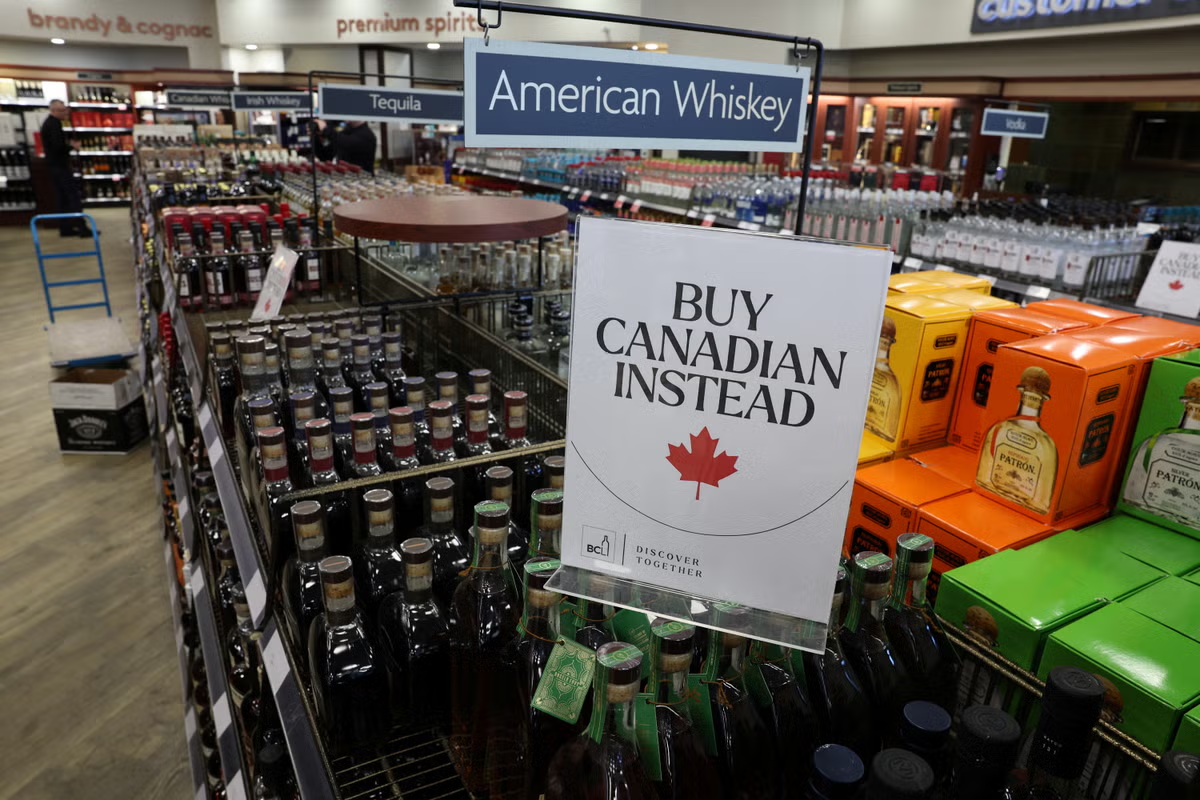
The collapse was not merely a result of products becoming more expensive due to tariffs. It was an orchestrated removal. Unlike the United States, where liquor sales are largely privatized, Canada’s alcohol market is dominated by provincial monopolies. When the trade war escalated in early 2025, boards like the Liquor Control Board of Ontario (LCBO) and the British Columbia Liquor Distribution Branch didn't just raise prices; they cleared the shelves.
By March 2025, American bourbon, rye, and Tennessee whiskey had effectively vanished from government-run retail stores in Canada’s most populous regions. This "shelf space death" is far harder to recover from than a simple tax increase. Once a brand is delisted, the gap is filled by domestic Canadian whiskies or international competitors from Ireland and Scotland. Even if every tariff were abolished tomorrow, American distillers would have to spend millions to re-earn the territory they lost in a single afternoon.
The irony is thick enough to clog a copper still. American consumers continue to buy record amounts of Canadian whisky, yet their northern counterparts have turned the act of buying a bottle of Kentucky bourbon into a political statement. The social stigma, combined with the lack of physical availability, has driven a 68% decline in consumer sales in provinces where the bans remain active.
The 14 Million Barrel Problem
The math of whiskey is unforgiving. In Kentucky alone, there are currently 14.3 million barrels of bourbon aging in rickhouses. That is more than three barrels for every person living in the state. Distillers ramped up production over the last five years based on the assumption that international markets, particularly Canada and the European Union, would continue their steady growth.
That assumption has proved fatal.
When exports to a primary market like Canada drop by $143 million in a single year, the "debt" stored in those barrels becomes a liability. You cannot simply stop making bourbon without devastating the local economy. The industry supports over 23,000 jobs in Kentucky and billions in tax revenue. However, the signs of a forced slowdown are appearing. Jim Beam recently announced a production pause at its Clermont facility for 2026, and other major players like Brown-Forman have initiated layoffs or shortened shifts.
Small craft distillers are in even deeper trouble. Unlike the global giants, these independent operations do not have the cash reserves to sit on inventory for another five years. For a boutique distillery in central Kentucky, a cancelled $50,000 order from a Canadian distributor isn't a line item—it's the difference between making payroll and locking the doors.
Collateral Damage in the Grain Belt
The trade war's reach extends far beyond the distillery walls. It is a domino effect that starts with the American farmer. Approximately 84% of the corn used in Kentucky distilling is grown by local farmers. As production slows, the demand for "distiller’s grade" corn vanishes.
The cooperages are next. By law, bourbon must be aged in new charred oak containers. If the whiskey isn't being made because it can't be sold, the demand for American white oak barrels—a signature industry in its own right—falls off a cliff. We are seeing a contraction of an entire ecosystem that took nearly thirty years to build after the dark days of the 1970s and 80s when the world lost interest in brown spirits.
The Supreme Court Gambit
In February 2026, the U.S. Supreme Court struck down several of the emergency tariffs imposed under the International Emergency Economic Powers Act (IEEPA), ruling them an unconstitutional overreach of executive power. While this offered a momentary glimmer of hope for trade enthusiasts, the victory has been largely symbolic for the alcohol industry.
The Canadian government, and more importantly the provincial liquor boards, have shown no urgency in restoring American brands to their former glory. They have discovered that the "Buy Canadian" sentiment is a powerful political tool. Prime Minister Carney’s administration has pivoted toward a more protectionist stance, using the trade friction as an excuse to bolster domestic spirits.
Breaking the Cycle
The industry’s plea is simple: "zero-for-zero" tariffs. History proves it works. When the 2018 tariffs were briefly suspended, exports to the EU surged by 60%. The appetite for American whiskey is there; the access is not.
To fix this, the conversation must move beyond the Oval Office and the Prime Minister’s Office. It requires a direct negotiation with the provincial premiers who actually control the retail gates. Until the LCBO and its peers see a reason to stop using Kentucky bourbon as a political hostage, the rickhouses will continue to overflow with whiskey that has nowhere to go.
The brutal reality is that the American whiskey industry is currently paying the bar tab for a trade war it never asked for. Every day the shelves in Toronto and Vancouver remain empty of American bottles is a day that the "Bourbon Boom" moves closer to a "Bourbon Bust."
Would you like me to analyze the specific impact of these export losses on Kentucky's state tax revenue forecasts for the 2026-2027 fiscal year?
.png?width=1200&auto=webp&trim=0%2C0%2C0%2C0)