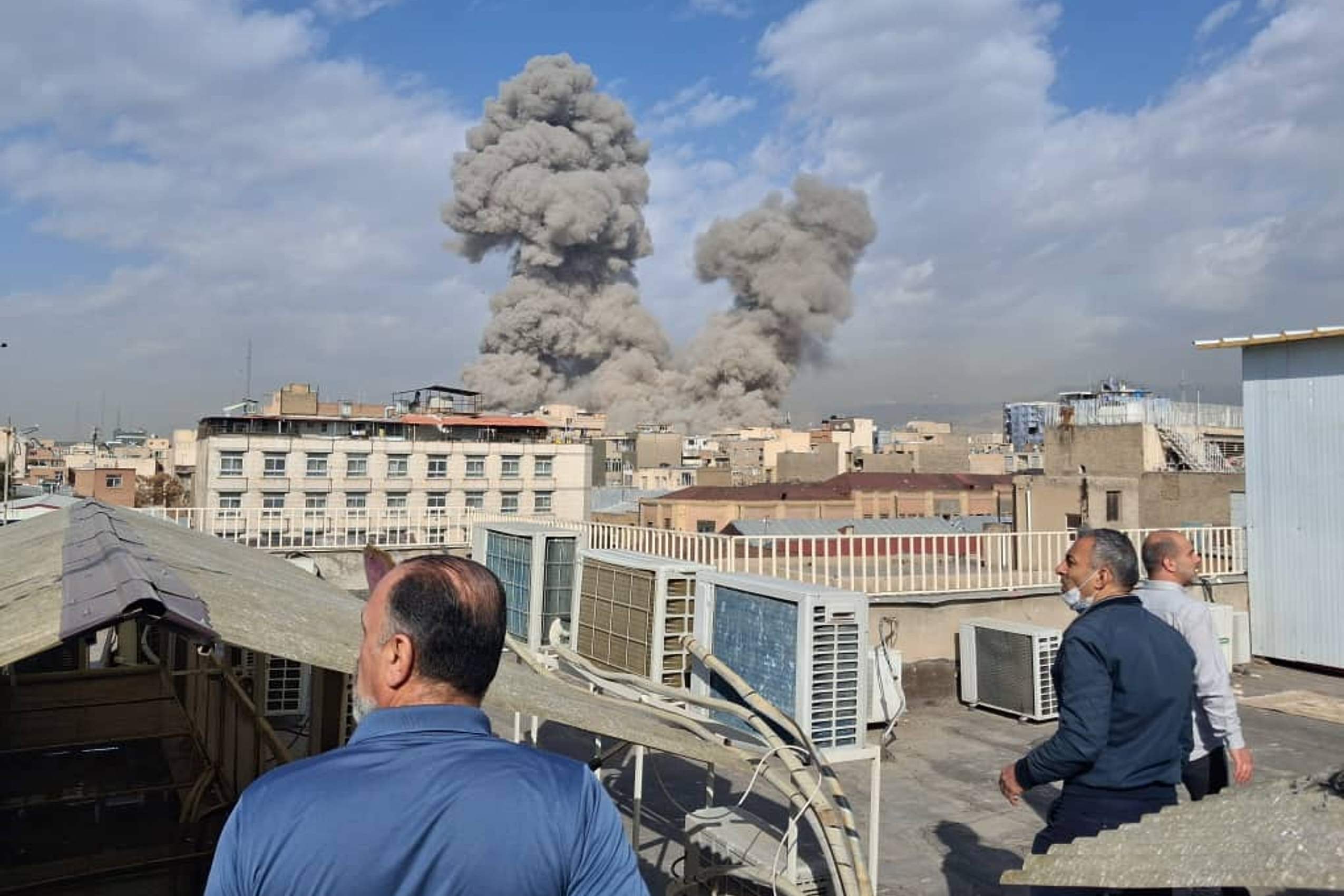
The recent surge in coordinated military strikes by the United States and Israel against Iranian infrastructure marks a departure from traditional containment. This is no longer a "shadow war" fought in the margins of the Levant. By explicitly calling for the Iranian people to seize control of their government, the Trump administration has effectively abandoned the pretense of strategic patience in favor of active destabilization. This strategy rests on a high-stakes bet that kinetic military pressure combined with a direct appeal to the Iranian street will finally break the back of the Islamic Republic.
The "why" is straightforward but the "how" is terrifyingly complex. Washington and Jerusalem are targeting specific nodes of the Islamic Revolutionary Guard Corps (IRGC) not just to degrade their capability to launch missiles, but to expose their domestic vulnerability. When a regime built on the myth of invincibility fails to protect its own soil, the social contract with its hardline base begins to fray. However, history suggests that external calls for revolution often trigger a "rally around the flag" effect rather than a democratic uprising.
The Silicon Siege and the New Rules of Engagement
While the headlines focus on F-35s and ballistic trajectories, the real war is being fought over the digital and economic architecture of the region. This isn't just about blowing up warehouses. It is about the systematic dismantling of the "Axis of Resistance" through a combination of high-precision kinetic strikes and cyber-sabotage.
The military logic is grounded in the concept of Escalation Dominance. By striking targets within Iran, the U.S. and Israel are signaling that the old rules—where Iran fought through proxies to avoid direct consequences—are dead. The message is loud. If Hezbollah or the Houthis strike, Tehran pays the bill in blood and steel.
The Logistics of Localized Collapse
For an internal takeover to happen, as suggested by the White House, the central nervous system of the IRGC must be paralyzed. This requires more than just luck. It requires the precise neutralization of:
- Command and Control (C2) Hubs: Cutting the links between the Supreme Leader's office and the regional commanders.
- The Basij Infrastructure: Disarming the internal security forces that typically crush domestic dissent.
- Fuel and Energy Reserves: Forcing the regime to choose between powering its military machine or keeping the lights on for a restless public.
The technical difficulty of this cannot be overstated. Iran has spent decades burying its most sensitive assets deep underground. We are seeing the deployment of specialized ordnance designed specifically to reach these hardened sites, effectively turning the regime’s "fortress" strategy against itself by trapping its leadership in bunkers that can be sealed from the surface.
Why the Street Stays Silent
There is a fundamental disconnect between Western rhetoric and the reality of the Iranian psyche. To suggest that Iranians should "take over" is to ignore the brutal efficiency of the regime's internal surveillance state. This is a country where the internet is a kill-switch away from total darkness.
In past uprisings, like the 2022 protests, the bravery of the Iranian youth was met with systematic violence. Without a clear defection from the middle layers of the military, a popular takeover remains a bloody fantasy. The U.S. strategy assumes that military humiliation will trigger these defections. It is a gamble on the psychology of a colonel who has spent twenty years being told that the West is the Great Satan.
The Economic Chokehold
The sanctions are no longer a background hum. They are a roar. By targeting the "shadow fleet" of oil tankers that fund the IRGC, the West is attempting to dry up the liquid capital used to pay the salaries of the internal security apparatus.
| Revenue Source | Target Status | Impact on Regime |
|---|---|---|
| Oil Exports (China) | Partially Throttled | Reduced foreign currency reserves |
| Bonyads (Charitable Trusts) | Sanctioned | Internal patronage networks under stress |
| Regional Smuggling | Interdicted | Proxy groups forced to find local funding |
The math is simple. A guard who isn't getting paid is a guard who might not shoot at protesters. But if the money stops, the regime will prioritize the military over bread, leading to a humanitarian crisis that the West will inevitably be blamed for.
The Israeli Calculus of Preemption
For Israel, this is an existential sprint. The intelligence community in Tel Aviv operates on the belief that Iran is closer to a nuclear "breakout" than at any point in history. The strikes we see now are likely rehearsals for a much larger operation against the Natanz and Fordow enrichment facilities.
Israel's involvement adds a layer of complexity to the U.S. call for regime change. To many Iranians, even those who loathe the mullahs, the prospect of a foreign-backed coup led by a regional rival is a bitter pill. This is the central friction of the current policy. The more the U.S. and Israel coordinate, the easier it is for Supreme Leader Ali Khamenei to frame the dissenters as foreign agents.
The Technological Edge
The use of Loitering Munitions (suicide drones) and Electronic Warfare (EW) suites has transformed the battlefield. We are seeing a new era where an air defense system can be "blinded" by code before it is hit by a missile. This technological disparity is what allows the U.S. and Israel to operate with relative impunity in Iranian airspace, but it also creates a false sense of security. Technology can win a battle, but it cannot govern a country of 88 million people.
The Missing Piece of the Strategy
If the goal is truly a new government, there is a glaring absence of a credible transition plan. Who takes over? The exiled opposition is fractured. The internal dissidents are imprisoned or dead. History is a graveyard of "regime change" operations that forgot to plan for the day after the statues fell.
The U.S. is counting on a spontaneous emergence of a secular, pro-Western leadership. This is a dangerous assumption. In the power vacuum created by a sudden collapse, the best-organized group usually wins. In Iran, that isn't the students or the shopkeepers; it's the remnants of the IRGC or even more hardline factions that have been waiting in the wings.
The Risk of Regional Contagion
A cornered regime is at its most dangerous. If the IRGC feels the end is near, they have little incentive to show restraint. The "takeover" of the Iranian government could very well begin with the mining of the Strait of Hormuz, effectively holding the global energy market hostage. 180°C heat in a desert is nothing compared to the political heat of a global oil shock.
The kinetic strikes are precise, but the political fallout is chaotic. We are watching a live experiment in whether military force can be converted into social revolution. The result will either be a new era for the Middle East or a century of renewed conflict.
The next few weeks will determine if the IRGC's "Ring of Fire" strategy can be extinguished by targeted strikes, or if the flames will simply spread to the entire neighborhood. If you want to see where the world is headed, don't look at the diplomatic cables. Look at the satellite imagery of the Iranian airfields and the price of crude oil in the morning.
Would you like me to analyze the specific cyber-warfare capabilities Iran might use in a retaliatory strike against Western infrastructure?


